Ableton Live 13 Announced: Step Sequencer and Drum Synth Lead Major Update

Ableton announces Live 13, expected in early 2027, centered on a step sequencer and drum synth and billed as its biggest update in years.
Ableton has officially announced Live 13, expected in early 2027 and described as its biggest version upgrade in years. The headline features are a native step sequencer and a new drum synth, which together reinforce Live's role as a core tool for rhythmic creation. Though most changes seem small on paper, their combination will significantly reshape the experience. Ableton is keeping its restrained release cadence, and the update responds to the hardware-friendly creation trend. Full details, pricing, and upgrade paths are still undisclosed; users should watch the step sequencer's Clip integration, the drum synth's modulation depth, and backward compatibility.
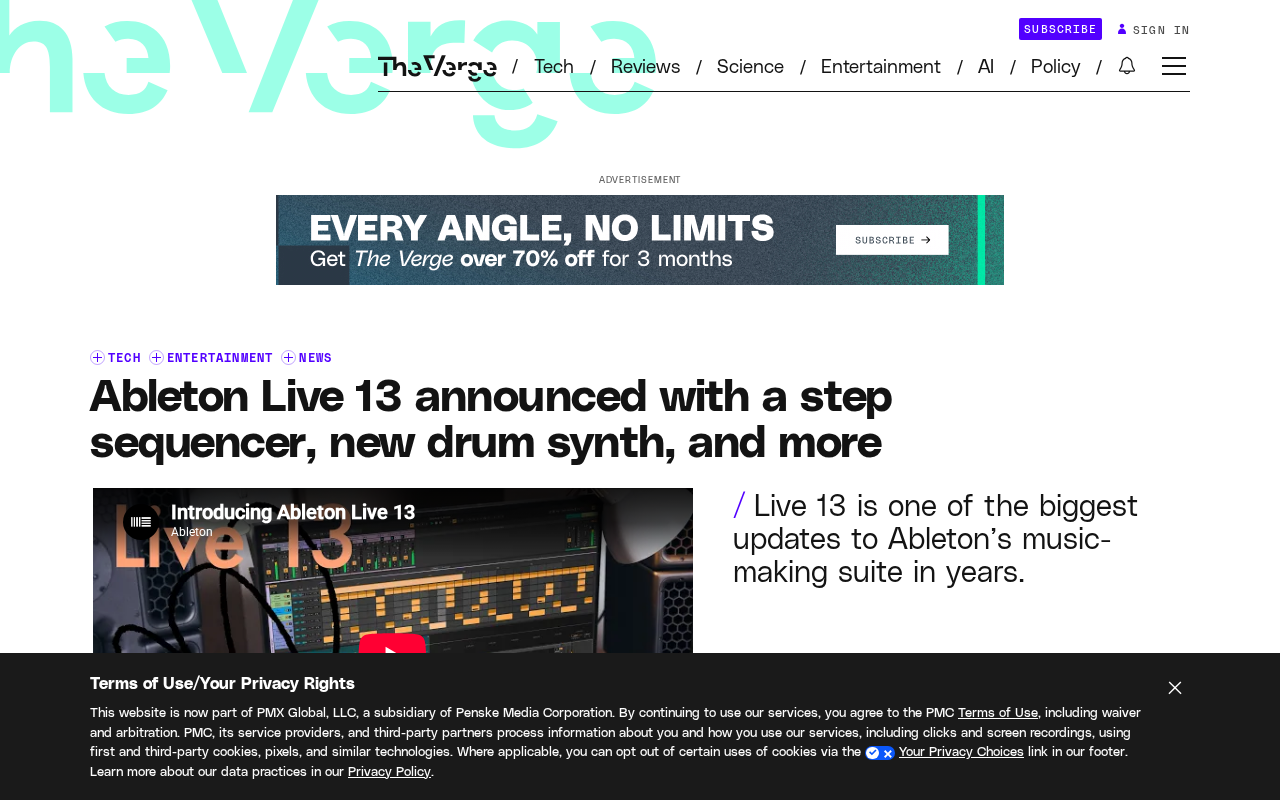
Ableton has officially announced Live 13, a highly anticipated DAW update expected in early 2027. On paper, most of the changes seem unremarkable, but taken together they add up to the biggest version upgrade Live has seen in years.
Core New Features: Step Sequencer and Drum Synth
According to the official announcement, the most eye-catching addition in Live 13 is a step sequencer. For Live users who have long relied on Session View and Clips for loop arrangement, a native, deeply integrated step sequencer means the beat-programming workflow will change significantly.
At the same time, Ableton is introducing a brand-new drum synth. This is not a simple sample-playback tool but a synthesis engine geared toward sound design, offering a more fundamental level of control for creating drum kit tones. The combination of step sequencer and drum synth sends a clear signal: Ableton is reinforcing Live's position as a core tool for rhythmic creation.
Step Sequencer is a grid-based approach to rhythm programming: users place notes or trigger events on a series of evenly divided time cells, rather than freely drawing durations as in a traditional piano roll. Its history traces back to early hardware drum machines (such as the Roland TR-808/909) and the analog step circuits on modular synths. In software, step sequencers typically offer per-step parameters such as velocity, micro-timing, probability, and conditional triggers, making them well suited to quickly building looped rhythmic patterns. Although Ableton Live previously allowed workarounds for similar functionality via MIDI effects or Max for Live, it lacked a natively, deeply integrated step sequencer—so this addition in Live 13 is seen as a key move to fill the gap in rhythm programming.
Drum Synth refers to generating drum tones from scratch through synthesis (such as subtractive synthesis, FM, physical modeling, etc.) rather than playing back pre-recorded samples. Compared with sample playback, synthesized drum tones allow real-time modulation of parameters like pitch, decay, and harmonics, which is convenient for sound design and dynamic variation. Ableton previously released the Drum Synth series as Max for Live devices, but if Live 13 brings it in as a native core component, that means lower CPU overhead, deeper effects integration, and a more unified workflow.
Why It's Called the "Biggest Update in Years"
The original article explicitly notes that most of Live 13's changes "seem small on paper." That description is telling—it suggests Ableton has not chosen to sell this release on a single blockbuster feature, but rather to reshape the overall experience through a series of interrelated improvements.
For a DAW that is already highly mature, this strategy is not surprising. Live's user base spans everyone from bedroom producers to professional musicians performing live, and any underlying change can affect existing workflows. By advancing the update as a combination, Ableton both reduces the migration risk of any single feature change and lets the overall benefits emerge gradually across multiple use cases.
Release Cadence and Industry Context
Live 13 is expected in early 2027. That timing means Ableton is continuing its relatively restrained release cadence—not chasing high-frequency major releases, but concentrating resources on meaningful architectural and feature evolution.
Amid increasingly fierce competition in the DAW market, the addition of a step sequencer and drum synth can be seen as Ableton's response to the trend toward hardware-friendly creation. More and more producers combine software with hardware controllers, and native step-sequencing capabilities can fit more naturally into this hybrid workflow.
DAW release cadence: Major digital audio workstations (DAWs) typically follow a 1–3 year major-version cycle. For example, about five years passed between Ableton Live 9 and 10, about three years between 10 and 11, and about three years between 11 and 12. If Live 13 arrives in early 2027, that puts it roughly three years after Live 12 (early 2024), consistent with its historical rhythm. This "low frequency, high substance" strategy contrasts with some competitors (such as FL Studio's lifetime free updates and Logic Pro's free major versions), and it also means Ableton relies more on architecture-level changes in major versions to drive upgrade intent.
Hardware-friendly creation trend: In recent years, deep integration between hardware controllers (such as Ableton Push, Novation Launchpad, and Elektron devices) and software has become mainstream in electronic music production. A native step sequencer maps better onto the grid layout of hardware pads, reducing reliance on mouse and keyboard and aligning with the live-performance philosophy of "the DAW as an instrument." This also explains why Ableton made the rhythm-creation toolchain a core focus of Live 13.
What It Means for Existing Users
Currently, the public information is still mainly a feature overview; specific implementation details, pricing strategy, and upgrade paths have not yet been fully disclosed. For existing Live users, the key things to watch include: how deeply the step sequencer integrates with the existing Clip workflow, the drum synth's modulation capabilities, and the new version's compatibility with older project files.
The full feature list and more technical details for Live 13 are expected to be revealed gradually before the official release. What is certain is that this update puts the rhythm-creation toolchain at its core—one of the areas Ableton users are most sensitive to and most eager for.
One-line Summary
Ableton announces Live 13, expected in early 2027, centered on a step sequencer and drum synth and billed as its biggest update in years.
Paragraph Summary
Ableton has officially announced Live 13, expected in early 2027 and described as its biggest version upgrade in years. The most anticipated new features are a native step sequencer and a brand-new drum synth, which together strengthen Live's position as a core tool for rhythmic creation. Although most changes seem small on paper, a series of interrelated improvements will significantly change the overall experience. Ableton is continuing its restrained release cadence, and this update is also seen as a response to the hardware-friendly creation trend. Full feature details, pricing, and upgrade paths have not yet been disclosed; existing users should focus on how deeply the step sequencer integrates with the Clip workflow, the drum synth's modulation capabilities, and compatibility with older projects.
Related articles

Microsoft Open-Sources Token Economizer: Saving 18%-31% on AI Coding Agent Costs
Microsoft's free open-source plugin Token Economizer cuts AI coding agent costs through micro skills, tool pruning, and failure loop intervention. Tests show 18.4% to about 31% average savings with Claude Code, Codex, and more.

Running GLM-5.3 on Two DGX Stations: A vLLM Tensor Parallelism Hands-On
NVIDIA engineers show how to run the 753B-parameter GLM-5.3 locally on two DGX Stations using vLLM tensor parallelism, covering RDMA setup, launch args, NCCL checks, and performance baselines.

97KB Single-File HTML Underwater World: A WebGPU Experiment in AI Programming
A developer used a single prompt in Claude Code to generate a 97 KB single-file HTML underwater world, fully procedurally generated with WebGPU—kelp forests, a shipwreck, and fish, no images or model libraries, MIT-licensed, playable on mobile.