Abseil: A Deep Dive into Google's Open-Source C++ Foundation Library

Abseil is Google's open-source C++ library that complements the standard library with battle-tested, high-performance utilities.
Abseil is a production-proven C++ foundation library open-sourced by Google, offering high-performance Swiss Table hash containers, intuitive string utilities, type-safe time APIs, rich concurrency primitives, and an explicit error-handling model via absl::Status. Used by gRPC, Protobuf, and TensorFlow, it fills critical gaps in the C++ standard library while co-evolving with the standard itself.
What Is Abseil
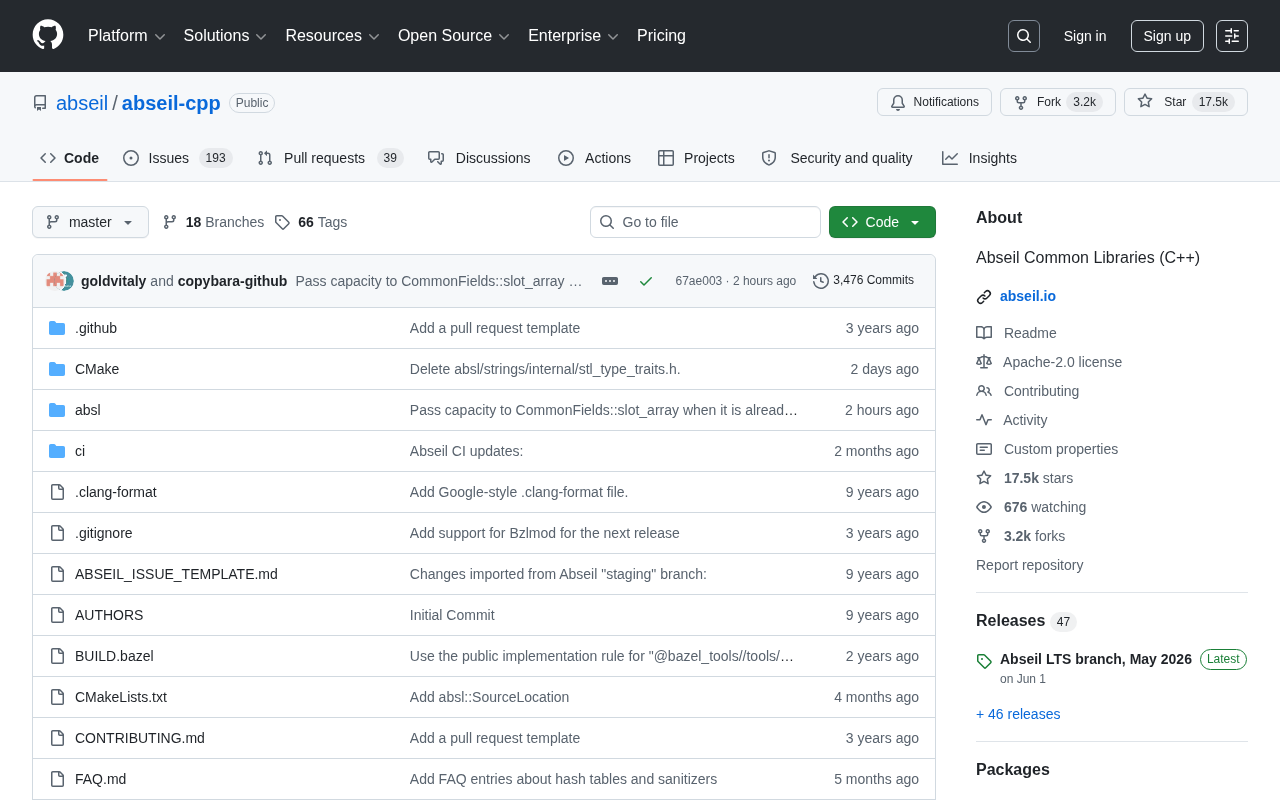
Abseil (pronounced /æbˈsiːl/) is a general-purpose C++ foundation library open-sourced by Google, distilled from code that has been used internally at Google and battle-tested in large-scale production environments. The project has earned over 17,480 stars and 3,189 forks on GitHub, with a consistently active community. Rather than replacing the C++ standard library, Abseil is designed as a complement and extension to it — providing capabilities that are frequently needed in real-world engineering but are either absent from the standard library or not ideally implemented there.
Abseil's core design philosophy is "co-evolution with the C++ standard." When a feature is adopted into the C++ standard, Abseil provides interfaces compatible with the standard library to enable smooth migration. For example, absl::string_view and absl::optional are designed to mirror std::string_view and std::optional, making it easy to switch to standard implementations in the future.
Core Modules
Abseil covers a remarkably broad range of functionality, touching nearly every aspect of everyday C++ development. Here are some of its most representative modules.
High-Performance Containers and String Utilities
Abseil provides a suite of high-performance containers, most notably absl::flat_hash_map and absl::flat_hash_set, built on the Swiss Table algorithm. Swiss Table is a novel open-addressing hash table implementation proposed by Google in 2017. Its key innovation lies in using SIMD (Single Instruction, Multiple Data) instructions to perform parallel metadata lookups — aggregating 1-byte control metadata per slot into 128-bit groups, then using SSE2 instructions to compare the high bits of 16 slot hashes in parallel, dramatically reducing the number of probes needed during hash collisions. The flat memory layout packs key-value pairs contiguously, eliminating the pointer-chasing overhead of std::unordered_map's chained structure and making far better use of CPU caches. As a result, these containers offer significant advantages in memory layout and lookup performance over std::unordered_map, making them the go-to replacement for performance-critical C++ projects.
On the string side, utility functions like absl::StrCat, absl::StrSplit, and absl::StrJoin greatly simplify string concatenation, splitting, and joining. Their interfaces are intuitive and efficient, fundamentally eliminating the performance overhead of repeatedly constructing temporary objects in traditional approaches.
Time Handling and Concurrency Primitives
absl::Time and absl::Duration offer a clear, type-safe API for working with time, directly addressing the verbosity and complexity of the standard <chrono> library. In the concurrency space, absl::Mutex is more feature-rich than std::mutex, supporting condition variable waiting, deadlock detection, and reader-writer locks — making it a powerful tool for building highly concurrent systems.
Error Handling and Logging
Abseil includes practical modules for logging and status codes (absl::Status / absl::StatusOr). absl::Status was influenced by Google's internal RPC status code system — at its core, it's a lightweight value type carrying an error code (aligned with gRPC status code enums) and an error message. absl::StatusOr<T> combines it with a return value, similar to Rust's Result<T, E>, forcing callers to explicitly handle both success and failure paths at the call site. Since Google's C++ style guide discourages exceptions in most scenarios, absl::Status represents the optimal engineering solution under that constraint. Its design philosophy has also significantly influenced the standardization of std::expected<T, E> in C++23. This pattern of explicitly propagating and handling errors is one of the best practices in modern C++ error handling.
Design Philosophy and Compatibility Strategy
Understanding the principles behind Abseil helps you use it more appropriately in your projects.
Compatibility guarantees: Abseil commits to API stability over a defined period, but explicitly does not guarantee long-term ABI compatibility. The official recommendation is therefore to build from source rather than relying on pre-compiled binaries. This strategy ensures Abseil can continuously optimize its internal implementation without being constrained by legacy baggage.
Evolving with the standard: The Abseil team actively tracks C++ standardization progress. Once a feature is standardized, clear migration paths are provided, effectively reducing long-term technical debt accumulation.
Modern C++ support: Abseil requires C++14 or later, is thoroughly tested against major compilers including GCC, Clang, and MSVC, and supports integration with both Bazel and CMake — keeping the barrier to entry low.
Use Cases and Ecosystem Value
Abseil is particularly well-suited for the following types of projects:
- High-concurrency services: Backend systems with stringent latency and throughput requirements
- Large-scale C++ codebases: Teams looking to unify their foundational tooling and avoid reinventing the wheel
- Adopting Google engineering practices: Technical teams wanting to bring industrial-grade C++ standards into their workflow
In practice, prominent open-source projects like gRPC, Protocol Buffers, and TensorFlow all depend on Abseil as a foundational layer — a strong testament to its reliability in production-grade projects. For demanding workloads such as AI inference and high-performance computing, where memory efficiency and execution speed are paramount, Abseil's high-performance containers and concurrency primitives fill the gaps that the standard library leaves open.
Conclusion
Abseil is a C++ foundation library proven at Google's production scale. Rather than reinventing the wheel, it builds on top of the standard library to provide more practical and efficient supplementary capabilities. Whether it's Swiss Table-powered high-performance containers, the elegant absl::Status error handling model, or its forward-looking design philosophy of co-evolving with the C++ standard — all of these reflect the depth of Google's engineering investment. For any serious C++ project, Abseil is well worth considering in your technology stack. It's more than just a utility library; it's a concrete embodiment of modern C++ engineering best practices.
Related articles

Network Doctor: An Open-Source Terminal Tool for Network Fault Diagnosis
Network Doctor is an open-source terminal network diagnostic tool that integrates ping, dig, curl, and traceroute, automatically detecting connectivity in stages and outputting fault conclusions in natural language.

LangChain Guardrails Explained: Building Safe and Controllable AI Agents
A detailed guide to LangChain Guardrails covering layered ecosystem architecture, middleware implementation, deterministic and model-driven protection for building production-grade secure AI Agents.

Deep Dive into Microsoft's AI Security Tools: Does Performance Really Surpass the Competition?
Microsoft launches enterprise AI security tools claiming superior performance. This deep analysis examines core capabilities, ecosystem advantages, and risks to guide enterprise security decisions.