Accuracy Degradation in Long-Horizon 3D Benchmarks: How Many Random Seeds Are Enough to Trust the Results?

A 3D perception demo shows sharp far-range accuracy drop, but tiny sample sizes demand multi-seed validation before conclusions hold.
A researcher shared 3D perception demo results on Reddit — 2/2 accuracy for nearby targets, dropping to 3/10 for distant ones — vividly illustrating distance-related accuracy degradation. However, the article's core argument is that the data itself is barely trustworthy: 2 near samples and 10 far samples cannot support statistically meaningful conclusions or distinguish system characteristics from random noise. This raises a key methodological question: how many random seeds are needed to trust the results? The answer involves running 3–10+ seeds, reporting means and confidence intervals, and evaluating accuracy in distance bins separately — especially critical for long-horizon tasks where errors accumulate over time.
A Demo Walk That Exposed a 3D Perception Challenge
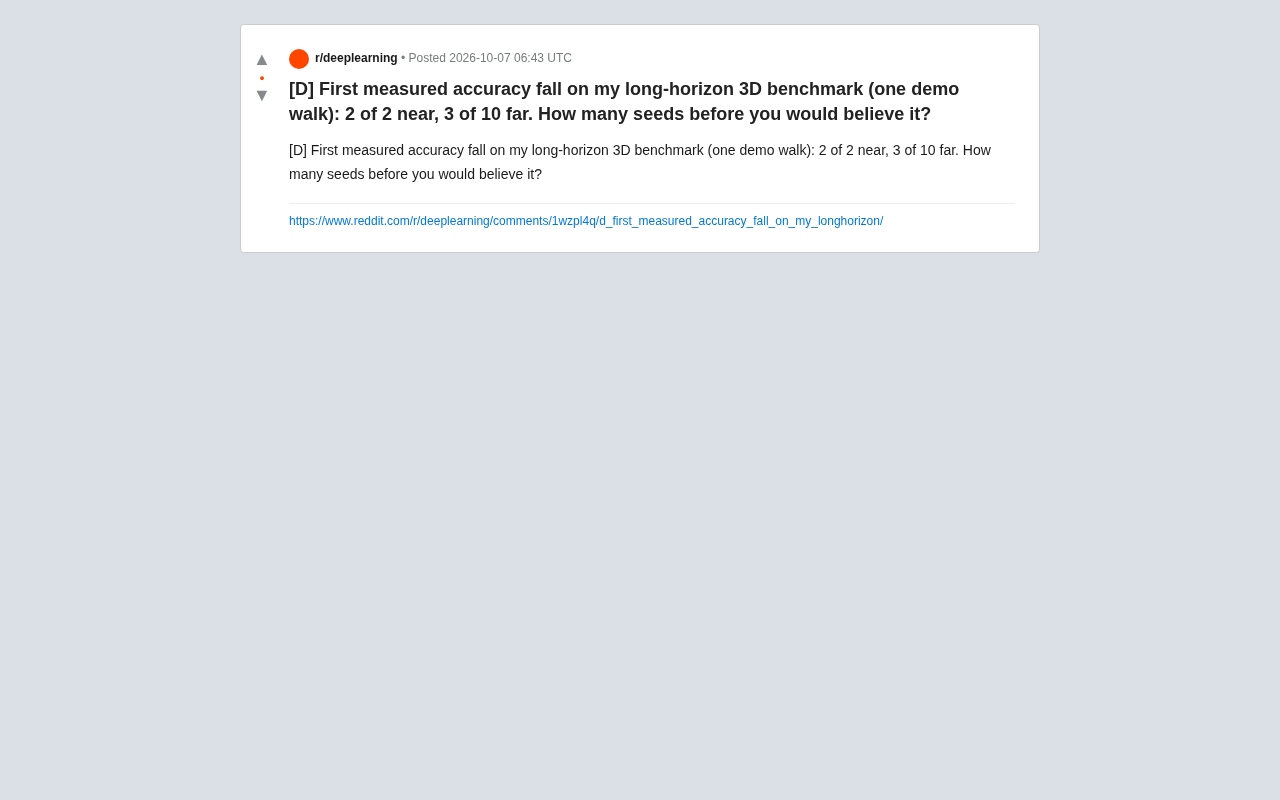
In a machine learning discussion on Reddit, a researcher shared their first observation from a long-horizon 3D benchmark: during a demo walk, the system achieved an accuracy of 2/2 on nearby targets, while accuracy plummeted to 3/10 on distant targets.
These numbers vividly illustrate a common pain point in 3D perception systems — accuracy degradation with distance. Nearby targets offer dense information, dense point clouds, and clear parallax, allowing models to recognize them nearly perfectly. Distant targets, however, face multiple challenges: sparse point clouds, reduced resolution, and accumulated noise — all of which cause accuracy to drop sharply. This pattern of high near-accuracy and poor far-accuracy is far from uncommon in tasks that rely on long-horizon perception, such as autonomous driving, robot navigation, and SLAM.
Point cloud sparsity is the key physical reason behind far-range accuracy degradation. Take LiDAR as an example: a sensor emits a fixed number of laser beams, and as target distance increases, the number of beams that can hit the same target surface decreases with the inverse square of the distance — double the distance, and point cloud density drops to roughly one quarter. When only a handful of points remain on a target, shape features are almost entirely lost, forcing the model to reason from an extremely degraded, sparse signal. Cameras face a similar predicament: distant targets occupy very few pixels in the image and are more susceptible to atmospheric scattering and motion blur. SLAM (Simultaneous Localization and Mapping) systems compound this further with pose estimation errors — localization drift accumulated during a long-horizon walk causes coordinate predictions for distant targets to shift even more, creating a cascading error effect.
What Can a Single Demo Tell Us?
The core issue isn't the phenomenon of "low far-range accuracy" itself — that's almost an expected result — but rather the critical follow-up question the author raises: how reliable is this data, really?
A single demo walk is just one sample sequence. While 2/2 and 3/10 appear to form a stark contrast, from a statistical standpoint the sample sizes are tiny. With only 2 near samples, the confidence interval remains extremely wide even with a perfect hit rate. The 3/10 for distant targets corresponds to a point estimate of roughly 30%, but with an equally massive standard error. A single run cannot distinguish whether this reflects a stable system characteristic or a chance fluctuation in one particular run.
This is precisely why the author asks: how many random seeds does it take before you'd believe the result? In deep learning and robotics experiments, random seeds affect initialization, data sampling order, environment noise, and many other factors. Results from a single seed are often not representative.
How Many Seeds Are Enough?
Answering "how many seeds is enough" isn't straightforward — it depends on several dimensions:
Effect Size and Variance
If the near-far gap is a real, stable, large effect (e.g., far-range accuracy is systematically below 40%), then a relatively small number of repetitions (say 5–10 seeds) might already reveal a significant and consistent trend. But if results fluctuate wildly across seeds, that signals high measurement noise, requiring more repetitions to converge on reliable mean values and confidence intervals.
Report Means and Intervals, Not Single Points
The community consensus is clear: don't draw conclusions from a single run. The more rigorous approach is to run multiple seeds (commonly starting with 3–5, and 10 or more for rigorous work), then report the mean accuracy, standard deviation, and ideally confidence intervals. For long-horizon tasks, since errors accumulate along the time axis, variance tends to be larger, making sufficient repetition even more critical for reducing uncertainty.
Stratified Evaluation by Near and Far Targets
Since the phenomenon clearly shows distance dependence, a well-designed benchmark should bin results by distance and report accuracy per bin separately, rather than mixing everything into a single overall score. Each distance bin should have sufficient sample counts — otherwise, data like "10 far-range samples" can hardly support any strong conclusion.
In deep learning experiments, a "random seed" controls the initial state of the pseudo-random number generator, which in turn affects weight initialization, data batch shuffling, Dropout masks, noise sampling in simulation environments, and more. Because neural network loss surfaces are highly non-convex, different seeds can lead the model to converge to different local optima, causing observable variation in final evaluation metrics. This "run-to-run variance" introduced by randomness is a source of noise independent of model architecture and data quality. In reinforcement learning and robotics simulation, seeds also affect environment initial states and physical engine perturbations, making result fluctuations even more pronounced. This is why top venues like NeurIPS now recommend multi-seed reporting (with mean and standard deviation) as standard experimental practice — results from a single seed are increasingly difficult to accept as valid evidence in peer review.
"Distance binning" is an established practice in autonomous driving perception evaluation. Benchmarks like KITTI and nuScenes report detection metrics separately for ranges such as 0–30m, 30–50m, and 50m+. The statistical rationale for binning is that overall accuracy across all distances is dominated by the large number of easy-to-detect near samples, masking true performance deficiencies at range. After binning, each interval needs to independently satisfy minimum sample size requirements — typically at least 50–100 valid samples per bin — for the accuracy estimate in that bin to have practical reference value. If a distance bin has insufficient samples, the correct approach is to explicitly flag those results as "unreliable" or exclude them from the report, rather than using small-sample numbers to create a false sense of precision.
Implications for Benchmark Design
This seemingly simple post actually touches on several key points in ML experimental methodology:
- Sample size awareness: Fewer than double-digit samples can barely support reliable accuracy conclusions, especially after binning.
- Reproducibility: A single demo has demonstration value, but cannot substitute for statistical validation across multiple runs.
- Error accumulation: What makes long-horizon tasks special is that errors propagate over time — evaluation must account for variance along the temporal dimension.
For developers building similar 3D perception benchmarks, this is a valuable reminder: establish the statistical reliability of your measurement pipeline first, then interpret the model mechanisms behind near-far accuracy gaps. Otherwise, a single impressive or poor demo can easily lead to the wrong conclusions.
Conclusion
The drop from 2/2 to 3/10 is vivid and striking — but it looks more like "a signal worth investigating" than "an established finding." The author's very question — how many seeds would it take to believe the result — reflects exactly the kind of caution a rigorous researcher should have. Before drawing any conclusions about far-range accuracy degradation, the foundation for credible claims must be built on sufficient repetitions, stratified statistics, and uncertainty quantification.
Related articles

OpenAI Partners with Shield: How the Astra Agent Revolutionizes IT Troubleshooting
OpenAI and Shield launch the Astra agent, which autonomously logs into computers and legacy systems to fix IT issues in real time, 35-40% faster than traditional models, with humans involved only when judgment is needed.

iPhone Duo Battery Life Tested: One Charge a Day Is Unavoidable, and the Large Screen Is the Culprit
iPhone Duo battery test: heavy use needs at least one charge a day, and about 30% remains after 6.5 hours of screen-on time. How often the large screen is unfolded is key; a MagSafe battery pack helps, and long-term degradation is also worth watching.

Kimi K3.1 Pro Open-Sourced: 2.8 Trillion Parameters Close In on Opus
Moonshot releases the open-source MoE model Kimi K3.1 Pro, with 2.8T total parameters and 104B activated, trailing Opus 5.5 by under 1 point on Terminal Bench 4.0.