Accused of Model Distillation by Anthropic: How to Prove Your Innocence?
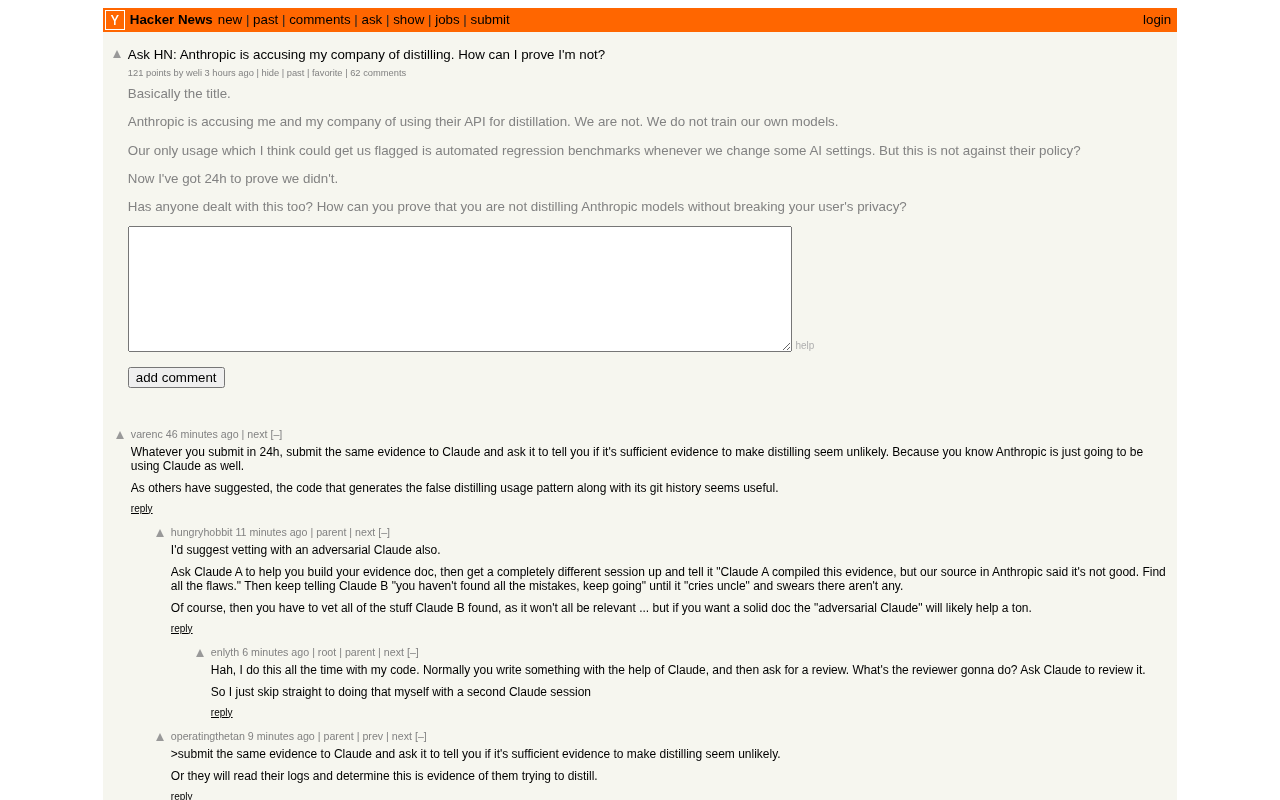
Anthropic accused a startup founder of model distillation, sparking HN debate on proving innocence and API compliance.
A startup founder on Hacker News said he was accused by Anthropic of model distillation, drawing 116 upvotes and 61 comments. Distillation refers to using large-model outputs to train small models, which may violate terms if unauthorized. Accusations are often based on abnormal API call patterns and output similarity, but normal data labeling or evaluation can easily be misidentified. Commenters suggested sorting through call logs, retaining proof of training data sources, and proactively communicating with Anthropic to provide audit logs. Legally, teams should review the terms of service and seek legal assistance. The incident warns teams relying on large-model APIs to define data boundaries, retain compliance evidence, monitor terms changes, and establish internal compliance processes in advance.
A Sudden Accusation
A help-seeking post from a startup founder on Hacker News has drawn attention: his company was accused by Anthropic of model distillation, but he insists he is innocent. The post received 116 upvotes and 61 comments, sparking lively discussion. Distillation generally refers to using the outputs of a large model to train a small model; if done without authorization, it may violate the terms of service. If the accusation is upheld, the company could face legal risks.
Knowledge Distillation was first proposed by Hinton et al. in 2015, referring to using the outputs of a large, complex "teacher model" (usually soft-label probability distributions) to train a small, lightweight "student model," so that the student model can approximate the teacher's performance while greatly reducing parameter count. Traditional distillation relies on the full probability distribution output by the teacher model, whereas in the large-model era it is more common to use text or logits returned by an API as training corpus, which is essentially "output imitation." Terms of service typically prohibit using model outputs to train competing models, because this bypasses API call costs and undermines the vendor's technical moat. Therefore, distillation accusations often focus on "whether the outputs were used as training data," rather than on model size itself.
Common Triggers of Distillation Accusations
How do vendors like Anthropic determine distillation? Common signals include: abnormal API call patterns (such as high-frequency, structured output collection), generated content highly similar to their own models, and converging behavioral characteristics of small models. But false positives can also occur: if a normal business makes extensive API calls for data labeling or evaluation, it is easily misidentified. The founder did not disclose specific details, but commenters suggested sorting through call logs to prove the data was used legitimately.
Abnormal API call patterns usually refer to call frequency, time distribution, and input-output structure significantly deviating from normal users. For example: high-frequency calls within a short period, highly templated prompts, systematic collection of long-text outputs, batch requests for the same type of task without retaining conversation context. Such patterns may trigger the vendor's risk control system and be flagged as suspected data scraping. However, normal data labeling, model evaluation, or synthetic data generation can also produce similar call characteristics, leading to false positives. Therefore, vendors generally combine multiple signals for comprehensive judgment rather than relying on a single metric.
How to Build Evidence to Prove Innocence
Both legal and technical approaches are needed. Technically, retain complete API call records, proof of training data sources, and model architecture and training logs to demonstrate that Anthropic outputs were not used as training data. Legally, review the restrictions on output usage in the terms of service and seek legal assistance if necessary. Some commenters suggested proactively communicating with Anthropic and providing audit logs, rather than waiting passively.
Industry Warning: Compliant API Use
This incident reminds all teams relying on large-model APIs: define data boundaries clearly, avoid using outputs to train competing models; retain compliance evidence; and pay attention to changes in terms. Distillation accusations may become commonplace, and establishing internal compliance processes in advance is a necessary investment.
Conclusion
An accusation is not a conviction, but responding requires professionalism. Technical transparency and legal preparation are the keys to proving innocence.
One-line Summary
Anthropic accused a startup founder of model distillation, sparking heated HN discussion on proving innocence and API compliance.
Paragraph Summary
A startup founder on Hacker News said he was accused by Anthropic of model distillation, drawing 116 upvotes and 61 comments. Distillation refers to using large-model outputs to train small models, which may violate terms if unauthorized. Accusations are often based on abnormal API call patterns and output similarity, but normal data labeling or evaluation can easily be misidentified. Commenters suggested sorting through call logs, retaining proof of training data sources, and proactively communicating with Anthropic to provide audit logs. Legally, teams should review the terms of service and seek legal assistance. The incident warns teams relying on large-model APIs to define data boundaries, retain compliance evidence, monitor terms changes, and establish internal compliance processes in advance.
Related articles

S&P Weighs Downgrading Nvidia's Credit Rating: Governance and Key Man Risk in Focus
S&P is considering downgrading Nvidia's credit rating to AA-, citing corporate governance and key man risk rather than financial performance. We analyze the drivers, potential impact, and the broader trend of governance scrutiny for large tech companies in the AI era.

Generating a 3D Stacking Game from a Few Prompts: Hands-on with the Playground Experimental Platform
Playground lets users generate the 3D stacking game One More Pie from a few text prompts. This article examines the capabilities and limits of prompt-based web game generation.
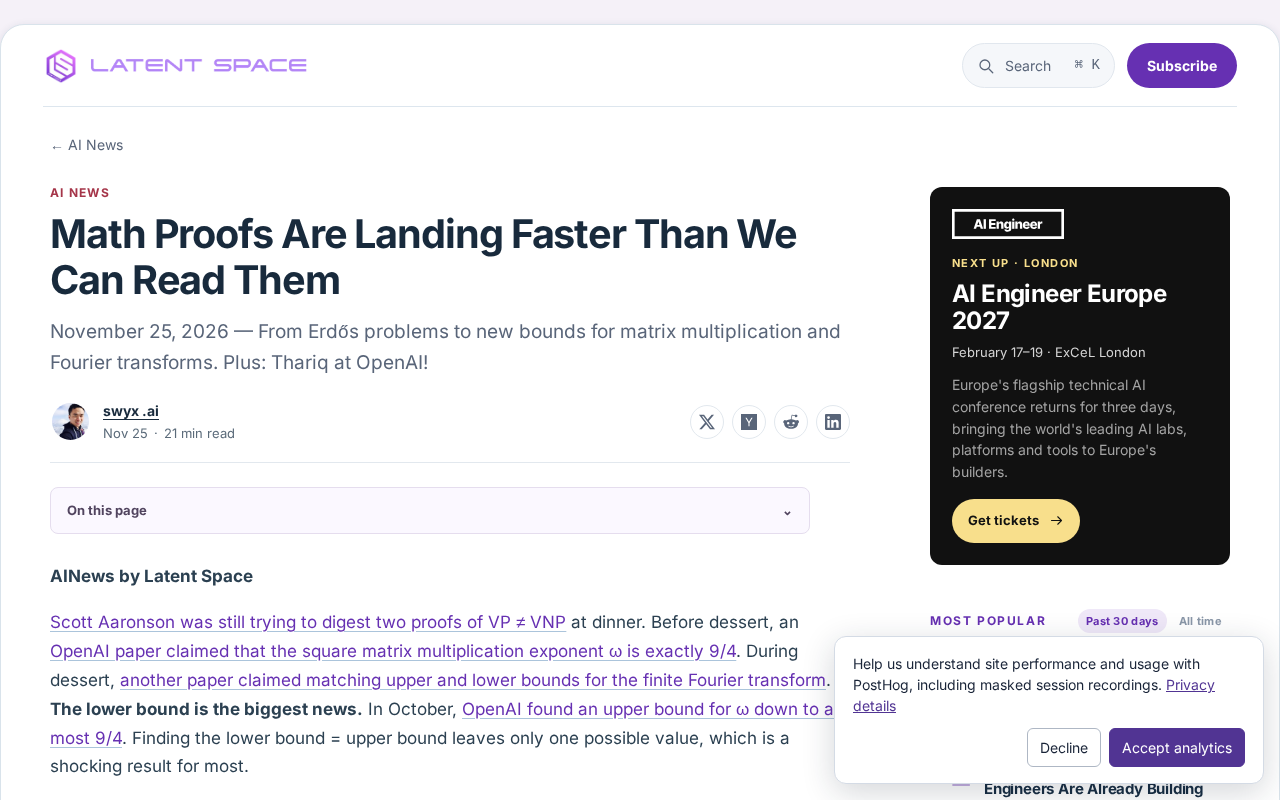
AI Math Proofs Are Exploding: Humans Can't Read Fast Enough
AI math proof output now outpaces human reading speed. AINews roundup covers Erdős problems, new matrix multiplication bounds, and Fourier transform bounds—verification is the new bottleneck.