AdaptiveSpec: Technical Breakdown of a Training-Free Speculative Decoding Method That Achieves 56% Speedup
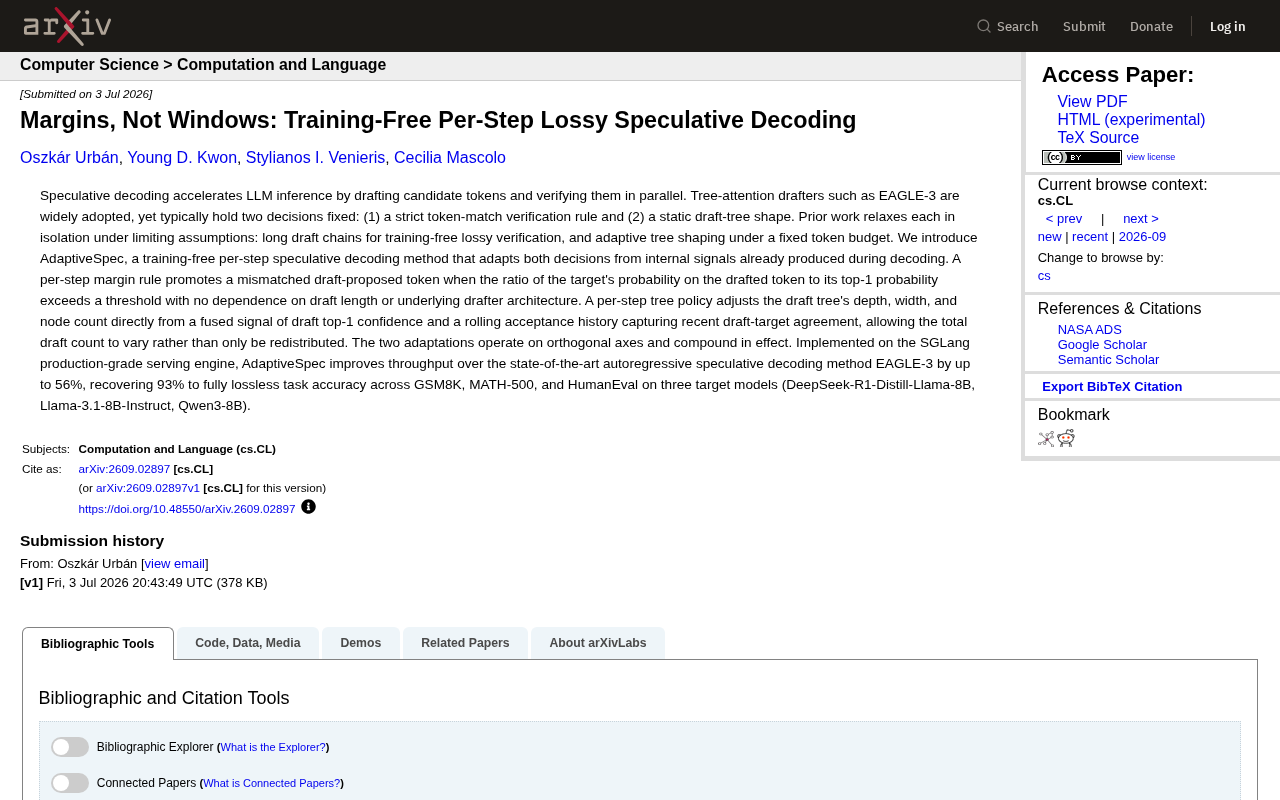
AdaptiveSpec boosts LLM inference throughput by 56% using training-free adaptive speculative decoding.
AdaptiveSpec is a training-free speculative decoding method that simultaneously optimizes two orthogonal dimensions: a per-step margin rule that accepts semantically equivalent draft tokens even without exact matches, and a dynamic tree policy that adjusts draft tree size based on confidence and acceptance history. Implemented on the production-grade SGLang engine, it achieves up to 56% throughput improvement over EAGLE-3 while recovering 93% to lossless accuracy on GSM8K, MATH-500, and HumanEval benchmarks.
A New Approach to LLM Inference Acceleration: Why Speculative Decoding Matters
Inference speed for large language models (LLMs) remains a core bottleneck limiting their large-scale deployment. LLMs generate text in an autoregressive manner, producing one token at a time, where each subsequent token must wait for the previous one to complete. This means generating a passage of N tokens requires N serial forward passes. Since modern GPUs are often memory-bandwidth bound rather than compute-bound during inference, the latency of a single forward pass cannot be linearly reduced by simply stacking more hardware — making token-by-token generation a fundamental performance bottleneck.
Speculative Decoding is an acceleration technique designed specifically for this bottleneck. The basic idea is to use a lightweight "drafter" model to quickly generate candidate tokens, which the target large model then verifies in parallel. This allows multiple tokens to be confirmed in a single forward pass, significantly reducing the latency of token-by-token generation. The core insight is that since the large model's per-forward-pass latency is relatively fixed, having it evaluate multiple candidate positions simultaneously enables "batch confirmation" of outputs, multiplying effective generation speed.
However, mainstream tree-attention draft schemes, such as the widely adopted EAGLE-3, typically hardcode two key decisions: strict token-matching verification rules and static draft tree structures. A paper published on arXiv titled Margins, Not Windows: Training-Free Per-Step Lossy Speculative Decoding proposes a method called AdaptiveSpec that attempts to break both limitations simultaneously — without any additional training.
Two Key Limitations of Existing Speculative Decoding Methods
Before understanding AdaptiveSpec's innovations, it's essential to clarify two key pain points facing existing speculative decoding methods.
Strict Token-Matching Verification
Traditional speculative decoding employs strict verification rules: a draft token is only accepted when it exactly matches the target model's sampling result. The theoretical foundation of this mechanism is a rejection sampling-based verification protocol — a draft token is accepted directly when its probability is no lower than the probability assigned by the target model; otherwise, it is rejected with some probability and resampled from a corrected distribution. This mathematically strict equivalence guarantees that the output is identical to the original model (lossless), but it also causes many semantically near-identical candidates to be rejected. For example, token pairs like "cannot" vs. "can not" or "1,000" vs. "1000" — which are semantically almost equivalent — can trigger rejection due to minor probability distribution differences, wasting draft computation resources.
Static Draft Tree Structure
The second issue is that the draft tree shape is fixed in advance. Tree Attention is an efficient verification strategy in speculative decoding — unlike simple single-chain drafts, it organizes drafts into a tree structure where each internal node can have multiple children representing different candidate continuation paths. During verification, the target model uses specially designed attention masks to evaluate the plausibility of all paths in the tree in a single forward pass, then greedily accepts as many tokens as possible along the highest-probability path.
The EAGLE series (EAGLE, EAGLE-2, EAGLE-3) represents the leading work in this direction. EAGLE-3, as the latest version, has undergone multiple rounds of optimization in autoregressive draft model training and tree structure construction, becoming a strong baseline in speculative decoding. However, regardless of the difficulty of the current decoding step, the draft tree's depth, width, and node count remain unchanged. This means computational resources are wasted in "easy-to-predict" scenarios, while "difficult scenarios" may miss acceleration opportunities due to insufficient drafts.
Prior research has attempted to relax these two constraints, but typically in isolation and with strong assumptions — for instance, training-free lossy verification relying on longer draft chains, or adaptive tree shaping constrained within a fixed token budget. The value of AdaptiveSpec lies in simultaneously and dynamically optimizing both dimensions.
Core Technical Innovations of AdaptiveSpec
AdaptiveSpec is a training-free, per-step adaptive speculative decoding method. Its elegance lies in the fact that all signals needed for decision-making are naturally produced during the normal decoding process, requiring no additional models or training overhead.
Per-Step Margin Rule: Replacing Windows with Marginal Ratios
The paper title "Margins, Not Windows" highlights the first core idea. AdaptiveSpec introduces a per-step margin rule: when the ratio between the target model's probability for the draft token and its top-1 token probability exceeds a certain threshold, the draft token is accepted even if the two don't exactly match.
This rule can be intuitively understood as a "relative confidence" judgment. For example, suppose the target model's top-1 token at a certain position is "excellent" (probability 0.35), while the draft proposes "great" (target model probability 0.30). The probability ratio is 0.30/0.35 ≈ 0.86. If the preset threshold is 0.8, the draft token is accepted. The semantic intuition behind this is: when the target model considers the draft token "almost as good as the best choice," the difference between them is unlikely to affect final output quality.
This rule has three key advantages:
- Draft-length independent: Applicable regardless of draft chain length, with independent decisions at each step
- Draft-architecture agnostic: No requirements on the underlying drafter type, offering plug-and-play universality
- Lossy but controllable: Flexible balance between speed and accuracy through threshold adjustment
Unlike the "sliding window" mechanisms used by some prior methods — which require accumulating statistics over a continuous draft chain before making a judgment — the margin rule makes independent decisions at each step, providing stronger generality.
Per-Step Tree Policy: Dynamically Adjusting Draft Tree Size
The second innovation is the per-step tree policy. AdaptiveSpec fuses two internal signals to dynamically adjust the draft tree's depth, width, and node count:
- Draft top-1 confidence: Reflects the draft model's certainty about the current prediction
- Rolling acceptance history: Captures recent trends in draft-target model agreement
Unlike previous methods that "reallocate" nodes within a fixed token budget, AdaptiveSpec allows the total number of drafts to vary. When recent acceptance rates are high and confidence is sufficient, the system expands the draft tree to pursue greater acceleration; conversely, it contracts the draft tree to avoid wasteful computation. This "elastic scaling" strategy dynamically matches computational resource allocation to actual decoding difficulty.
Orthogonal Stacking: The Synergy of Two Adaptive Mechanisms
The paper specifically notes that these two adaptive mechanisms operate on orthogonal dimensions — the margin rule optimizes "verification decisions" (how to judge acceptance or rejection of already-generated drafts), while the tree policy optimizes "generation decisions" (how many and what structure of drafts to generate next). They do not interfere with each other. Therefore, their effects can compound rather than cancel out. This design decoupling is the key reason AdaptiveSpec achieves significant overall gains.
Experimental Results: 56% Throughput Improvement with Accuracy Preservation
AdaptiveSpec is not merely theoretical. The research team implemented it directly on the production-grade serving engine SGLang, making the experimental results more relevant for engineering applications. SGLang is an open-source LLM inference and serving framework developed by institutions including UC Berkeley, designed for high-throughput, low-latency production deployment. Its core technologies include RadixAttention (an efficient KV cache reuse mechanism) and continuous batching. Compared to research-only inference scripts, implementing and evaluating on an engine like SGLang means dealing with real system-level challenges — including multi-request concurrent scheduling, GPU memory management, and dynamic allocation and reclamation of KV caches — making the results more reflective of real-world deployment scenarios.
In comparison with EAGLE-3, the current state-of-the-art autoregressive speculative decoding method, AdaptiveSpec delivered impressive results:
- Up to 56% throughput improvement
- Recovered 93% to fully lossless task accuracy across three major benchmarks: GSM8K, MATH-500, and HumanEval
- Covered three mainstream target models: DeepSeek-R1-Distill-Llama-8B, Llama-3.1-8B-Instruct, and Qwen3-8B
The three evaluation benchmarks chosen in the paper assess different dimensions of model capability. GSM8K (Grade School Math 8K) contains approximately 8,000 elementary school math word problems, primarily evaluating multi-step arithmetic reasoning. MATH-500 is a 500-problem subset drawn from the MATH competition mathematics dataset, covering algebra, geometry, number theory, and more, with extremely high demands for precise reasoning. HumanEval is a code generation benchmark released by OpenAI containing 164 Python programming problems that evaluate a model's ability to generate functionally correct code. The common characteristic of these three benchmarks is that they all impose strict requirements on output precision — math problems require correct final answers, and coding problems require passing all test cases.
The significance of these results is that the 56% throughput improvement was achieved with nearly no loss in task accuracy (minimum 93%, mostly approaching lossless). The lossy speculation did not sacrifice model capability; instead, it precisely "passed through" semantically insignificant differences. Maintaining such high accuracy recovery rates on benchmarks with stringent precision requirements powerfully demonstrates that the margin rule's lossy strategy does not undermine the model's core reasoning ability.
Engineering Significance and Future Outlook
AdaptiveSpec's value lies not only in the numerical improvements but also in revealing an important direction: the next breakthrough in LLM inference acceleration may not come from training better draft models, but from more intelligently leveraging internal signals already available during the decoding process.
The "training-free" characteristic deserves particular attention. It means existing deployments can benefit directly without retraining any components, significantly lowering the barrier to production adoption. In real-world LLM serving, training or fine-tuning a dedicated draft model often requires substantial computational resources and data preparation work paired with the target model — a step that AdaptiveSpec bypasses entirely. Additionally, the method's direct implementation on the production-grade engine SGLang demonstrates that it is not merely a lab-based proof of concept but an engineering solution with real deployment potential.
Of course, the "acceptable loss" in lossy decoding still depends on the specific application scenario. For precision-sensitive tasks like code generation and mathematical reasoning, whether 93% accuracy recovery meets requirements needs to be weighed against business tolerance. However, for the vast number of scenarios that are latency-sensitive but insensitive to subtle differences — such as conversational chat, text summarization, creative writing, and more — AdaptiveSpec offers an attractive option of "trading minimal accuracy for significant speed."
As speculative decoding technology evolves from static to adaptive, and from strict matching to margin tolerance, LLM inference efficiency is poised for another round of substantial breakthroughs. The "training-free + orthogonal stacking" design philosophy demonstrated by AdaptiveSpec also provides a valuable technical paradigm for future work: rather than seeking extreme optimization along a single dimension, identify mutually independent optimization axes and let their gains compound naturally.
Key Takeaways
Related articles
vLLM v0.29.0rc4 Released: Fixing the TRT-LLM Inference Synchronization Bottleneck Explained
Deep dive into vLLM v0.29.0rc4: fixing unnecessary GPU sync in TRT-LLM ragged prefill to eliminate CPU-GPU overhead and boost inference throughput.
OpenAI's Migration to HTTPX: Why They Abandoned the requests Library
In-depth analysis of why OpenAI migrated its Python SDK from requests to HTTPX, covering async dual-mode support, HTTP/2 multiplexing, and the real impact on developers.
PyTorch Conference 2026: Hardware Acceleration and Compute Infrastructure Outlook
In-depth analysis of PyTorch Conference 2026 hardware acceleration core topics, covering heterogeneous chip adaptation, compilation stack evolution, torch.compile optimization, and distributed compute scheduling, examining future trends and industry impact of AI compute infrastructure.