ADE Index: A Sourced and Ranked Index of 975 Agentic Coding Tools

ADE Index covers 975 agentic coding tools with sourced rankings, aiming to ease AI coding tool selection.
The article introduces ADE Index, launched on Hacker News Show HN, covering 975 agentic coding tools with "sourced" and "ranked" as its core design principles. It notes that agentic coding tools are proliferating and highly homogenized, and that developers' real pain point is not knowing which tool is worth their time; a ranked index can act as a pre-filter, narrowing candidates from nearly a hundred to a handful. It also counsels caution: the project has only 3 points and 1 comment on Hacker News, its ranking methodology is untested at scale, and developers should treat it as a starting point for exploration rather than a final decision, verifying further via documentation, commit history, and community reputation.
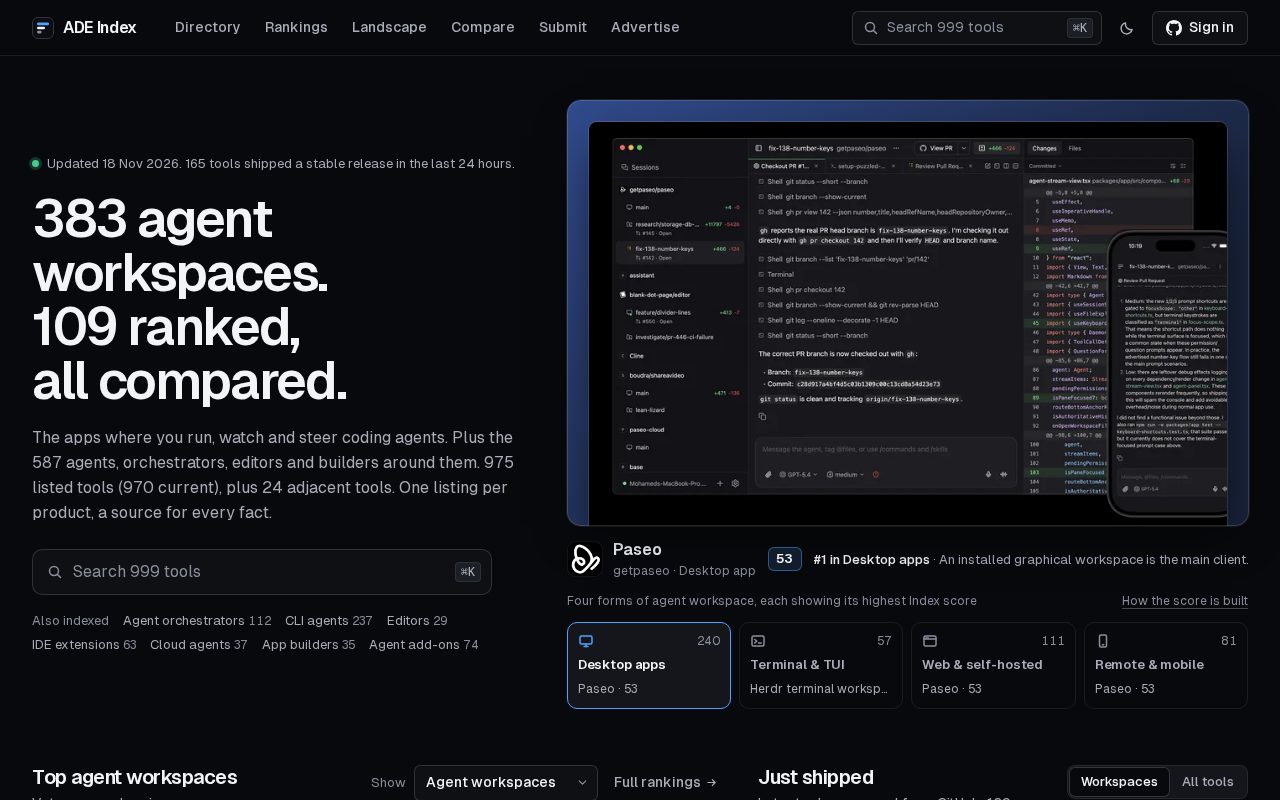
AI coding tools are emerging at a staggering pace, and developers facing an overwhelming array of options often struggle to tell which projects are genuinely active and which are just flashes in the pan. In the Show HN section of Hacker News, a project called ADE Index attempts to solve this information overload problem—it has built an index covering 975 agentic coding tools, each of which it claims comes with source attribution and a ranking.
Why an Agentic Coding Tool Index Is Needed
"Agentic coding" refers to a way of working in which AI doesn't just complete code, but can autonomously plan tasks, invoke tools, iterate on changes, and even submit PRs. Tools of this kind have proliferated rapidly over the past while: from IDE plugins and command-line agents to standalone coding assistants and automation pipelines, they take many forms, and their names and capability boundaries overlap heavily.
For developers, the real pain point isn't "can't find tools"—it's "can't tell which one is worth investing time in." A tool may have a polished website yet no commits for months; another may be obscure but generate a lot of community discussion. ADE Index's value proposition puts "sourced" and "ranked" front and center—rather than just listing links, it provides an information source for each entry and gives a comparable position.
Agentic coding is fundamentally different from traditional AI code completion. Completion tools like GitHub Copilot work on the model of "a human types in the editor and the model suggests a continuation," with control always in the developer's hands. Agentic coding tools typically have three characteristics: task planning (breaking a natural-language request into multiple steps), tool invocation (reading and writing files, executing commands, running tests, accessing the network), and self-iteration (revising the approach based on error feedback). The most typical form is a coding agent that can complete an issue end-to-end and submit a PR. This paradigm shift means the evaluation dimensions for tools expand from "completion accuracy" to more complex metrics such as task completion rate, execution cost, and failure recovery capability—which is precisely why a simple feature list is no longer enough to support tool selection.
Two Core Design Choices of ADE Index
A Sourced Collection Approach
A common problem with index products is that their data provenance is unclear: users have no way of knowing how entries were created, how often information is updated, or whether paid promotions are included. ADE Index emphasizes that every tool has a source, which means there is verifiable evidence behind each ranking rather than an editor's arbitrary ordering. For developers, this directly determines the index's credibility—when you use it for tool selection, you at least know where the conclusions come from.
In the tool index space, "sourced" usually means each entry is linked to verifiable information sources, such as the official repository URL, documentation pages, release dates, star counts, and last commit times—public metadata rather than descriptions written by hand by editors. The common alternative is purely manual curation, where entry provenance is opaque and it's hard to tell whether sponsorships or promotions are mixed in. The practical value of a sourced design is that when a ranking is questioned, users can trace back to the original data and judge for themselves; it also makes it easier to update entries later through regular scripted scraping, reducing the risk of the index becoming stale over time. Note, however, that sources vary in quality—if a source is merely marketing copy from an official website, its credibility is still limited.
Combining Scale with Ranking
975 is a substantial coverage figure. Scale alone isn't a moat, but scale combined with ranking creates a filtering funnel: developers can look first at how the top tools are ordered, then drill down into subcategories as needed. This structure of "broad coverage plus tiered ranking" is closer to the real tool-selection decision process than a simple tool directory site.
What This Kind of Index Means for Developers
A notable characteristic of the agentic coding space is severe homogenization. Many tools have highly similar feature descriptions, and the real differences lie in engineering maturity, community activity, and actual task completion rates. Trying each one manually is neither realistic nor cheap. A ranked index can serve as an early-stage "pre-filter," narrowing the candidate set from nearly a hundred down to a handful.
Another point worth noting is timeliness. AI coding tools generally have short lifecycles, and an index that isn't continuously updated quickly becomes stale. By making "sourcing" a core selling point, ADE Index is, in a sense, also reserving a verifiable path for ongoing maintenance.
Homogenization is especially pronounced in the AI coding tool space, largely because the underlying model capabilities are converging: many tools are in fact wrappers around the same closed-source or open-source LLM APIs, differing in their interaction layer and engineering workflow. This makes feature lists look highly similar, with the real differences hidden in details that are hard to see from a website—prompt engineering, context management strategies, sandboxed execution environments, error retry mechanisms, and so on. As a result, commonly used objective signals for measuring these tools include repository commit frequency, issue response speed, benchmark results (such as SWE-bench and other evaluations based on fixing real GitHub issues), and community discussion density. The problem with manual trials is that they are costly and based on a single sample—a developer's few daily tasks can hardly cover a tool's capability boundaries, which is exactly what aggregator indexes try to compensate for through scale and ranking.
Reasons for Caution
The project's discussion on Hacker News is not yet very active: the post has received only 3 points and 1 comment, so community feedback is extremely sparse. That means whether the ranking methodology holds up, how often the data is updated, and whether there is collection bias have all yet to be tested by a large user base.
For developers planning to use this kind of index, a reasonable approach is to treat it as a starting point for exploration rather than the end point for decisions: use the ranking to narrow the scope, then verify against the tool's actual documentation, commit history, and community reputation. The index addresses "knowing what exists," not "confirming which is best."
Summary
The proliferation of agentic coding tools is giving rise to a wave of "meta-tools"—tools that don't write code directly but help developers manage their choices. ADE Index enters this need with a collection of 975 tools and sourced rankings, and its thinking is clear. Whether it becomes a trusted reference point in this space will depend on the ongoing effort put into maintaining the data and the transparency of its rankings—which is precisely the hardest part of the work for index products to sustain.
One-line Summary
ADE Index covers 975 agentic coding tools with sourced rankings, aiming to solve the problem of choosing among AI coding tools.
Paragraph Summary
The article introduces the ADE Index project, launched in the Show HN section of Hacker News, which covers 975 agentic coding tools and makes "sourced" and "ranked" its two core design principles. It notes that agentic coding tools are proliferating and highly homogenized, and that developers' real pain point is not being able to tell which tool is worth investing time in; a ranked index can act as a pre-filter, narrowing the candidate set from nearly a hundred to a handful. The article also counsels caution: the project has only 3 points and 1 comment on Hacker News, its ranking methodology has yet to be tested by a large user base, and developers are advised to treat it as a starting point for exploration rather than a final decision, verifying further through documentation, commit history, and community reputation.
Related articles

Gemini 4 Neon Leak: A Potential Strong Contender Against Opus 5.5
A Hacker News thread suggests Gemini 4 Neon looks like an Opus 5.5 competitor. This article unpacks the product positioning behind this community signal, shifts in the top-model competitive landscape, and what it means for developers' model selection strategy.

Claude Fable 5.2's Self-Authored Short Film 'Fable' Sparks Discussion
A short film 'Fable,' credited to Claude Fable 5.2 for script, visuals, and directing, appears on Hacker News. This article analyzes the significance of full-pipeline AI creation, community reactions, and what it means for content creators.

Anthropic IPO Pricing: A Signal of AI Giants Going Public
Anthropic's IPO pricing draws attention. This article analyzes its potential impact on AI industry valuation, commercialization paths, and the competitive landscape, and highlights public-market expectations and challenges for AI companies.