AdmitRaven: The Duolingo for College Applications — Daily Micro-Lessons Replace $10K Consultants

AdmitRaven gamifies college applications with daily micro-lessons and AI coaching at a fraction of counselor costs.
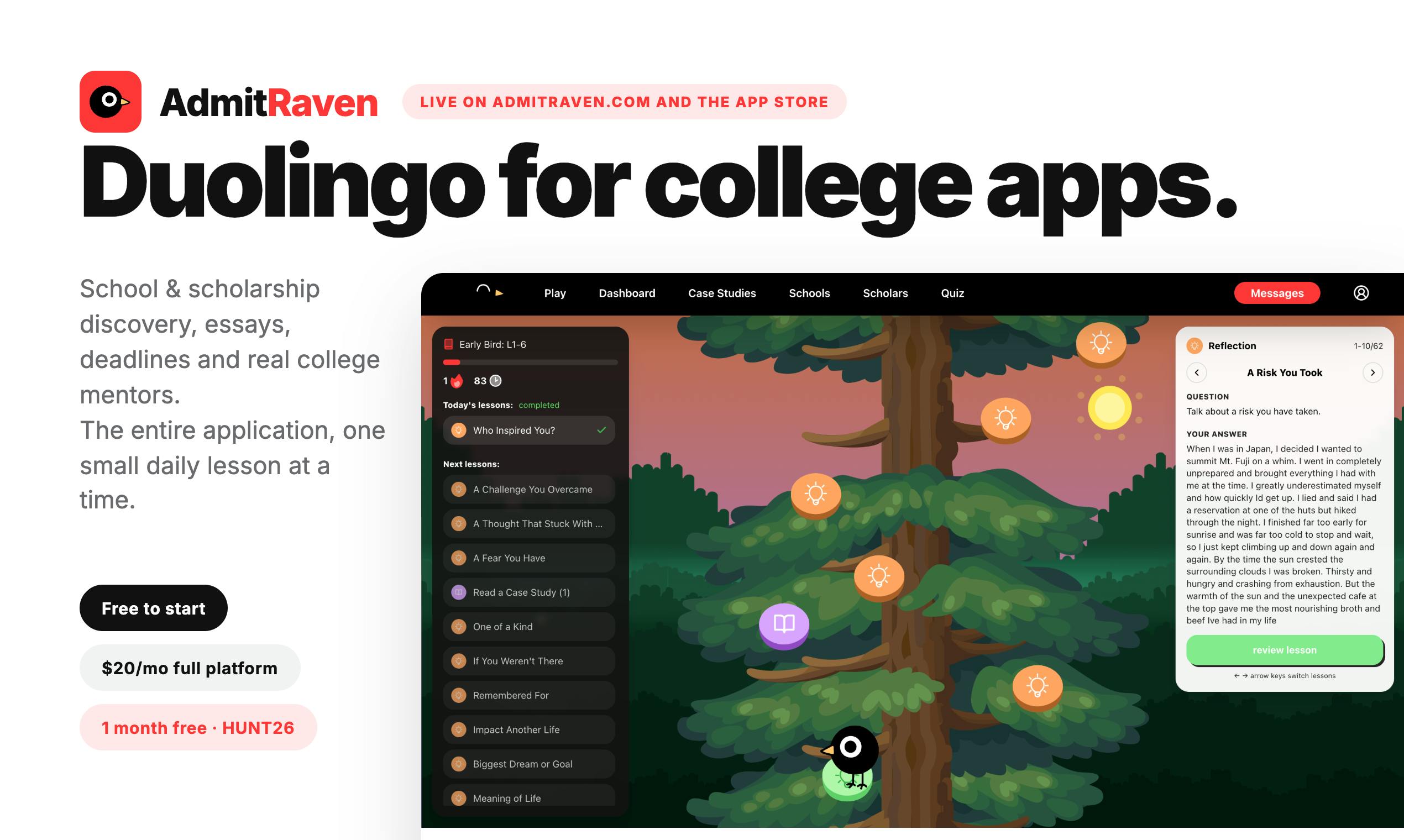
AdmitRaven positions itself as the "Duolingo for college applications," breaking the complex admissions process into daily bite-sized lessons with anti-procrastination mechanisms. It offers AI essay coaching, deadline management, smart school/scholarship matching, and a library of real admitted student essays with direct Q&A access. By democratizing services previously locked behind $10K+ counselor fees, it targets the 70%+ of families who can't afford professional guidance.
AdmitRaven: A Tool That Turns Application Season Into a "Level-Up Game"
For many students and parents, college applications are an anxiety-ridden, drawn-out journey. Professional college counselors routinely charge thousands — even tens of thousands — of dollars, putting their services out of reach for average families. AdmitRaven, which debuted on Product Hunt, aims to solve this pain point with a lighter, more accessible approach — calling itself the "Duolingo for college applications."
Built by Xander Hastings, the product positions itself as a "college counselor in your pocket," guiding students through the entire application process via Duolingo-style daily micro-lessons. After launch, it garnered 65 upvotes, landing at #19 on the daily leaderboard, categorized under Productivity, Writing, and Education.
Core Mechanics: Daily Micro-Lessons + Anti-Procrastination Design
AdmitRaven's most compelling design choice is breaking the complex application process into "daily, bite-sized lessons." This approach directly borrows from language-learning app Duolingo's proven formula — using low-barrier, high-frequency short tasks to combat procrastination and overwhelm.
Duolingo's success is no accident; it's backed by solid learning science. This "Microlearning" model stems from Cognitive Load Theory, which states that human working memory has limited capacity, and breaking complex information into 5-10 minute units significantly improves knowledge retention. Duolingo also heavily employs Spaced Repetition and instant feedback loops, combined with a "streak" mechanism that activates users' loss aversion psychology. By 2023, Duolingo had over 500 million registered users, proving this methodology's effectiveness at massive scale. AdmitRaven transplants this validated behavioral design framework into the college application context — a cross-domain methodology transfer.
Taking it further, AdmitRaven introduces a slightly "coercive" mechanism: blocking users' mindless doomscrolling until they complete their daily lesson. Doomscrolling refers to the behavior of endlessly scrolling through social media content without purpose — a term that gained widespread use during the 2020 pandemic. Research shows teens spend an average of 4.8 hours daily on social media, and this behavior is strongly correlated with anxiety and attention decline. AdmitRaven's "Task-Gating" mechanism belongs to a Digital Wellbeing intervention design pattern, similar in concept to Apple's Screen Time and the Forest focus app — using technology to delay instant gratification and guide users toward completing high-value tasks first. For easily distracted teenagers, this design that ties "task completion" to "entertainment unlock" is essentially a behavioral incentive — using product-level constraints to cultivate discipline during application season.
From Gamification to Application Habit Formation
Gamified learning isn't new, but applying it to college applications — a "one-time, high-stakes" scenario — still carries genuine novelty. Application season typically lacks a clear "daily progress" concept, and students often scramble only as deadlines approach. By breaking the entire process into daily, incrementally advancing steps, AdmitRaven tries to turn this "sprint" into a "marathon," thereby reducing overall stress.
Four Core Features: From Essay Coaching to School Matching
According to official descriptions, AdmitRaven covers several key phases of application season:
- AI Essay Coaching: Helps students polish "authentic, compelling" application essays — often the make-or-break element in admissions decisions.
- Deadline & Materials Management: Tracks deadlines and required materials for every school, preventing costly oversights.
- Smart School & Scholarship Matching: Recommends suitable schools and scholarship opportunities based on student profiles, addressing the "information asymmetry" pain point.
- Real Admitted Student Essay Library: The most differentiated feature — students can read essays from real students admitted to their dream schools, and can even directly ask these admitted students questions.
Technical Foundation and Ethical Considerations of AI Essay Coaching
AI essay coaching typically relies on Large Language Models (LLMs), learning from large volumes of excellent essays to provide structural suggestions, language polishing, and thematic guidance. Technically, it may encompass grammar checking, narrative structure analysis, emotional resonance scoring, and other dimensions. However, since 2023, multiple universities (including Columbia and Yale) have explicitly expressed concern about AI use in application essays. The Common Application platform hasn't fully banned AI assistance but requires essays to reflect the student's own voice and experiences. The industry broadly agrees that there's a fundamental distinction between AI as a "writing coach" (helping students discover their stories and express them better) and AI as a "ghostwriter" (directly generating content). This line is blurry and technically difficult to detect, making it the core ethical challenge facing all AI essay tools.
The Value of Real Admitted Student Essay Examples
In essay writing, the hardest part often isn't the writing itself — it's "not knowing what kind of essay moves admissions officers." AdmitRaven's real admitted student essay samples, combined with direct conversation channels, essentially platformize and make transparent the "insider information" that previously circulated only through private tutoring or personal networks.
Sharing admitted student essays isn't AdmitRaven's invention. Several platforms have attempted similar models: CollegeVine offers free essay samples and peer review, AdmitSee has over 60,000 admitted student profiles available for paid browsing, and the Harvard Crimson publishes incoming freshmen's application essays annually. But these platforms are mostly static libraries lacking interactivity. AdmitRaven's differentiation lies in introducing a social feature for "directly asking admitted students questions," effectively building a cross-cohort student community network. This P2P (Peer-to-Peer) experience-sharing model is known in education as peer learning within the "Zone of Proximal Development" — experiences from peers are often more actionable and psychologically relatable than expert advice.
Pricing Logic: Democratizing College Counseling
A point AdmitRaven repeatedly emphasizes is "a fraction of the cost" — delivering services at a fraction of what traditional counselors charge. Behind this is a clear market thesis: quality college counseling has long been locked behind high price barriers accessible only to a few families, and AI plus productization can dramatically reduce the marginal cost of these services.
The U.S. college counseling market is estimated at over $2.6 billion, with private counselors charging anywhere from $200 per hour to $100,000 for full-service packages. Top consultancies like IvyWise charge up to $150,000 for their "platinum package." Meanwhile, approximately 3.5 million American high school seniors face college applications each year, with over 70% of families unable to afford professional counselors. Public school guidance counselors average 400-500 students each — far exceeding the American School Counselor Association's recommended 250:1 ratio. This severe supply-demand imbalance means vast numbers of students lack effective guidance during the application process, especially first-generation college students and low-income families who face systemic disadvantages in information access.
From a business model perspective, AdmitRaven follows the classic "democratizing expert services" playbook. This is a major trend in current AI applications, with similar examples including: DoNotPay, dubbed the "robot lawyer," offering basic legal consultation via monthly subscription; Woebot providing mental health support using cognitive behavioral therapy principles; and Lemonade reshaping insurance claims with AI. The shared logic: taking fields that traditionally required expensive professionals delivering one-on-one service, using AI to handle standardized components, and drastically reducing marginal costs to bring prices down to 1/10th or even 1/100th of the original. The key lies in identifying which components can be automated (information organization, process reminders, template matching) versus which still require human judgment (personalized strategy, emotional support, ethical decisions), and finding a reasonable division between the two.
AdmitRaven doesn't attempt to fully replace the deep companionship of human counselors. Instead, it delegates standardized, process-oriented tasks to automated product features while converting the scarce value of "people" (like admitted students' experiences) into reusable community assets.
Potential Concerns Worth Watching
As an early-stage product, AdmitRaven has several directions yet to be validated:
Ethical boundaries of essay coaching: AI-assisted essay writing has always been controversial in education — drawing a clear line between "helping with expression" and "ghostwriting" involves both academic integrity and the product's own compliance risks.
Content quality and coverage: The accuracy of school matching and scholarship recommendations, as well as the scale and diversity of the real admitted student essay library, directly determine the product's actual value. Currently with only 1 comment, it's clearly at a very early stage, with genuine user feedback yet to accumulate.
Geographic limitations of target market: The product clearly targets the U.S. college application system (essays, scholarship matching, etc.). Whether it can expand to application contexts in other countries remains unknown.
Summary: Can Gamification + AI Reshape the College Application Experience?
AdmitRaven represents an interesting trend: repackaging professional services that previously relied on expensive human labor through gamified design and AI capabilities, making them cheaper, easier to stick with, and more transparent. The "Duolingo for college applications" tagline is both its product philosophy and its ambition — using habit formation to accompany students through the anxious journey of applications. Whether it can truly deliver on the promise of "a college counselor everyone can afford" remains to be proven by time and users.
Related articles

Why Does the Tesla Roadster Need to Fly? A Deep Dive into Musk's Wild Demo
Tesla's Roadster launch showed wall-climbing, upside-down driving, and flying stunts—but The Vergecast notes the demo car may lack a battery, the Rocket version is invite-only and not street-legal, and the website terms don't guarantee delivery. After nine years of delays, why does this car still need to exist?

AI Is Not a Replacement: Human-AI Collaboration Through the Lens of Factory Root Cause Analysis
Starting from factory root cause analysis, this article explains how AI accelerates evidence chain construction rather than replacing human experts, exploring the pragmatic implementation logic and business value of 'AI supporting people rather than replacing them.'

AI Agent Decision Auditing: Building an Evidence Chain in Regulated Workflows
Starting from a Reddit discussion, this article analyzes three core issues in AI agent decision auditing within regulated workflows: what fields audit records should contain, how to handle feedback latency for erroneous decisions, and how to continuously calibrate LLM judge consistency with human judgment.