Aegisora: A Deep Dive into the Open-Source Security Control Layer for AI Agents

Aegisora is an open-source runtime security control layer for AI agent tool calls and API access.
Aegisora is an open-source project that provides a narrow control plane for AI agent security. It intercepts malicious LLM behavior, enforces least-privilege API access, performs real-time PII redaction, and generates audit logs. Positioned as a zero-latency proxy layer, it targets AppSec teams seeking verifiable operational controls for autonomous agents rather than abstract AI safety promises.
When AI Agents Start Acting Autonomously, Who's in Charge of Security?
As AI agents powered by large language models (LLMs) accelerate into production, a previously overlooked question is surfacing: What constraints actually govern these agents that can autonomously call tools, access APIs, and manipulate data?
AI agents are software systems built on top of LLMs that can autonomously plan and execute multi-step tasks. Unlike traditional chatbots, agents possess "tool-calling" capabilities—they can proactively invoke external APIs, execute code, read/write databases, send emails, and more, based on user instructions or their own reasoning. Typical agent frameworks like LangChain's Agent module, AutoGPT, and OpenAI's Function Calling mechanism all allow LLMs to decide when and which tools to call during inference. This leap from "generating text" to "taking action" extends security risks from the information layer to the operational layer.
Traditional application security (AppSec) systems are designed around human operators and deterministic programs, but AI agent behavior is highly non-deterministic—an agent might execute a malicious API call due to a prompt injection attack, or inadvertently leak sensitive PII (Personally Identifiable Information). The recently launched open-source project Aegisora on Product Hunt targets precisely this gap.
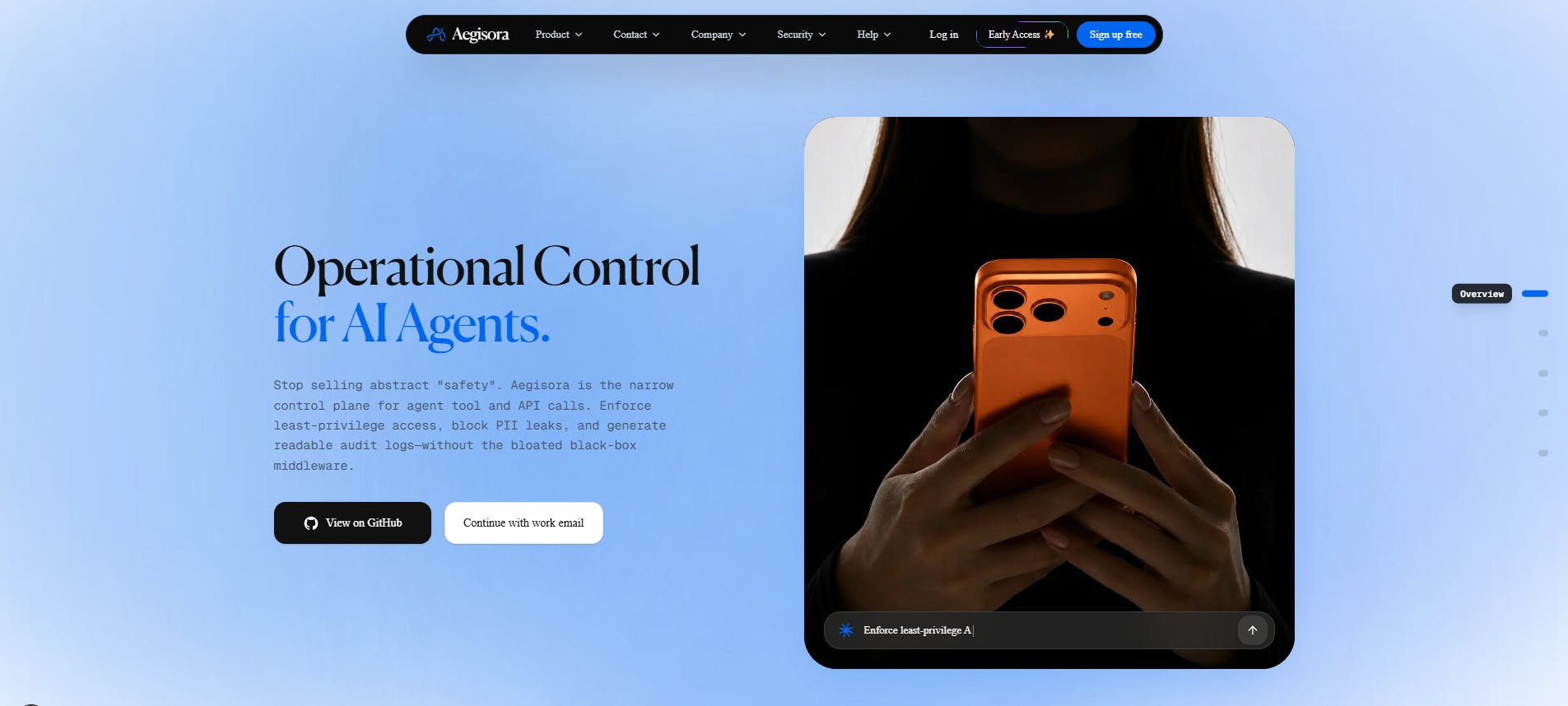
Its positioning is clear: a "narrow control plane" for AI agent tool and API calls.
Aegisora's Core Philosophy: From "AI Safety" to "Operational Control"
Aegisora's product philosophy contains a particularly insightful statement: "Stop selling abstract 'AI safety'—enterprises buy operational control."
This statement exposes a pain point in the current AI security landscape. Many products on the market use "AI Safety" as a selling point, but the concept remains abstract and difficult to implement. When enterprises try to buy in, they often can't figure out what specific problem is actually being solved. Aegisora takes the opposite approach, focusing on verifiable, enforceable operational-layer controls:
- Intercept malicious LLM behavior—inspect actions before the agent actually executes them
- Enforce least-privilege API access—following the least-privilege principle to limit the scope of resources an agent can touch
- Real-time PII redaction—dynamically masking sensitive information during data flow
- Generate readable audit logs—maintaining clear records of every action taken by autonomous agents
This shift from "abstract promises" to "concrete controls" essentially translates AI security problems into language that enterprise AppSec teams can understand and validate.
New Challenges for the Least Privilege Principle in the Agent Era
The Least Privilege Principle is a cornerstone concept in information security, stating that every subject in a system should be granted only the minimum permissions needed to accomplish its task. In traditional software, this is typically implemented through Role-Based Access Control (RBAC) or Attribute-Based Access Control (ABAC). But in AI agent scenarios, the challenge is significantly greater: agent tasks are often dynamic and context-dependent, making it difficult to predetermine the exact scope of permissions required. Many developers, for convenience, configure agents with overly broad API tokens or database permissions. Once agent behavior is hijacked, the attack surface expands dramatically. Aegisora's approach of enforcing least-privilege API access aims to dynamically constrain the agent's operational scope at runtime, moving permission control from static configuration to dynamic governance.
Zero-Latency Proxy Layer: Balancing Performance and Security
Aegisora describes itself as a zero-latency proxy layer. This technical positioning deserves attention.
Proxy layer architecture has a long history in cybersecurity, from traditional Web Application Firewalls (WAF) to API gateways—all embodying the proxy pattern. Its core advantage is being "non-invasive"—no modification of the protected application's source code is required; you simply insert an intermediary layer into the communication path to achieve interception, detection, and policy enforcement. In AI agent scenarios, the proxy layer sits between the tool call requests issued by the agent and the actual API endpoints, enabling permission verification, parameter checking, and sensitive information filtering before requests reach the target service.
A proxy layer naturally lends itself to interception, filtering, and auditing by mediating communication between agents and external tools/APIs. The "zero-latency" claim addresses engineers' most immediate concern—security components often come at the cost of performance. "Zero-latency" typically means the system employs efficient asynchronous processing, memory-level policy matching, or streaming architectures to keep security check overhead at sub-millisecond levels. For agent applications that frequently call tools, any significant latency increase would degrade user experience.
The project also emphasizes "without the bloated middleware," suggesting a lightweight architecture that's easy to integrate into existing tech stacks—rather than yet another heavy platform requiring large-scale infrastructure changes.
Open-Source Strategy and Target User Positioning
Aegisora adopts an open-source model, which is a compelling choice for security tools. Security products need trust above all else, and open source means auditable code and transparent logic. AppSec teams can independently verify whether the protection mechanisms actually work, rather than blindly trusting vendor claims.
In the security software domain, the open-source model offers unique trust-building advantages. Enterprises face a fundamental contradiction when procuring security products: they need to trust that the security tool itself won't introduce new risks. Closed-source security products require users to "blindly trust" the vendor, while open source provides verifiability—security teams can audit source code, verify cryptographic implementations, and confirm there are no backdoors or data exfiltration logic. Successful industry examples like HashiCorp Vault (secrets management), OWASP ZAP (security scanning), and Falco (runtime security) demonstrate that open-source security tools can continuously strengthen defenses through community collaboration while building a foundation of commercial trust.
Its target user group is also clearly defined—AppSec (Application Security) teams. This means Aegisora isn't a convenience tool for general developers, but rather aims to embed itself within enterprise security governance workflows. Classification-wise, it spans Developer Tools, Artificial Intelligence, and Security—sitting at the intersection of all three.
Core Security Threats Aegisora Addresses
The security threats facing AI agents today are far from hypothetical:
- Prompt injection attacks can trick agents into executing unauthorized operations
- Over-permissioning gives agents far more API access than their tasks require
- Data leakage risks are amplified as agents process and forward information
- Lack of auditability makes post-incident accountability and compliance difficult
Among these, prompt injection is one of the most threatening attack vectors in AI security. Its core mechanism works as follows: attackers embed malicious instructions in data that agents will process (such as web content, email bodies, or document attachments). Since LLMs cannot reliably distinguish between "system instructions" and "user data," they may treat malicious content as legitimate commands and execute them. For example, an agent with email access, after reading an email containing hidden instructions, could be tricked into forwarding sensitive emails to an attacker. Indirect prompt injection attacks are particularly dangerous because attackers don't need direct access to the target system—they only need to poison data sources that the agent might access.
Regarding data leakage, real-time PII redaction faces unique technical challenges. In AI agent scenarios, the difficulty lies in "real-time processing" and "context awareness": agents may transmit sensitive data such as names, ID numbers, phone numbers, and addresses while interacting with multiple APIs, and the system needs to detect and replace this data at every node in the data flow. Common real-time redaction techniques include regex-based pattern matching, Named Entity Recognition (NER) models, and tokenization-based replacement mechanisms. The challenge lies in balancing precision and recall—neither missing genuine sensitive information nor over-redacting to the point of impairing agent functionality.
Aegisora's four core capabilities map directly to these attack surfaces. It brings the agent's "action capabilities" under controlled governance—a critical step in the transition from experimental demos to enterprise-grade production environments.
AI Agent Runtime Security: An Emerging Category Taking Shape
Based on the 82-vote count and #15 ranking on Product Hunt, Aegisora is still in its early stages, with community response being moderate rather than explosive. However, the direction it's pursuing—runtime security governance for AI agents—is clearly becoming a distinct emerging category.
As more enterprises experiment with deploying autonomous agents, "how to maintain control while granting agents the ability to act" will become an unavoidable core challenge. Traditional security boundaries are being redefined in the agent era, requiring new control planes to manage these "semi-autonomous digital employees." This trend follows the same evolutionary logic as cloud-native security's shift from perimeter defense to zero-trust architecture—when trust boundaries become blurred, verification and control must happen at the level of every individual access request.
Aegisora's value proposition hits the mark: it doesn't attempt to solve the vague philosophical question of "is AI safe," but instead provides a concrete, deployable, and transparent set of operational control mechanisms. For enterprise AppSec teams exploring agent deployment, tools like this will likely transition from "nice-to-have" to "infrastructure."
Conclusion: Verifiable Control Capabilities Are More Valuable Than Abstract Promises
Aegisora represents a pragmatic approach in the AI security space: rather than selling abstract promises, deliver verifiable control capabilities. As agent autonomy continues to increase, establishing defenses of least privilege, real-time redaction, and comprehensive auditing for every tool call and API access is gradually shifting from optional to mandatory.
Whether this open-source project can grow into standard equipment for AppSec teams remains to be validated by time and community adoption. But the question it raises—who constrains AI that can act autonomously?—is destined to be one of the most important topics in security engineering for years to come.
Related articles

Uber Deploys ChatGPT Work Company-Wide: AI in the Workplace Enters the Scaled Implementation Phase
Uber deploys ChatGPT Work to 30,000+ employees, extending it from engineering to all roles. We analyze its expert-engineer pairing, end-to-end automation, and questions of AI control and power concentration—insights for scaling AI in the workplace.

Shift at Midnight Hands-On: When "ID Verification" Becomes Alien Hunting
Shift at Midnight blends ID verification with horror survival in a four-player co-op game. We break down its inspection mechanics and chaotic humor.

Zelensky Recounts the Outbreak of War: I Need Ammunition, Not a Ride
Zelensky recalls the first day of war in a YouTube interview: farewell to family, rejecting Biden's evacuation offer with "I need ammunition, not a ride," and how Bucha shaped his stance on compromise and peace talks.