Aeropod: The No-Robot Soil Aeration Innovation Making Its Debut at TechCrunch

Muju Earth's Aeropod tackles soil compaction without robots — a simpler, cheaper path to better crop yields.
AgTech startup Muju Earth Technologies is debuting Aeropod at TechCrunch Disrupt — a soil aeration device that deliberately avoids robotic technology. Its "deceptively simple" mechanism aims to automate soil aeration at a lower cost and maintenance burden, making it more accessible to small and mid-sized farmers. Soil compaction is a persistent yield-limiting problem, and Aeropod promises to address it by improving root environments while cutting operational costs. Key technical details and quantified performance data have yet to be disclosed, but its "simple and reliable over complex and smart" product philosophy represents a noteworthy pragmatic direction in AgTech innovation.
A Deceptively Simple Agricultural Innovation That Hits a Real Pain Point
In the agtech (AgTech) space, innovation is typically synonymous with self-driving tractors, drone seeding, or AI-powered crop disease detection — solutions that are heavy on technological complexity. But Aeropod, developed by startup Muju Earth Technologies, offers a counterintuitive reminder to the industry: products that solve real problems don't always need to pile on sophisticated robotic systems.
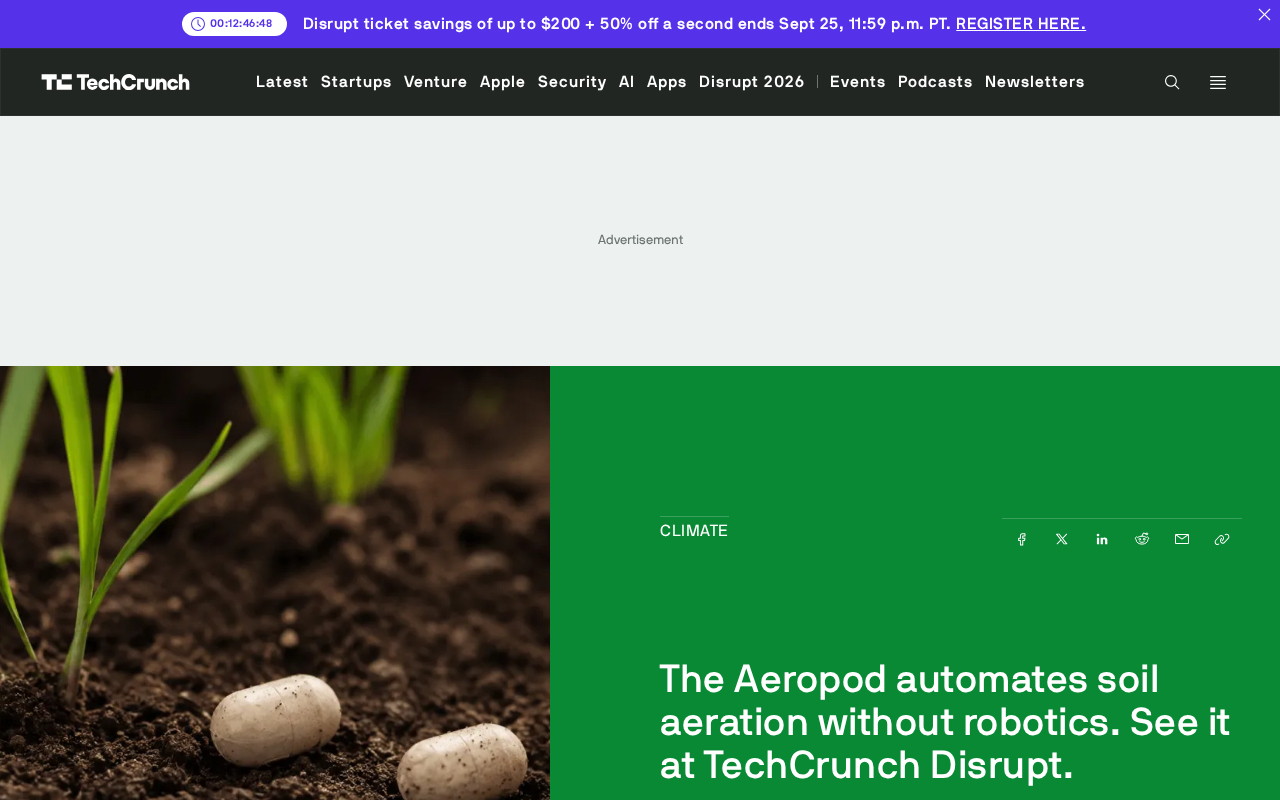
As reported by TechCrunch, Muju Earth Technologies has developed a "deceptively simple" soil aeration device called Aeropod, designed to help farmers reduce costs while boosting crop yields. The product is set to make its official debut at TechCrunch Disrupt.
Why Soil Aeration Deserves More Attention
Soil aeration is an often-overlooked yet critically important step in agricultural production. Compacted soil restricts a plant's root system from absorbing oxygen, water, and nutrients, directly impacting crop health and yield. Traditionally, improving soil aeration has relied on mechanical tillage or dedicated loosening equipment — approaches that consume energy, increase labor costs, and can damage soil structure when overdone.
This is precisely where Aeropod's value proposition lies. It seeks to deliver "automated" soil aeration while deliberately avoiding the robotic technology route. This suggests the device likely employs some passive or low-maintenance mechanical or physical mechanism, rather than a complex system driven by sensors, motors, and algorithms. For small and mid-sized farmers with limited budgets and technical support capabilities, this "less is more" philosophy tends to be far more practical to implement.
Soil compaction is a pervasive problem in global agriculture, particularly on fields that are frequently traveled by heavy farm machinery. Research shows that as soil porosity decreases due to compaction, gas exchange within the soil is impaired — reducing the efficiency of root aerobic respiration and disrupting key nutrient cycles such as nitrogen fixation and phosphorus uptake. USDA data indicates that severe soil compaction can reduce crop yields by 10–25%. While traditional core aeration techniques are well-established, they typically require specialized equipment and fixed operational windows, with soil improvement effects lasting only weeks to months after each treatment. Achieving low-cost, continuous maintenance of good soil structure has therefore long been a key challenge in precision agriculture research.
The Product Logic Behind "De-Robotization"
In today's technology landscape, nearly every agricultural innovation is gravitating toward automation and intelligence. Muju Earth is swimming against the current, emphasizing "automation without robots" — a product positioning that itself is worth unpacking.
Robotic solutions, while powerful, come with steep acquisition costs, complex maintenance requirements, and dependence on stable power and connectivity. In real-world field environments, these factors frequently become barriers to practical adoption. A device that requires no robots, is structurally simple, and has a low failure rate may actually deliver superior economics and reliability. This is exactly why TechCrunch described it as "deceptively simple" — the straightforward exterior often conceals a deep understanding of the actual use context.
The wave of robotization in AgTech has accelerated rapidly in recent years. Prominent examples include Blue River Technology (acquired by John Deere), which uses computer vision for precision spraying, and Monarch Tractor's electric autonomous tractor, with individual units often priced above $150,000. This price point effectively excludes the majority of small and mid-scale farmers — according to the U.S. Agricultural Census, approximately 89% of American farms report annual sales below $250,000, making the financial burden of high-end robotic farm equipment considerable. In developing-country agricultural markets, this barrier is even more pronounced. "De-robotization" is therefore not a technological step backward — it's a product strategy calibrated to real user segmentation: stripping core functionality out of complex systems to serve the mainstream farmer population, which high-end solutions have largely overlooked, at a lower total cost of ownership.
A Dual Promise: Lower Costs and Higher Yields
Aeropod's core appeal to farmers rests on two pillars: saving money and increasing output.
Cost savings come from reducing the energy consumption and labor associated with mechanical field operations, as well as lower equipment maintenance expenditures. Yield gains stem from the improved crop performance that a healthier root environment enables. Together, these create a clear return-on-investment logic: the upfront cost of the device can be gradually recovered through operational savings and yield improvements.
It's worth being candid about what we don't yet know. Publicly available information remains quite limited. The specific mechanism by which Aeropod achieves "automated" aeration, the crop types and soil conditions it's suited for, and any quantitative data on cost savings and yield increases have not been detailed by the company. These critical specifics will ultimately determine whether the product can genuinely establish itself in the market.
What Debuting at TechCrunch Disrupt Signals
Choosing TechCrunch Disrupt — one of the most prominent stages in the tech startup world — for its public debut suggests that Muju Earth Technologies is aiming to attract attention from investors, partners, and early adopters through industry exposure. For AgTech startups, Disrupt serves both as a proving ground for market interest and as a key entry point for accessing capital and distribution resources.
From a broader perspective, Aeropod represents an innovation direction in AgTech that deserves encouragement — not chasing the flashiest technology, but pursuing the solution that best fits farmers' actual needs to address a long-standing, fundamental problem. Whether it can deliver on its promise of lower costs and higher yields will ultimately be proven by real-world data after the product launches.
Closing Thoughts
Aeropod's story is still in its early chapters, and publicly available information is sparse. But the question it raises is genuinely thought-provoking: in an era when everyone is chasing complex intelligent systems, could a "simple" product actually be the more pragmatic answer to agricultural modernization? That question may be worth more to the industry than the product itself.
Related articles

iPhone Duo Battery Life Tested: One Charge a Day Is Unavoidable, and the Large Screen Is the Culprit
iPhone Duo battery test: heavy use needs at least one charge a day, and about 30% remains after 6.5 hours of screen-on time. How often the large screen is unfolded is key; a MagSafe battery pack helps, and long-term degradation is also worth watching.

Kimi K3.1 Pro Open-Sourced: 2.8 Trillion Parameters Close In on Opus
Moonshot releases the open-source MoE model Kimi K3.1 Pro, with 2.8T total parameters and 104B activated, trailing Opus 5.5 by under 1 point on Terminal Bench 4.0.

Costco Tech Price Guessing: Are Monitors, Keyboards, Mice, and Bose Speakers Worth It?
A YouTube blogger guesses prices of Costco tech products: 2K 180Hz monitor, Logitech keyboard and mouse, Bose speaker, and CyberPower UPS, revealing warehouse-store selection and brand premium.