After the RAG Pipeline Works: Permission, Traceability, and Data Consistency Challenges in Enterprise Retrieval-Augmented Generation

Getting RAG to run is easy; enterprise deployment is hard because of three engineering hurdles: permissions, traceability, and data consistency.
Starting from a Reddit discussion, the article points out that when RAG moves from demo to production, three types of problems immediately surface: users can only receive answers generated from documents they are authorized to view, so document-level, passage-level, and even field-level access control must intervene at the retrieval stage; enterprise compliance and auditing require every answer to be traceable, able to reconstruct cited documents, the reranking process, and the basis for judgment; and source data is scattered across mutually inconsistent systems like CRMs, data warehouses, and wikis—if conflicts aren't handled, answers become self-contradictory. The author emphasizes that none of these three points is a prompt problem or a pipeline problem, yet most RAG tutorials skip them—tutorials favor easy-to-demonstrate model-layer optimizations like "more accurate, better, more fluent," while the bulk of enterprise cost lies precisely in permission models, audit logs, and data governance. The article introduces Brian Bønk's advocacy of "building in security, traceability, and evaluation from day one" and offers three self-check questions for teams.
Many teams can build a RAG pipeline that retrieves, reranks, and answers. The truly hard part only surfaces after real users start pouring in.
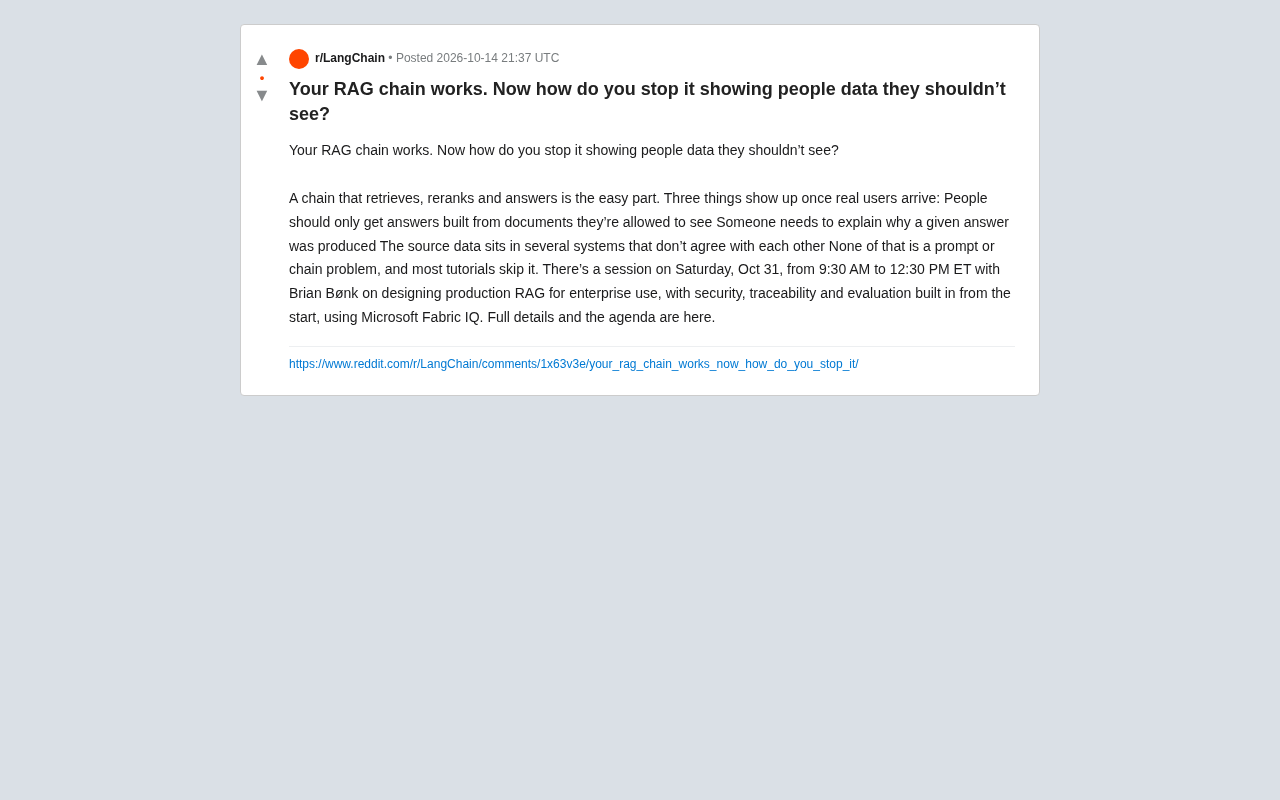
A discussion on Reddit hits this pain point directly: between the demo stage and the production stage of retrieval-augmented generation (RAG), there lie three hurdles most people aren't prepared to answer.
Three Hurdles: Permissions, Traceability, Data Consistency
The original post breaks the problem down clearly. Once real users start using the system, three things immediately surface:
First, users can only receive answers built from documents they are authorized to view. This is not something you can solve by tuning the top-k of retrieval results up or down. Access control at the document level, passage level, or even field level must intervene at the retrieval stage, not wait until after the answer is generated to filter.
Second, someone must be able to explain why a given answer was generated. In enterprise scenarios, compliance, auditing, and internal accountability all require traceability: which documents this answer cited, what reranking it went through, and what context the model based its judgment on.
Third, source data is scattered across multiple mutually inconsistent systems. The same piece of customer information may differ across the CRM, the data warehouse, and the internal wiki. If the RAG system doesn't handle such conflicts, the answers it outputs will be self-contradictory.
The difference between document-level, passage-level, and field-level access control (ACL) directly determines the complexity of the retrieval architecture. Document-level ACL is the easiest to implement—you just filter the candidate document set once before retrieval. Passage-level ACL requires the system to recognize sensitive differences between different segments within the same document, typically by tagging each chunk with permission labels during the chunking stage. Field-level ACL is the finest-grained, meaning even a single attribute in a structured record (such as salary or ID number) must have its visibility independently controlled. This is especially tricky in vector retrieval, because once a field is embedded into the same vector, it cannot be separated after retrieval. Production-grade RAG typically adopts "pre-filtering" rather than "post-filtering," because the latter lets unauthorized content enter the model context first—wasting tokens and posing a leakage risk. Even if the final answer isn't displayed, the model may be induced to leak information during intermediate steps.
Why This Is Not a Prompt or Pipeline Problem
The original post makes a crucial judgment: none of the above three points is a prompt problem, nor a chain problem, yet most RAG tutorials skip right over them.
This actually points to a structural gap in the current RAG content ecosystem. Tutorials on the market are highly concentrated on "how to make retrieval more accurate," "how to make reranking better," and "how to make answers more fluent"—the model and pipeline layers—because these are easy to demonstrate with intuitive results. But the bulk of enterprise implementation cost lies precisely in the less "sexy" engineering areas: permission models, audit logs, and data governance.
In other words, the technical barrier to RAG is falling, but the engineering barrier to enterprise-grade RAG is not.
Building in Security, Traceability, and Evaluation from Day One
The original post mentions an online session led by Brian Bønk on designing production-grade RAG for enterprise scenarios, advocating that security, traceability, and evaluation be built in at the project's inception rather than patched on afterward, and mentions using Microsoft Fabric IQ as the implementation tool.
This "build in from day one" approach is worth expanding on. If permissions are patched on at a higher layer later, it often means going back to refactor the entire retrieval pipeline. If traceability isn't recorded synchronously at generation time, it's nearly impossible to reconstruct the context afterward. If evaluation metrics aren't defined in advance, you can only discover problems after launch through user complaints.
Front-loading these three things is essentially redefining RAG from "a pipeline that runs" into "a system that can be operated." This shift in perspective determines whether a project can survive inside an enterprise far more than swapping in a stronger embedding model or reranker.
Microsoft Fabric IQ is an umbrella term for a set of intelligent capabilities within Microsoft's Fabric data platform system. Its positioning is to connect data assets on OneLake with enterprise-grade AI applications (including RAG, Copilot, etc.), providing unified data governance, security policies, and semantic layer support. In RAG scenarios, its value lies not primarily in the "retrieval algorithm" itself, but in converging capabilities that were originally scattered across multiple systems—permission inheritance, data lineage, audit logs—into a single platform. The motivation for choosing such a platform tool is to avoid teams building the governance layer from scratch—self-developed solutions often expend enormous effort on permission models and source system synchronization, whereas a platform-based approach can reuse existing identity systems and data catalogs, shifting engineering focus back to business logic.
What This Means for Teams Currently Working on RAG
If your RAG pipeline already runs, the next step is worth asking yourself three questions first: Does retrieval carry the user's identity and permission context? Can every answer be traced back to a complete citation chain? When multiple data sources conflict, how does the system adjudicate?
The answers to these three questions essentially determine whether a RAG project remains an internal demo or can truly be delivered to the people who need it.
One-line Summary
Getting RAG to run is easy; enterprise deployment is hard because of three engineering hurdles: permissions, traceability, and data consistency.
Paragraph Summary
Starting from a Reddit discussion, the article points out that when RAG moves from demo to production, three types of problems immediately surface: users can only receive answers generated from documents they are authorized to view, so document-level, passage-level, and even field-level access control must intervene at the retrieval stage; enterprise compliance and auditing require every answer to be traceable, able to reconstruct cited documents, the reranking process, and the basis for judgment; and source data is scattered across mutually inconsistent systems like CRMs, data warehouses, and wikis—if conflicts aren't handled, answers become self-contradictory. The author emphasizes that none of these three points is a prompt problem or a pipeline problem, yet most RAG tutorials skip them—tutorials favor easy-to-demonstrate model-layer optimizations like "more accurate, better, more fluent," while the bulk of enterprise cost lies precisely in permission models, audit logs, and data governance. The article introduces Brian Bønk's advocacy of "building in security, traceability, and evaluation from day one" and offers three self-check questions for teams.
Related articles

Gemini 4 Argon Hands-On: AI Builds Board Games, Constructs Temples, and Trains Robots Autonomously
Gemini 4 Argon hands-on roundup: AI autonomously builds a desk racetrack and temple in Blender, writes a ray tracing engine, trains a humanoid robot to sink 7 shots, plus API pricing and developer access.

The Magic Octagonal Coin: Why Only 9% of People Can Predict Its Flip?
Only 9% of people can correctly predict the Magic Octagon coin flip. This article explains its spatial rotation mechanism, common cognitive pitfalls, and a new hypothesis based on Relevance Theory, exploring the limits of human spatial reasoning.

Sam Altman: AI Is Entering the Era of Scientific Discovery — Math Breakthroughs Will Replicate in Biology and Energy
Sam Altman says AI is entering the era of scientific discovery — math breakthroughs will replicate in biology, materials science, and energy to help develop new drugs and energy sources.