Afterparty: Turning Meeting Notes into Action with AI Agents That Execute Your To-Dos

Afterparty uses AI agents to auto-draft meeting to-dos into emails, invites, and CRM records—sent only after approval.
Afterparty is an AI meeting execution tool that debuted on Product Hunt, turning meeting to-dos from lists into actual actions. After users paste a transcript or connect a note-taking tool, its AI agents draft emails, invites, and customer records in email, calendar, messaging, and CRM—but all content requires user approval before being sent. This approval gate balances automation efficiency with communication risk. Its differentiation lies in execution depth, filling the gap between meeting recording and task management tools, though it demands complex multi-app integration. Integration scope, ambiguous to-do handling, and data permissions remain undisclosed, with the product still in early stage.
After a meeting wraps up, the real hassle usually isn't the note-taking—it's converting each captured to-do into emails, invitations, and CRM updates. Afterparty, newly launched on Product Hunt, is trying to automate this chore with AI agents.
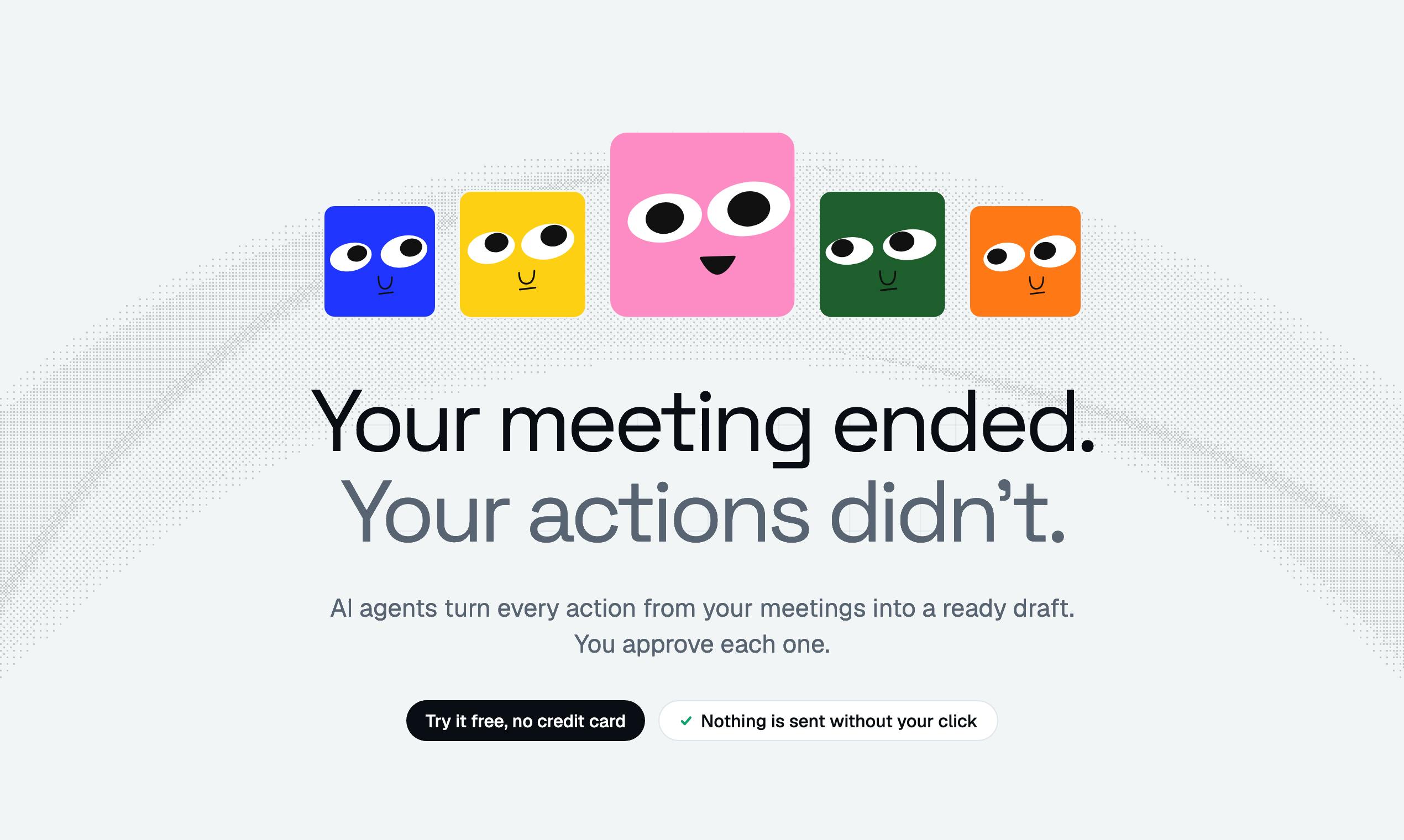
The Second Half of Meeting Notes: From "Writing It Down" to "Getting It Done"
Most AI meeting tools on the market solve the "recording" problem: converting speech to text and summarizing it into a list of action items. What users end up with is still a checklist they have to tackle themselves.
Afterparty's approach is to push that list further down the pipeline. Its official description is blunt: "Note takers give you a list. Afterparty does the list." Users simply paste a meeting transcript or connect their existing note-taking tool, and Afterparty's AI agents draft every email, message, calendar invite, and CRM record in the corresponding application.
This positioning targets a neglected gap. Meeting action items often span multiple tools—Outlook or Gmail for emails, Slack for messages, calendars for invites, Salesforce or HubSpot for customer records. The back-and-forth switching between these tools is where time truly gets consumed.
How It Works
Afterparty's workflow can be broken down into three steps:
Ingest meeting content. Users can paste a meeting transcript or connect their existing note-taking tool. The product emphasizes "context from your tools," meaning the agent references context from the user's own tools when drafting content, rather than generating from scratch.
Agents draft deliverables. This is the core step. AI agents generate corresponding outputs for each to-do item and create drafts in the right application—emails go to the email draft folder, invites go to the calendar, customer follow-ups go to the CRM.
Human review before sending. Afterparty explicitly sets a gate: "Nothing goes out until you approve it." All agent-generated content exists as drafts, only being sent or written after user confirmation.
This approval gate is a key design trade-off. Full automation sounds cooler, but meeting communications involve clients, colleagues, and external partners—if AI writes to the wrong person or gets the content wrong, the cost far exceeds manual verification. Leaving the final decision to humans is a more pragmatic approach for AI agents entering enterprise scenarios today.
AI Agent is the key to understanding Afterparty's positioning. Unlike traditional AI assistants—which typically respond to a single user instruction and generate a piece of text—AI agents possess goal-oriented autonomous execution capabilities: they can plan steps across multiple applications, invoke tools, create objects, and adjust behavior based on context. For example, faced with the to-do "send a follow-up email to the client," the agent must determine who the recipient is, which email account to use, which meeting's content to reference, and then generate a draft in the email system. Afterparty's use of the plural "agents" suggests it likely employs a multi-agent architecture: different agents handle different applications such as email, calendar, messaging, and CRM, with a scheduling layer dispatching tasks based on to-do type. This architecture handles cross-system complex operations better than a single model, but also demands higher standards for permission management and state synchronization.
How It Differs from Similar Tools
Placing Afterparty in the AI meeting tools space, its differentiation lies not in recording quality but in execution depth.
One common category is meeting recording and summarization tools, whose output is documents; another is task management tools, whose output is to-do lists. Afterparty aims to occupy the white space between the two: converting to-dos directly into sendable communications and writable system records.
This positioning also brings more complex engineering requirements. It needs to integrate with users' email, calendar, messaging, and CRM systems, and understand which application each to-do should land in, who should send it, and which customer it relates to. The mention of "agents" (plural) in the product description hints that behind the scenes there may be a set of agents tailored to different applications and task types, rather than a single model doing everything.
CRM (Customer Relationship Management) is a core tool for enterprise sales and customer success teams, with common products including Salesforce, HubSpot, Pipedrive, and others. It records customer information, communication history, deal stages, and follow-up tasks, serving as the source of truth for the sales process. After a meeting, salespeople typically need to manually enter communication highlights, next steps, and commitments into the CRM—a step that teams most easily overlook and most easily get wrong. Missing or delayed records directly impact follow-up. Afterparty's claim to automatically create records in the CRM essentially automates the "meeting → customer profile" pipeline. The challenge: CRM data structures are complex—a single record may involve multiple objects such as accounts, contacts, opportunities, and activities. AI agents must correctly identify fields and relationships, or the data written could contaminate the system instead.
Several Questions Worth Watching
Product Hunt data shows Afterparty received 73 votes, ranking 13th for the day, with 4 comments, from maker Isak Tapper. The vote count isn't particularly impressive, indicating it's still in an early exposure phase.
Several questions currently lack answers in publicly available information:
Which note-taking tools and CRM systems are supported? The product mentions "connect your note taker" and "the right app," but doesn't list specific integrations. Integration breadth directly determines its practical value for different teams.
How do agents handle ambiguous to-dos? Meetings often contain action items like "follow up later" with no clear recipient or deadline. AI needs to decide whether to ask, skip, or generate a placeholder draft.
How are permissions and data security handled? When agents need access to email, calendar, and CRM, enterprise customers will care about data flows and access controls.
Permissions and data security are core thresholds for enterprise AI agent adoption. When Afterparty needs to read email, calendar, and CRM, it effectively gains broad access to users' work data. Enterprise customers typically focus on several levels: whether data will be used for model training, how access tokens are stored and revoked, whether agent operations leave audit logs, and compliance with SOC 2 or GDPR. Additionally, the principle of least privilege requires agents to receive only the permissions needed for specific tasks, not full account access. These issues are often downplayed in consumer products, but in enterprise scenarios targeting sales and customer success teams, they often directly determine purchasing decisions. Afterparty has not yet disclosed these details—a hurdle it must clear to move from early exposure to enterprise adoption.
Who Should Use It
Based on its positioning, Afterparty is more suited to roles like sales, customer success, project management, and consulting—positions with frequent meetings where outputs need to translate into external communications. To-dos from these roles' meetings typically correspond to specific emails, invites, and customer records, which are exactly what Afterparty claims to draft automatically.
For users who only need meeting summaries and don't require cross-tool execution, existing recording tools may already suffice. Afterparty's value depends on how many of your meeting outputs actually need to be "sent out" or "written into systems."
AI agents are moving from "helping you write" to "helping you do." Afterparty is a concrete example on this path: it sets the automation boundary before approval, leaving the final strike to humans. This sense of proportion may be more noteworthy than how many steps it automates.
One-line Summary
Afterparty uses AI agents to automatically draft meeting to-dos into emails, invites, and CRM records—sent only after approval.
Paragraph Summary
Afterparty is an AI meeting execution tool that debuted on Product Hunt, positioned to turn meeting to-dos from lists into actual actions. After users paste a meeting transcript or connect a note-taking tool, its AI agents draft corresponding emails, invites, and customer records across email, calendar, messaging, and CRM applications—but all content requires user approval before being sent. This "nothing goes out until you approve it" gate is its key design trade-off, balancing automation efficiency with communication risk. Its differentiation lies not in recording quality but in execution depth, occupying the white space between meeting recording tools and task management tools—though it requires more complex multi-application integrations. Currently, key information about integration scope, ambiguous to-do handling, and data permissions has not been disclosed, and the product remains in its early stage.
Related articles

Gemini 4 Argon Hands-On: AI Builds Board Games, Constructs Temples, and Trains Robots Autonomously
Gemini 4 Argon hands-on roundup: AI autonomously builds a desk racetrack and temple in Blender, writes a ray tracing engine, trains a humanoid robot to sink 7 shots, plus API pricing and developer access.

The Magic Octagonal Coin: Why Only 9% of People Can Predict Its Flip?
Only 9% of people can correctly predict the Magic Octagon coin flip. This article explains its spatial rotation mechanism, common cognitive pitfalls, and a new hypothesis based on Relevance Theory, exploring the limits of human spatial reasoning.

Sam Altman: AI Is Entering the Era of Scientific Discovery — Math Breakthroughs Will Replicate in Biology and Energy
Sam Altman says AI is entering the era of scientific discovery — math breakthroughs will replicate in biology, materials science, and energy to help develop new drugs and energy sources.