Agenda Hero Magic Labs: Redefining Schedules with AI, the End of Static PDFs
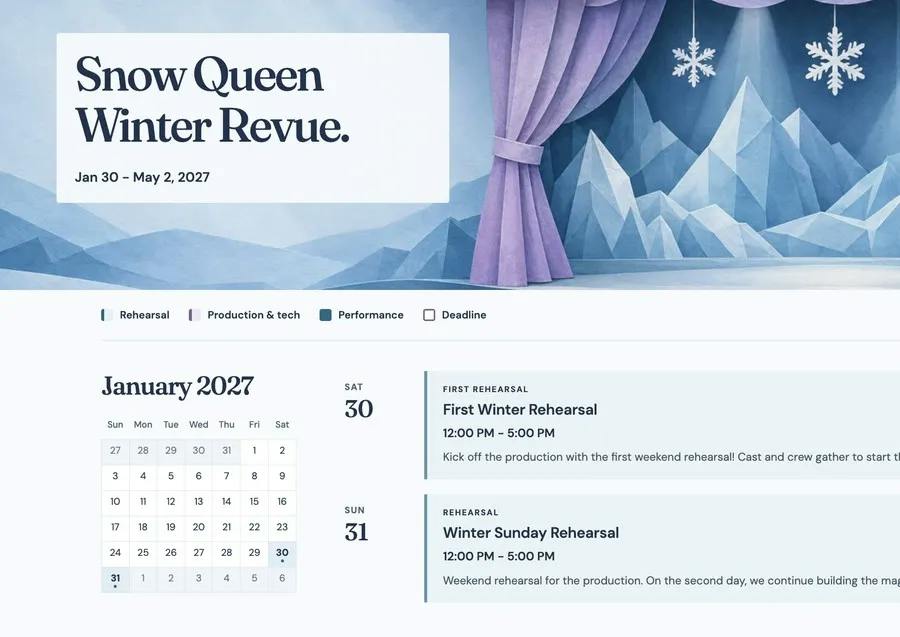
Agenda Hero Magic Labs replaces static PDFs with real-time, data-driven dynamic schedules featuring auto-adapting design and calendar sync.
Agenda Hero Magic Labs ranked #10 on Product Hunt's daily leaderboard, aiming to replace static PDFs with real-time, data-driven dynamic schedules. Its core mechanism separates structured schedule data from automated design rendering: the underlying data remains editable and subscribable, while the top-layer design adapts automatically as data changes and subscribers' calendars sync updates. The product is categorized under design tools, calendar, and AI, suggesting AI may power smart layout and style recommendations. Typical scenarios include team outings and sports seasons, solving version-staleness friction in multi-person collaboration. Currently named "Magic Labs," it is positioned as an experimental feature in early validation.
From Static PDFs to Dynamic Data: A New Species of Schedule
Agenda Hero Magic Labs, which hit #10 on Product Hunt's daily leaderboard with 114 votes, is taking on a seemingly minor yet ubiquitous pain point: static PDF schedules. Whether it's a team outing itinerary or a full football season fixture list, people are used to sharing plans via PDF or images—but this approach is essentially a "dead" document. Once a time or location changes, every distributed copy instantly becomes outdated.
Agenda Hero Magic Labs' answer is to replace PDFs with "a new kind of artifact built for dates and times." No longer a static screenshot, it's a visual schedule driven by real-time data. When plans change, not only does the design adapt automatically, but any calendar subscribed to the schedule syncs the update as well. This sounds like a natural evolution of calendar tools, but underneath lies the logic of separating the data layer from the presentation layer.
Data-Driven Design: No More "Expired" Schedules
The core mechanism of Agenda Hero Magic Labs can be broken down into two layers. At the bottom is structured schedule data, which records events, times, locations, and other fields while remaining editable and subscribable. On top is automated design rendering, where the system generates visually pleasing layouts and styles from the data in real time. The official description emphasizes "Any schedule. Any layout. Any style."—meaning that from team events to sports seasons, users can fit any type of schedule into any design template without manually adjusting the layout.
The immediate benefit of this separation: when data updates, the design follows automatically, and subscribers' calendars stay current. This solves a long-standing collaboration friction—in the past, event organizers had to re-export PDFs and resend emails after every change, while recipients had to manually compare old and new versions. Now, a change becomes a single data write, and all downstream consumers sync automatically.
Structured schedule data typically follows common standards such as iCalendar (.ics), breaking events into fields like start time, end time, location, and recurrence rules, stored as plain text. This format is widely supported by mainstream calendar services like Google Calendar and Outlook, giving it native subscribability and sync capabilities. When the underlying data is exposed in a standard format, any compatible calendar client can automatically pull updates via a subscription link without user intervention. This is precisely the technical foundation for Agenda Hero Magic Labs' "change once, sync everywhere"—the design layer can render freely, while the data layer remains a machine-readable single source of truth.
Separation of presentation and data layers is a common pattern in software architecture, typified by MVC (Model-View-Controller) frameworks. In this product, the "model" is the schedule data and the "view" is the visual layout. After separation, the same data can be rendered as a webpage, an image, or different styles embedded in a calendar, while data updates require changes in only one place. This decoupling also brings scalability: adding a new schedule type or design template requires no changes to data logic; conversely, when data fields are added, the rendering engine can adapt automatically, avoiding the chain cost of "change one thing, re-layout everything" in traditional PDF workflows.
The Intersection of AI and Calendars: The Possibilities of Smart Layout
Product Hunt lists the product under three categories—"Design Tools, Calendar, Artificial Intelligence"—suggesting that AI's role may go beyond simple template filling. Although the official description doesn't detail the AI implementation, the product positioning suggests that AI may be used to automatically generate layout schemes matching schedule content, optimize information hierarchy, or recommend styles based on event type.
One detail worth noting: Agenda Hero Magic Labs is not an isolated new product but a "labs" feature within the Agenda Hero ecosystem. This means it may carry the team's exploration of the future form of calendar products—shifting from merely "recording time" to "expressing time." Once a schedule has design sensibility and real-time capability, it ceases to be just a tool and becomes a vehicle for organizers to project a professional image.
Smart Layout refers to a system automatically deciding the position, size, and hierarchy of elements based on content, rather than relying on manual dragging. In the schedule scenario, AI can analyze event count, time span, and text length to recommend the most suitable grid or timeline style, and automatically adjust fonts and whitespace. Such technology typically combines rule engines with machine learning—for example, using constraint satisfaction algorithms to prevent information overlap, and generative models to explore diverse visual schemes. For users, this means producing professional-grade schedules without a design background, lowering the design barrier.
Practical Value in Collaboration Scenarios
Judging from the use cases listed on the product page, team outings and football seasons are typical representatives. What these scenarios share is multiple participants, varying time spans, and frequent changes. Traditional PDF schedules often devolve into "one-time references" in team settings, because no one can guarantee everyone holds the latest version. Agenda Hero Magic Labs' subscription mechanism lets every participant get updates through their own calendar, and organizers no longer need to repeatedly broadcast notifications.
For periodic activities like sports seasons, a real-time data-driven schedule can also naturally accommodate adjustments to match times or venue changes. The decoupling of design layer and data layer means that even if a fixture list expands from 8 teams to 16, the layout adapts automatically without a designer re-laying it out.
Market Positioning and Competitive Landscape
Under Product Hunt's categorization, Agenda Hero Magic Labs touches three tracks at once: design tools, calendars, and AI. This means it faces competition from multiple directions: general-purpose design tools like Canva offer schedule templates, while calendar products like Google Calendar and Notion Calendar occupy user habits. Agenda Hero Magic Labs' differentiation lies in combining design capability and calendar subscription capability into one, with "real-time data" as the connective thread.
However, the product's current name, "Magic Labs," indicates it may still be experimental. The official call to action, "Try it today in Agenda Hero Magic Labs," suggests this is a testing ground for early users. With 114 votes and 19 comments, engagement is above average for Product Hunt, indicating initial interest in the concept, but mass adoption remains to be seen.
Product Hunt's leaderboard rankings are based on user votes and engagement, and a top-10 daily ranking usually means the product received significant community attention on launch day. 114 votes is above average, reflecting proof-of-concept momentum, but still far from mass adoption. Meanwhile, the product's placement in three categories—"Design Tools, Calendar, Artificial Intelligence"—shows a positioning that spans multiple tracks: it must compete with design tools like Canva on template richness while vying with calendar products like Google Calendar for user habits, making differentiation challenging.
Conclusion: The Imaginative Space of Schedules as "Living Documents"
Agenda Hero Magic Labs proposes a simple yet powerful thesis: schedules shouldn't be static artifacts but living data. When design automatically follows data changes and subscribers always see the latest version, the information asymmetry in collaboration is greatly reduced. Whether this product can truly replace PDF calendars depends on whether it can make both "design sensibility" and "real-time capability" good enough—but judging from its product thinking, it at least offers a direction worth watching for calendar tool innovation.
One-line Summary
Agenda Hero Magic Labs replaces static PDFs with real-time, data-driven dynamic schedules, enabling automatic design adaptation and synchronized calendar updates.
Paragraph Summary
Agenda Hero Magic Labs ranked #10 on Product Hunt's daily leaderboard, aiming to replace static PDFs with real-time, data-driven dynamic schedules. Its core mechanism separates structured schedule data from automated design rendering: the underlying data remains editable and subscribable, while the top-layer design adapts automatically as data changes and subscribers' calendars sync updates. The product is categorized under design tools, calendar, and AI, suggesting AI may be used for smart layout and style recommendations. Typical scenarios include team outings and sports seasons, solving version-staleness friction in multi-person collaboration. Currently named "Magic Labs," it is positioned as an experimental feature in early validation.
Related articles

Nothing CMF Buds 2A Drops to $17.89 on Black Friday: A New Low for ANC Earbuds
Nothing CMF Buds 2A wireless earbuds Black Friday deal: just $17.89 on Amazon, about $11 off retail and a record low. ANC earbuds at an entry-level price.

When AI Creation Gets Accused of "Spitting": Hacker News Heats Up Over the Glaude Controversy
A Hacker News post, "Spitting in the Face of Glaude," sparks debate on AI creation transparency and attribution ethics. This analysis examines the blurred creator identity behind the controversy and offers practical advice for AI content production.

Akai Embraces Custom Firmware: MPC Sample 1.4 Lets Users AI-Program Their Sampler
Akai embraces the modding community with MPC Sample 1.4 firmware, supporting vibe-coded custom firmware and effects. We analyze the impact of this open strategy on music hardware and AI-assisted programming.