Agent Context Network (ACN): An Open-Source Solution for Secure Context Sharing Among AI Agents
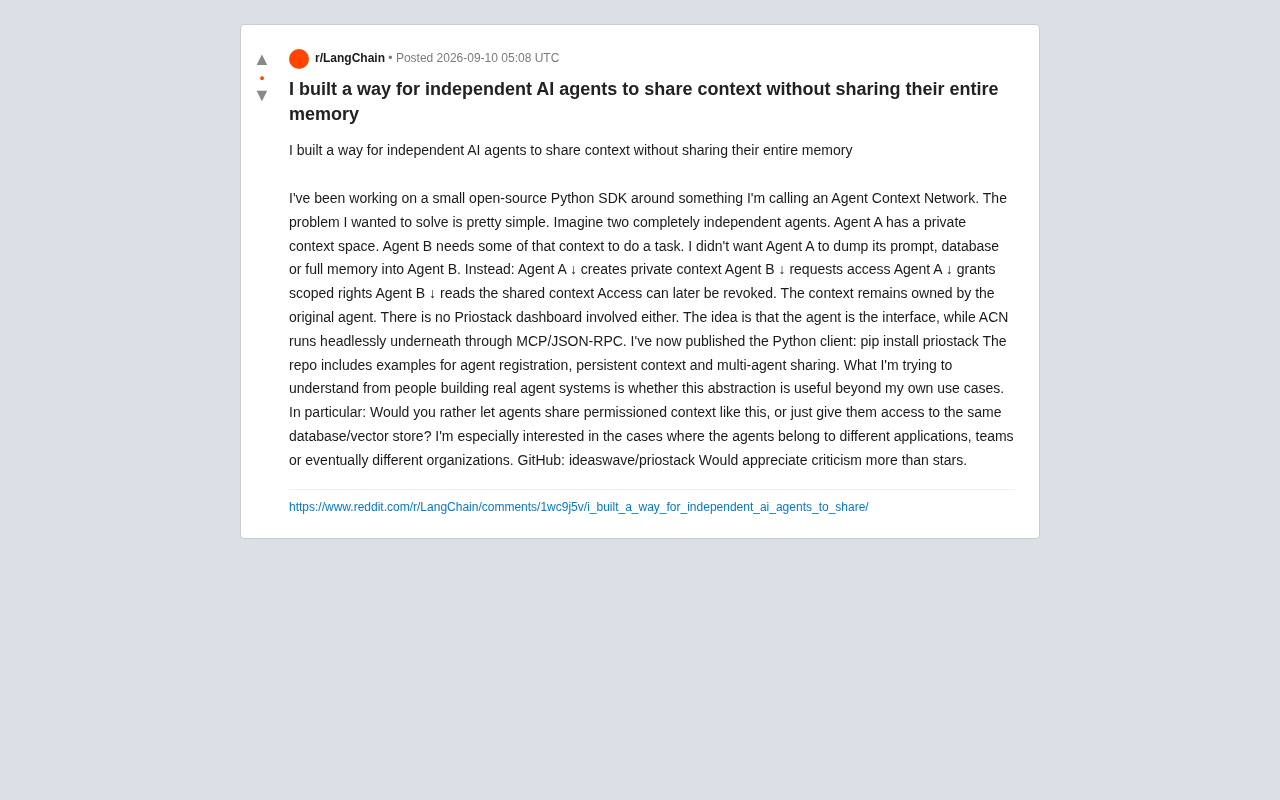
ACN is an open-source SDK enabling AI agents to securely share context with fine-grained permissions instead of full memory exposure.
Agent Context Network (ACN) is an open-source Python SDK that addresses a critical multi-agent collaboration challenge: how agents share context without exposing their entire memory. Built on the MCP protocol with a headless architecture, ACN implements OS-like permission management with revocable, scoped access rights. The article explores the core trade-off between shared storage simplicity and permission-based security, particularly for cross-organizational agent collaboration scenarios.
An Overlooked Challenge in Multi-Agent Collaboration
As AI agent systems evolve from monolithic designs to collaborative architectures, a fundamental question emerges: When two independent agents need to work together, how should they exchange information?
AI agents are fundamentally different from traditional chatbots—they are software systems capable of autonomously perceiving their environment, making decisions, and taking actions, with goal-driven behavior, tool invocation, and autonomous planning capabilities. Since 2024, as large language model capabilities have taken a leap forward, the industry has rapidly progressed from single-agent to multi-agent collaborative architectures. The emergence of frameworks like AutoGen, CrewAI, and LangGraph is a concrete manifestation of this trend. In these architectures, different agents each handle specific responsibilities (e.g., one for information retrieval, one for code generation, one for quality review), collaborating through division of labor to accomplish complex tasks that a single agent couldn't handle alone. However, multi-agent collaboration is far more complex than single-agent operation, and one of the most fundamental yet thorny problems is how context information flows securely and efficiently between agents.
The current mainstream approach is blunt—have all agents share the same database or vector store. But this method is fraught with risks in real production environments. Recently, a developer shared his open-source solution on Reddit, attempting to solve this problem at the architectural level. He built a Python SDK called Agent Context Network (ACN), with a single core objective: enabling agents to share context on demand without exposing their entire memory.
The author wrote at the end of his post: "I'd rather receive criticism than upvotes." This pragmatic attitude perfectly reflects the reality that multi-agent infrastructure is still in its early exploratory stage.
The Limitations of Traditional Sharing Approaches and ACN's Solution
Why Shared Databases Don't Work
Consider this scenario: Agent A has a private context space (which might include its prompts, conversation history, and database records). Agent B needs a small subset of this information to complete a task.
Following the "shared database" approach means:
- Agent A must fully expose its prompts, database, or complete memory to B
- Once any agent is compromised, the attack surface covers the entire shared storage
- Fine-grained permission control is impossible, let alone post-hoc revocation
It's worth understanding the role of vector stores in AI systems. Vector stores are database systems specifically designed for high-dimensional vector data, such as Pinecone, Weaviate, Chroma, and Milvus. In AI applications, unstructured data like text and images are converted into high-dimensional vectors (i.e., embeddings) by large language models, stored in vector databases, and then rapidly retrieved via semantic similarity—this is a core component of RAG (Retrieval-Augmented Generation) architecture. When multiple agents share the same vector store, it essentially means all agents' memories, conversation histories, and knowledge bases are mixed together in a single data pool—any agent could potentially retrieve another agent's private information, with no inherent isolation mechanism.
This might barely work within the same application or team, but once agents belong to different applications, different teams, or even different organizations, this kind of "naked sharing" becomes completely untenable.
How ACN Achieves Fine-Grained Context Sharing
The model proposed by the author introduces a mechanism similar to operating system permission management. The entire process can be broken down into four steps:
- Agent A creates a private context — Data ownership always remains with the originating agent
- Agent B initiates an access request — Actively requesting context within a specific scope
- Agent A grants scoped rights — Only opening up the necessary portions, not everything
- Agent B reads the shared context — Using data within the authorized scope
The key point is that this authorization is revocable. Context ownership never transfers, and A can revoke B's access at any time. This is fundamentally different from "copying data and tossing it over"—it's more akin to "lending" rather than "giving."
ACN Technical Architecture: Headless Design Based on the MCP Protocol
The author deliberately emphasized a design philosophy: no centralized dashboard.
In many existing solutions, multi-agent collaboration often relies on a visual console to manage permissions and data flows. ACN takes a completely different approach—the agents themselves are the interface, and ACN runs "headless" under the hood via MCP (Model Context Protocol) / JSON-RPC.
MCP (Model Context Protocol) is an open standard protocol released by Anthropic in late 2024, designed to provide a unified way to connect large language models with external data sources and tools. Its design philosophy is similar to a USB-C port—providing AI applications with a standardized "socket" so that context data from different sources can be accessed by models in a unified format. MCP uses a client-server architecture and communicates via JSON-RPC 2.0 message format. JSON-RPC is a lightweight remote procedure call protocol that encodes requests and responses in JSON format, inherently supporting cross-language and cross-platform interoperability. MCP has already attracted attention and support from OpenAI, Google DeepMind, and other organizations, and is becoming one of the most promising interoperability standards in the agent ecosystem.
This choice carries significant implications:
- MCP protocol is a recently spotlighted agent interoperability standard; choosing it means ACN is trying to integrate into the broader agent ecosystem rather than building from scratch
- Headless operation reduces system coupling, making context sharing a programmable underlying capability rather than a management action requiring human intervention
- Developers don't need to switch to an additional management interface—everything is completed within the agents' natural interaction flow
Headless architecture is a widely proven design philosophy in the software world, referring to systems that run without depending on a graphical user interface, interacting entirely through APIs or protocol interfaces—from headless CMS to Headless Chrome, its core value lies in completely decoupling functionality from presentation. Applying this philosophy to multi-agent infrastructure means that permission management, authorization flows, and other operations are all completed through programmatic interfaces, without requiring humans to open management panels for manual operation. In a collaborative network consisting of dozens or even hundreds of agents, it's impossible to require human approval for every information-sharing event. Headless design makes permission management an atomic operation that agents can automatically invoke, truly enabling machine-to-machine (M2M) autonomous collaboration.
The project has already released a Python client with a straightforward installation:
pip install priostack
The code repository (ideaswave/priostack) includes three types of examples: agent registration, persistent context, and multi-agent sharing, covering the complete path from getting started to actual collaboration.
The Core Trade-off: Permission Models vs. Shared Storage
The feedback the author most wants from developers actually building agent systems is:
Would you prefer agents to share context through this permission-based approach, or simply have them access the same database/vector store?
This question seems simple but touches on the core trade-off in multi-agent architecture.
The advantage of shared storage lies in its simplicity and low performance overhead—for internally trusted agent clusters, it's sufficient. The team has full control over all agents, and trust boundaries are clear.
The value of a permission model becomes apparent in cross-boundary scenarios. When agents belong to different applications, teams, or even organizations, you can't let external agents freely browse your complete memory. In such cases, fine-grained authorization, ownership retention, and permission revocation shift from "nice-to-have" to "must-have."
In other words, ACN is betting on a future trend: the agent economy will move toward cross-organizational collaboration. When agents from different companies need to temporarily collaborate on tasks, a standardized, secure context-sharing protocol will become essential infrastructure.
Limitations and Unverified Challenges of the ACN Approach
One important detail: the analysis in this article is based solely on the author's single-source share on Reddit, with no independent cross-verification of its actual effectiveness and performance. Readers should therefore maintain cautious optimism about this solution.
From an engineering perspective, ACN faces several challenges that remain to be validated:
- Performance overhead: Every cross-agent read must go through a request-authorization flow. Is the latency acceptable in high-frequency interaction scenarios?
- Root of trust: How do you prevent agents from spoofing identities to fraudulently obtain authorization? The identity authentication mechanism for cross-organizational scenarios remains unclear.
- Ecosystem adoption: Binding to the MCP protocol is a wise choice, but whether it will become a de facto standard remains to be seen.
Root of Trust is a core concept in information security, referring to the lowest-level, unquestionable starting point of trust in a security system. In traditional internet systems, this is typically handled by the Public Key Infrastructure (PKI) and Certificate Authorities (CAs). However, identity authentication faces entirely new challenges in the agent world: agents are not human users and cannot be authenticated through passwords or biometrics; agents can be dynamically created and destroyed, making identity persistence difficult to guarantee; in cross-organizational scenarios, there is no unified identity-issuing authority. This means a malicious agent could theoretically impersonate a legitimate agent to fraudulently obtain context access. Current industry explorations include W3C's Decentralized Identifiers (DID) standard, blockchain-based Verifiable Credentials (VC), and OAuth-style agent authorization flows, but no mature solution has been deployed yet.
Nevertheless, the question raised by this project is extremely valuable in itself. As agent systems grow increasingly complex, secure context sharing is destined to become an unavoidable infrastructure challenge. The author's choice to open-source the project and actively solicit criticism is exactly the healthy approach needed to drive this kind of infrastructure toward maturity.
For developers currently building multi-agent systems, even if you don't directly adopt priostack, simply thinking about the question "how much should your agents actually share" is immensely worthwhile.
Key Takeaways
Related articles

Edu-QuRating: How Multi-Dimensional Educational Data Curation Improves LLM Training Quality
Deep dive into the Edu-QuRating multi-dimensional educational data curation framework, achieving 0.917 accuracy via distilled pairwise judgments across six dimensions to improve LLM pre-training and GRPO post-training.

The AI Filmmaking Cost Revolution: A $2 Million Production Completed for $90
A creator spent just $90 on AI tools to independently produce a short film that would traditionally cost $2 million. Explore how AI is revolutionizing filmmaking from visuals to voice to music.

Vercel AI SDK xAI Integration Adds Batch Management Features
Vercel AI SDK xAI provider releases v4.0.57 with batch cancellation and listing features, improving cost management and task observability for Grok model apps.