Agent Development Engineer: The Most In-Demand Engineering Role in the AI Era — A Four-Step Guide to Breaking In

Agent Development Engineer is a pure engineering role with high pay driven by supply-demand mismatch — four steps to break in.
The article introduces the Agent Development Engineer, a new role that ByteDance, Meituan, Alibaba, Tencent, and other big tech companies are desperately hiring for. It's a pure engineering role with no deep learning or algorithm background required; the core work is turning large model capabilities into reliably running enterprise product features, with key skills being business process decomposition, tool integration, and exception handling. Due to the lack of matching university majors and the extreme scarcity of versatile talent who understand both business and AI, the supply-demand mismatch creates a clear salary premium — junior roles with one to two years of experience can reach two to three times previous pay. The article lays out a four-step entry path: prompt engineering, RAG knowledge base building, Agent workflows, and real-scenario practice to build a portfolio, emphasizing "learning by doing" and deliverable work.
A New Role That Big Tech Is Desperately Hiring For
A newly emerging role has recently surfaced that lets people with a hardware background earn a monthly salary of 35,000 RMB — without worrying about being replaced by AI. This is the Agent Development Engineer. ByteDance, Meituan, Alibaba, and Tencent are all hiring aggressively. Junior roles with one to two years of experience can command two to three times their previous salary, and senior roles have no upper limit. It's equally friendly to career changers and candidates from non-elite universities — no major requirements.
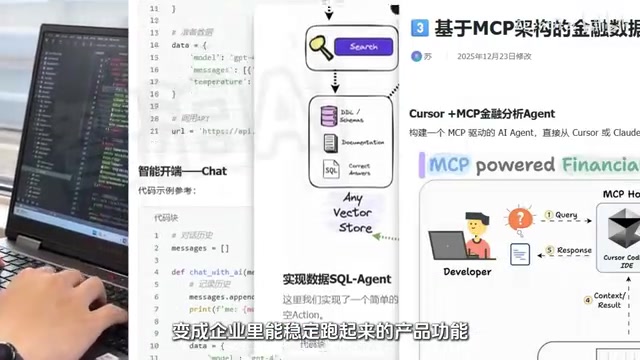
This isn't a joke — it's a new profession being created in the AI era. What an Agent Development Engineer does can be summed up in one sentence: turn large model capabilities into product features that can run reliably in an enterprise. It's not an algorithm role — no Transformer or Attention questions, no need for deep learning expertise or published papers. It's a pure engineering role. What matters is whether you can break down business processes, integrate tools, and handle things when they go wrong.
What Does Agent Development Actually Do?
In plain terms: a user asks a question, and the system you built can figure out on its own what to insert, what to call, which flow to follow, and ultimately deliver a reliable answer — without a human directing it step by step. Many people's first reaction is that it sounds like "calling APIs, AI edition," but a look at the job market tells you this is one of the hardest roles for companies to fill right now.

Algorithm folks don't understand business, business folks don't understand AI, and there are very few people in the market who can bridge both sides. What makes Agent development valuable is that it addresses what bosses actually care about: every enterprise wants to integrate AI into business workflows to cut costs and boost efficiency, but nobody can make it happen. Leadership cares about whether processes can be standardized, whether AI can genuinely replace human work, and whether things will blow up after launch.
Getting Started as an Ordinary Person: The Core Is Three Words — "Learn by Doing"
You don't need to start by grinding through low-level algorithms. Just follow four steps.

Step 1: Learn Prompt Engineering
First, understand how to make large models output what you want reliably and obediently. Once you've mastered this step, you can build your first working thing: automatic meeting minutes, automatic daily report generation, automatic sales pitch scripts. You go from "using AI" to "commanding AI."
Prompt Engineering refers to the technical practice of designing, organizing, and optimizing text instructions fed to large models so that outputs become more stable, controllable, and aligned with expectations. Core techniques include defining role settings, breaking down task steps, specifying output format constraints, providing few-shot examples, and limiting answer boundaries. For Agent development, prompt engineering isn't about "writing one good sentence" — it's about building reusable instruction templates that keep model behavior consistent across business scenarios. It's the foundational skill for subsequent RAG and workflow orchestration, because whether it's retrieval augmentation or multi-step processes, context and task requirements ultimately need to be passed to the model through prompts. Only by mastering this layer can developers shift from "using AI by luck" to "commanding AI through engineering."
Step 2: Learn to Build RAG Knowledge Bases
Learn to feed the enterprise's own materials to AI so its answers are grounded in evidence. Once you've mastered this step, you can build a private knowledge base for your team — this is the most commonly deployed and most impressive capability enterprises need.
RAG (Retrieval-Augmented Generation) is an architecture that combines external knowledge retrieval with large model generation. The basic flow: first split enterprise documents into chunks and convert them into vectors stored in a vector database; when a user asks a question, retrieve the most relevant chunks first, then pass them as context to the large model to generate an answer. RAG's value lies in making model answers "grounded in evidence," reducing hallucinations, and enabling updates to enterprise private knowledge without retraining the model. Building a RAG knowledge base involves engineering steps such as document parsing, text chunking, embedding model selection, vector retrieval, and reranking — it's one of the most common capabilities in Agent development and one of the easiest to deliver value with to enterprises.
Step 3: Learn Agent Workflows
Learn to chain multiple AIs into an automated pipeline, so a task goes from input to output fully automatically. Once you've mastered this step, you'll have the Agent engineer's most core delivery capability: turning a vague business requirement into a stable, automated workflow.

Agent Workflow refers to orchestrating large models, tool calls, conditional logic, and multi-step tasks into an automatically running pipeline. Unlike single-turn Q&A, an Agent in a workflow needs to decide — based on current state — which tool to call next, whether retrieval is needed, whether to loop and retry, until the goal is achieved. Common implementation approaches include Function Calling, task planning and decomposition, and state machine or graph-based orchestration. The engineering challenge isn't getting the flow to "run once" — it's handling edge cases like timeouts, tool errors, and malformed model output, ensuring the flow is stable and observable. This is precisely the Agent Development Engineer's core delivery capability, and the reason enterprises are willing to pay a premium.
Step 4: Practice with Real Scenarios
Don't wait for someone to hold your hand. Pick a workflow around you and redo it with AI. As long as it actually runs, it's not a toy — it's your Agent engineer portfolio and your strongest leverage in interviews.
Why Is This Role Worth Betting On?
The scarcity of Agent Development Engineers comes from a supply-demand mismatch: enterprises don't need people who can train models — they need people who can engineer and productize model capabilities. Such people must understand business logic, be able to build systems hands-on, and handle all kinds of exceptions after launch. Universities don't yet have matching majors, and the existing talent pool in the market is tiny, so the salary premium is obvious.
For career changers, the advantage of this path is that the barrier is on the engineering side, not the academic side. You don't need a math PhD background — you need problem-decomposition skills and a habit of hands-on building. The four-step learning path corresponds to four deliverable capabilities, each producing something visible. Accumulated over time, that becomes a persuasive portfolio.
Content compiled from the Bilibili AI Agent Development tutorial series. The original course has 748 episodes, covering a complete path from beginner to enterprise-level practice.
Supply-demand mismatch here specifically means: university talent development systems still focus on algorithm and model research, while enterprises deploying AI need engineering and productization capabilities — there's a clear time lag between the two. As large model capabilities converge, the competitive focus shifts to "who can integrate models into business systems and keep them running reliably," making versatile talent who understand business processes and can build systems extremely scarce. Meanwhile, Agent development involves multiple engineering steps — prompting, retrieval, tool calling, exception handling — and experience is hard to accumulate quickly, so the existing talent pool is naturally limited. The salary premium is essentially the market pricing this scarce engineering capability, not short-term hype.
One-line Summary
Agent Development Engineer is a pure engineering role with high pay driven by supply-demand mismatch — ordinary people can break in with four steps.
Paragraph Summary
The article introduces a new role that ByteDance, Meituan, Alibaba, Tencent, and other big tech companies are desperately hiring for — the Agent Development Engineer. It's essentially a pure engineering role requiring no deep learning or algorithm background; the core work is turning large model capabilities into reliably running enterprise product features, with the key skills being business process decomposition, tool integration, and exception handling. Because universities have no matching major and versatile talent who understand both business and AI is extremely scarce, the supply-demand mismatch creates a clear salary premium — junior roles with one to two years of experience can reach two to three times previous pay. The article lays out a four-step entry path: prompt engineering, RAG knowledge base building, Agent workflows, and real-scenario practice to build a portfolio, emphasizing "learning by doing" and deliverable work.
Related articles

Will GitHub Die? Open Source Maintainer Burnout and the Collaboration Crisis in the AI Era
Lex Fridman podcast discussion on open source maintainer burnout and GitHub's predicament: massive pull requests overwhelm core maintainers, and AI worsens code bloat. Using math journal peer review and Poincaré conjecture verification as analogies, the article analyzes why verification in knowledge production must be deliberately slow, and how open source communities can avoid the failure mode of maintainers exiting.

Stop Building Cookie-Cutter AI Websites: 3 Tools That Transform Your Coding Agent
Three tools that boost AI coding agents: FFmpeg skill for local video editing in Claude Code and Cursor, Hallmark's 50 design themes to fix cookie-cutter AI sites, and Jailbreaks' 25+ model prompts.

How America's Gerontocracy Squeezes the Younger Generation
Americans over 55 hold nearly three-quarters of national wealth, alongside an 80-year-old president and elderly congressional leaders. The Atlantic's Idrees Kahloon explains how gerontocracy drives up housing costs, squeezes opportunities for the young, and explores zoning reform and child poverty reduction as practical fixes.