Agent Infinite Loop Engineering Guide: Detection, Breaking, and Root Cause Analysis

A practical engineering guide to detecting, breaking, and diagnosing infinite loops in LLM Agent systems.
Agent infinite loops are a common failure mode that exhaust tokens without producing results. This guide systematically covers three loop patterns, trajectory-based detection with hash deduplication, active strategy switching (including dynamic temperature adjustment), root cause analysis focusing on context grounding and termination conditions, and multi-layer fallback mechanisms including Checkpoints and human takeover.
Article Content
In AI engineering interviews at top tech companies, one question comes up repeatedly: When an Agent frequently falls into infinite loops, how do you diagnose, detect, and resolve it at the engineering level?
Many candidates immediately blurt out: "Set a max steps limit." Not only does this answer fall flat, it invites a chain of follow-up questions — How do you precisely determine that a loop has actually occurred? What are the underlying root causes that make an Agent spin in circles? Without real hands-on experience building Agent systems, these questions are hard to answer well.
This article is based on content from Bilibili creator "默默"'s AI fundamentals series. It systematically breaks down the engineering mindset behind this question, helping you build an Agent system that is detectable, breakable, diagnosable, and fault-tolerant.
Part 1: What Does an Agent Infinite Loop Actually Look Like?
The most typical failure scenario for an Agent is exhausting the token budget without producing a final result. The infinite loops that cause this kind of deadlock fall into exactly three categories:
- Single tool action repeated indefinitely: The Agent keeps calling the same tool, doing the same ineffective thing over and over;
- Two-state ping-ponging: The Agent oscillates between two states in an ABAB pattern;
- Persistent tool failures with mindless retries: Despite repeated errors, the Agent keeps retrying mechanically.

Understanding these three patterns is a prerequisite for detection and resolution. They all share the same trait: the Agent is doing useless work with no mechanism to break free.
Background: The ReAct Framework and Loop Runaway
The root cause of these three loop types is closely tied to the underlying architecture of modern LLM Agents. Most Agents use the ReAct (Reasoning + Acting) framework, where the model iterates through "Thought → Action → Observation" at each step. This design is inherently iterative — so when something goes wrong in one stage, such as an Observation not being written back correctly or a tool returning an error code that isn't parsed, the model will keep repeating the same decision path without receiving new information. Understanding this underlying mechanism is what makes context grounding the core fix for infinite loops, rather than superficial step-count limits.
Part 2: Loop Detection — Track Trajectories, Not Individual Steps
Reliable loop detection in production never examines a single action in isolation — it tracks the Agent's full decision trajectory.
Why Single-Step Checks Are Unreliable
If you only check whether the current step's state is repeated, the false positive rate is extremely high. During normal reasoning, an Agent may briefly revisit a similar state — that doesn't mean it's stuck. A single-step snapshot lacks context and cannot distinguish between "a normal detour" and "a pathological loop."
The Three-Layer Verification Mechanism
A more robust approach is to generate a unique hash for each round's runtime state, perform bidirectional deduplication by comparing "historical actions + state," and combine three dimensions for evaluation:
- Step threshold: Has the number of steps exceeded a reasonable range?
- Trajectory similarity: Are consecutive rounds of decisions highly similar?
- Closed-loop pattern matching: Has an ABAB-style repeating loop appeared?
Once a repeating closed loop is matched, a loop alert is immediately triggered.
Background: Technical Details of Hash Deduplication and Trajectory Similarity
Generating a unique hash for runtime state essentially serializes the Agent's current "memory snapshot" and computes a digest (e.g., MD5 or SHA-256), enabling O(1) time complexity for historical comparisons. Trajectory similarity is typically measured using edit distance (Levenshtein Distance) or cosine similarity to quantify overlap across consecutive action sequences. ABAB loop detection can borrow from string periodicity detection algorithms (such as KMP's failure function) to identify repeating subsequences within a sliding window. In practice, a fixed-length circular buffer is maintained to enable real-time detection without significantly increasing memory overhead — which is why this mechanism can be deployed in latency-sensitive production environments.
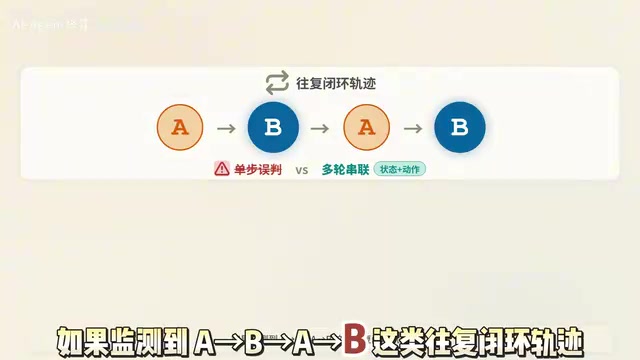
The key to detecting loops is chaining together the state and action combinations across consecutive rounds, not examining any single action in isolation. Only by recognizing the repeating closed-loop pattern can you precisely determine that an Agent has entered an invalid loop state.
Part 3: Breaking Loops — Actively Switch Strategies, Don't Retry Blindly
Setting a max step count is only the most basic fallback measure — it isn't a real solution. True engineering loop-breaking logic means immediately terminating the current ineffective retry upon detecting a repeated trajectory and forcing a strategy switch.
Four Strategy-Switching Techniques
Strategy switching is not random — it's targeted, precise error correction:
- Replace the tool being called: If the current tool isn't working, switch to a more suitable one;
- Revise the original query instruction: Reorganize the model's input to shift its reasoning path;
- Roll back to the last valid node: Restart from the most recent normal state;
- Replan the execution chain: Reconstruct the task's execution plan from scratch.

Inject a Small Random Factor
When necessary, you can introduce a small random factor into the decision logic to break the model's fixed reasoning and execution habits. When a model produces the same decision under the same context every time, a little perturbation is often enough to push it out of the dead end.
Background: Random Factors and Their Engineering Relationship to the Temperature Parameter
At the LLM level, "small random factor" directly corresponds to raising the sampling Temperature or Top-P parameter. The temperature parameter controls how flat the model's output probability distribution is: as temperature approaches 0, the model trends toward greedy decoding, always outputting the highest-probability token — which is the fundamental cause of fixed decision-making. A common engineering practice is: when repeated trajectories are detected, dynamically raise the Temperature for that call from the default (e.g., 0.2) to 0.7–1.0, forcing the model to explore sub-optimal but semantically valid alternative paths, thereby escaping local optima. This "dynamic temperature adjustment" strategy is more precise than static temperature settings — it doesn't affect determinism during normal reasoning, while injecting necessary exploration capability at critical moments.
The gap between "mindless retrying" and "active error correction" is exactly what separates junior engineers from senior ones on this question.
Part 4: Root Cause Analysis — Most Loops Are Design Flaws, Not Code Bugs
In practice, Agent infinite loops rarely stem from code defects. The core issues almost always fall into two categories:
1. Poorly Designed Prompt Instructions
The task lacks clear termination conditions. The model doesn't know when to stop, so it just keeps going.
2. Missing Context Grounding Mechanism
This is the most common and most hidden problem: the observation results from tool execution are not written back into the conversation context.

The consequences are immediate — the model receives identical context every round and naturally can only repeat the same decisions and tool calls, ultimately forming an infinite loop.
Background: Engineering Practices for Context Grounding (Observation Write-back)
Context Grounding refers to appending the Observation returned after tool execution to the conversation history (Message History), so it serves as input for the next round of reasoning. In OpenAI Function Calling or LangChain's Tool invocation spec, this step corresponds to inserting a
toolrole message into the messages list. Common engineering mistakes include: async tool calls not beingawait-ed, leaving the Observation empty; tool return values exceeding the context window and getting truncated; and incorrectly writing Observations into the system prompt instead of the user message track. Any of these situations will make the model "blind" to the execution result, causing it to spin in place. It's recommended to add an Observation validation middleware at the tool-calling layer to ensure the result is non-empty and properly formatted before advancing to the next round of reasoning.
Therefore, engineering diagnosis always comes down to two things:
- Are tool execution results fully written back into the context?
- Are the task termination conditions clearly defined and actually in effect?
Investigate these two points thoroughly and the vast majority of infinite loop problems will be resolved. This also shows that Agent stability depends largely on context management and prompt design, not purely on code quality.
Part 5: Engineering Fallbacks — Multi-Layer Fault Tolerance for Service Stability
When proactive strategy switching and loop-breaking measures all fail and the max step limit is triggered, you still need multi-layer fallback mechanisms to maintain service stability:
- Roll back to a Checkpoint: Return to the most recent successfully executed checkpoint and replan the task flow;
- Human takeover: Automatically trigger a human intervention mechanism to handle the anomaly;
- Return the best available result: In extreme scenarios, directly return the best result generated so far, completely avoiding service deadlock and wasted token burn.
Background: Checkpoint Mechanisms and State Persistence
The Checkpoint mechanism originates from fault-tolerance design in distributed systems and deep learning training. The core idea is to periodically persist system state so that after a failure, recovery can begin from the most recent valid node rather than from scratch. In Agent engineering, a Checkpoint typically includes: the list of completed subtasks, tool call history and their Observations, and intermediate variable states. Implementation can use Redis or a relational database to store serialized Agent state snapshots, triggered after each successful milestone action. This aligns with the built-in Persistence Layer design in frameworks like LangGraph, and is indispensable infrastructure for building long-horizon task Agents. For complex tasks that span multiple conversation turns or even multiple days, Checkpoints are the last line of defense for ensuring business continuity.
This combination of "proactive loop-breaking + reactive fallbacks" represents the robustness design that production-grade Agents should have.
Conclusion: What Interviews Are Really Testing Is Engineering Mindset
This interview question has never been about whether you "know" that Agents can get stuck in loops. It's about verifying whether you have an engineering mindset for production deployment — whether you can build an Agent into a complete, closed-loop, stable system:
- Detectable: Precise identification via trajectory tracking + three-layer verification;
- Breakable: Actively switch strategies rather than retry blindly;
- Diagnosable: Zero in on context grounding and termination conditions as the two core root causes;
- Fault-tolerant: Checkpoint rollback, human takeover, and returning best available results.
For any developer looking to go deep in Agent engineering, understanding and practicing this methodology is far more valuable than memorizing a max_steps parameter.
Related articles
Deep Dive into vLLM Worker-Side GPU KV Cache Initialization
Deep dive into vLLM's Worker-side KV Cache GPU memory allocation, covering the full pipeline from KVCacheConfig generation to physical memory binding via ModelRunner.
Zepto Builds AI Customer Service with MLflow: An Evaluation-Driven Practice Guide
Deep dive into how Zepto built an evaluation-driven AI customer service system using MLflow and Databricks, achieving 60% faster responses and 40% less manual handling. From technical architecture to practical insights.

Iran Captures U.S. Underwater Drone in Strait of Hormuz: A Comprehensive Analysis
Iran announces capture of U.S. Navy underwater drone in Strait of Hormuz. In-depth analysis of the incident, strategic value of UUVs, U.S.-Iran geopolitical competition, and implications for global energy security and military dynamics.