Agent Retrieval Bench: Evaluating Whether Coding Agents Can Find the Right Files

Agent Retrieval Bench benchmarks coding agents on finding the right files before fixing code, filling a key blind spot in mainstream evals.
Agent Retrieval Bench is a specialized benchmark focused on the code retrieval phase, built on the principle of "can it find the files before it fixes the code." Mainstream coding agent benchmarks like SWE-bench use end-to-end evaluation with final test pass rates as the sole metric, systematically obscuring retrieval accuracy — when an agent fails, developers can't tell whether the root cause was wrong file localization or incorrect edits. By decoupling retrieval from editing, this benchmark provides a more granular tool for diagnosing agent weaknesses and guiding modular optimization, offering a structural correction to the industry's reliance on end-to-end success rates.
The Critical Step Most Benchmarks Ignore
When we talk about AI coding assistant capabilities, attention typically focuses on the quality of generated code, whether it passes unit tests, and bug-fix success rates. But there's a prerequisite question that most evaluation frameworks — deliberately or inadvertently — leave hidden: Before the agent starts modifying code, did it actually find the right files in the repository?
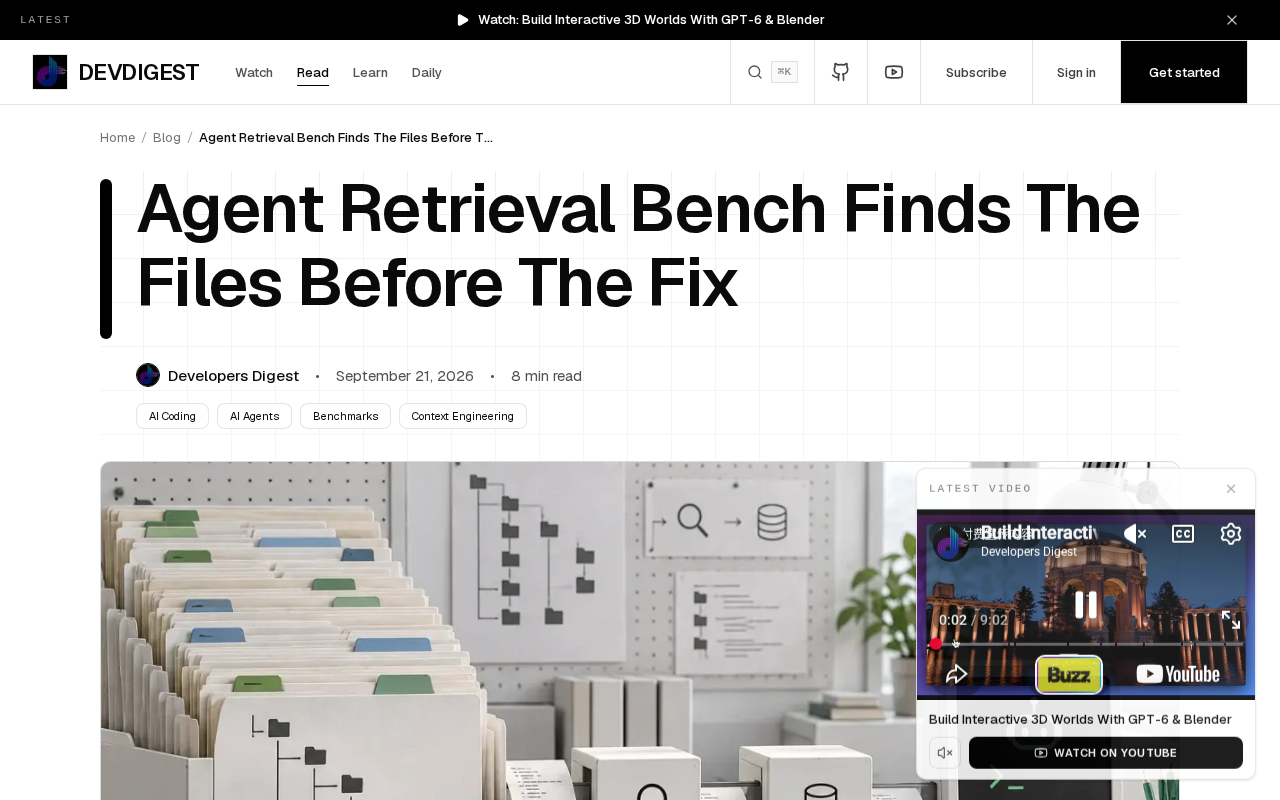
Agent Retrieval Bench is a benchmark designed specifically for this step. It isolates the part of a coding agent's workflow that's most easily obscured — the accuracy of the code retrieval phase — and evaluates it independently. Its core philosophy can be summed up in one line: Finds The Files Before The Fix.
Why the Retrieval Step Matters So Much
Real-world codebases routinely contain hundreds or thousands of files, and a single feature's implementation may span multiple modules. When a user makes a natural language request like "fix the session expiration issue during login," the agent's first task isn't to write code — it's to locate the specific files relevant to the problem.
If the agent gets this step wrong, then no matter how elegant or syntactically correct the generated code is, all that effort is wasted in the wrong place. It's like asking a surgeon to operate without a diagnosis — technical skill means nothing without knowing where to cut.
Traditional end-to-end benchmarks (such as having an agent run through test cases) have a blind spot: they only look at whether the final result passes, and cannot distinguish whether failure occurred at the retrieval stage or the editing stage. When an agent underperforms on a comprehensive benchmark, developers have no way to pinpoint the root cause — did it find the wrong files, or did it find the right files but write incorrect code?
From a technical standpoint, code retrieval in programming agents typically relies on a combination of strategies: keyword-based symbolic search (e.g., grep/ripgrep), vector embedding similarity search (converting code snippets into semantic vectors for nearest-neighbor queries), and symbol reference navigation via the Language Server Protocol (LSP). Each strategy has its blind spots — keyword search can miss semantically related files with different naming conventions; vector search quality varies considerably in the code domain; LSP requires correct project configuration to function properly. Real codebases often involve cross-language calls and dynamic loading, further complicating localization. These technical challenges are the fundamental reason why the retrieval step deserves to be measured independently.
The Differentiated Value of Agent Retrieval Bench
Agent Retrieval Bench is designed around isolating variables. By extracting retrieval capability from the complete coding workflow and evaluating it independently, it provides a more precise tool for diagnosing an agent's weaknesses.
A More Transparent Capability Breakdown
Decoupling the evaluation of "finding files" from "editing files" means developers can answer questions that were previously difficult to address: Does a given model have sufficient spatial awareness for code understanding and localization? Does it accurately grasp the structure of a codebase? This decomposition provides clear direction for targeted model optimization.
Exposing the "Hidden Variable" in Evaluations
The project explicitly notes that this is the part "most evals hide" — a phrase worth dwelling on. It implies that the mainstream coding agent evaluation ecosystem has a systemic blind spot. While the entire industry touts end-to-end success rates to demonstrate agent progress, retrieval accuracy — a critical metric — has long been absent from the conversation. The emergence of Agent Retrieval Bench is, in some sense, a corrective push against this evaluative inertia.
The dominant coding agent benchmarks (such as SWE-bench) use an end-to-end evaluation model: given a GitHub issue, the agent operates autonomously on a code repository, and success is judged solely by whether the corresponding test cases pass. This design has the advantage of reflecting real-world scenarios, but the trade-off is compressing the full pipeline — understanding requirements → locating files → modifying code → verifying results — into a binary pass/fail signal. Researchers have already observed that a significant portion of failures on SWE-bench stem from agents modifying irrelevant files rather than the truly related modules, yet this information completely disappears in the final score. Agent Retrieval Bench's positioning is therefore complementary to SWE-bench, not competitive with it.
What This Means for Developers and Researchers
For teams building or selecting coding agents, an independent evaluation of retrieval capability offers a more granular basis for decision-making. An agent that excels at retrieval — even if its editing capability is currently limited — has greater optimization potential, because file localization is often harder to automate than the fix itself.
For researchers, this kind of focused benchmark helps drive modular agent architecture design. When retrieval and editing are clearly distinguished, research can focus more precisely on improving specific technical areas such as codebase understanding, context management, and relevant file ranking.
Conclusion
The core contribution of Agent Retrieval Bench isn't a new technical method — it's a redefined perspective on how we evaluate coding agents. It reminds the industry: before chasing code generation quality, we need to make sure the agent is standing at the right starting line. Finding the right files is the prerequisite for fixing the code, and it's the first step most easily overlooked.
Given the limited public information currently available, specific details about the benchmark's testing methodology, supported programming languages, participating models, and their scores are yet to be disclosed. But the question it raises is already sufficient to prompt serious reflection on the existing paradigms for evaluating coding agents.
Related articles

From Python to AI Agents: A Full-Stack Learning Path with 488 Lessons and 23 Projects
A Udemy course covering Python, machine learning, deep learning, LLMs, RAG, and AI Agents, with 488 lessons and 23 real-world projects. This article analyzes the logic of this full-stack AI learning path, who it suits, and self-study advice.

What Is a Residential Proxy? A Comparative Analysis of ISP, Datacenter, and Residential Proxies
An in-depth analysis of residential proxies (ISP proxies), their types, and how they differ from datacenter proxies, covering static vs. rotating residential IP selection criteria, use cases, and FAQs for e-commerce, social media, and data collection teams.

Creating Your Ideal Home: A Practical Guide to Curated Home Decor
Curated home decor guide: wall paintings, decorative mirrors, wall clocks, lamps, coffee tables, and more — with buying tips and styling advice for a cozy, comfortable home.