Agent Scraper Mines Taoguba Hot Money Data: A Practical Review and Zero-Basics Deployment Tutorial

AI Agent scrapes Taoguba hot money discussions to generate pre-market plans, achieving 11.72% returns and sharing deployment methods.
This article dissects an AI Agent trading system based on Taoguba data: scraping hot money discussions via crawler, extracting key judgments to generate pre-market plans, and achieving an 11.72% return on October 21. The system's core is rule-first—using opening price as a switch condition to avoid emotional operations during the session; it also sets up a reverse validation table to record the opportunity cost of "not buying," counteracting human weaknesses. The article also provides a zero-basics deployment path, including two zip files (project package and capability package), model selection, and browser permission configuration, and points out boundaries such as insufficient backtest samples and platform compliance risks. Overall, this is an application sample that transforms unstructured community content into structured trading rules, with return sustainability yet to be observed.
When an AI Agent starts automatically extracting information from Taoguba's hot money discussions, generating pre-market plans, and actually earns 11.72%, that itself is worth dissecting. According to a Bilibili creator, the "Taoguba scraper Agent" he built not only completed data scraping but also generated an executable trading plan based on hot money thinking and achieved positive returns. More critically, he packaged the entire pipeline from data collection to rule iteration into a deployable solution, complete with pitfall-avoidance experience and quantitative backtesting data. This article will combine the creator's operational details to analyze the actual working logic of this system and how ordinary users can deploy it from scratch.
Behind the 11-Point Return: How the Agent Digests Hot Money Information
The "Taoguba" mentioned by the creator is called a "hot money incubation center," where a large number of short-term hot money ideas, plans, and discussions are concentrated. The traditional approach is manual market watching and thread scrolling, while the Agent's approach is to batch-scrape these text contents, extract key judgments, and combine them with market data to generate its own pre-market plan. The execution sheet for October 21 shows that the strategy achieved a daily return of 11.72% that day, and the creator himself said he was somewhat surprised.
The core of this process is not "how much data was scraped" but the efficiency of information transformation. Retail investors often panic and exit when they see a gap-down open, while the Agent judges whether to trigger a stop-loss based on pre-written rules. For example, the plan explicitly states: if Lujin A's opening price is greater than or equal to 69.687, execute Plan I20; if it gaps down more than 4%, close intraday execution and wait until 14:50 to close the position. This "condition-first" decision-making approach strips emotional interference from the execution phase.
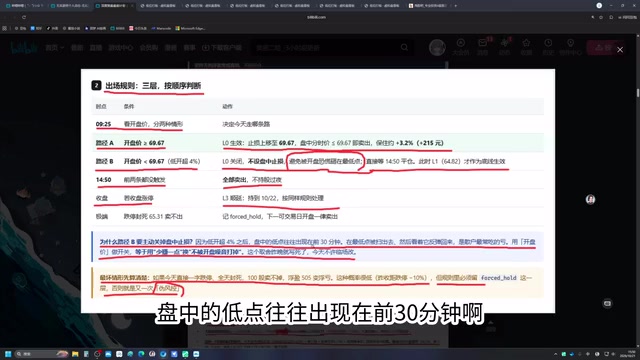
The creator specifically highlighted a common retail trap: after a gap-down, the intraday low often appears in the first thirty minutes, and retail investors get swept out at that point, then watch the price rebound. The Agent's approach is to use the opening price as a switch, "trading a little less profit for not being knocked out by opening noise." This is essentially a trade-off, but the rules are written in advance, so there's no improvisation during the session.
Taoguba is a stock forum centered on short-term trading discussions, gathering a large number of hot money players, short-term traders, and retail investors, with content mainly consisting of pre-market plans, intraday real-time discussions, and post-market reviews. Because of its high information density and fast update speed, it is often viewed as a window for observing market sentiment and hot money movements. However, the platform's content is highly unstructured, filled with colloquial expressions, coded language, and emotional remarks, making manual extraction of useful information extremely costly. The value of AI Agent intervention lies in its ability to batch-scrape text and perform semantic understanding, transforming scattered discussions into structured judgment basis, thereby improving information processing efficiency.
Rule-Based Breakdown of the Pre-Market Plan: Three-Layer Switches and Reverse Validation
The most instructive part of this plan is that it treats "not buying" as a formal decision to be recorded. The creator mentioned that "not buying has zero cost in terms of price," so he specifically set up a reverse validation table: if a stock he didn't buy today rises later, it means the judgment was off; if it falls, it means discipline worked. This making opportunity cost explicit is very rare in retail trading.
In terms of specific rules, the Agent sets up multi-condition screening: low position, crossing three moving averages, seal order available for buying, and net buying on the Dragon-Tiger List—all four conditions must be met simultaneously to act. That day, no stock in the entire market met all conditions simultaneously, so the conclusion was "it's not that there are no opportunities, it's that none of the opportunities are cheap." For stocks like Changjingmi that met three conditions, the Agent also explicitly recorded why it was abandoned—position too high.
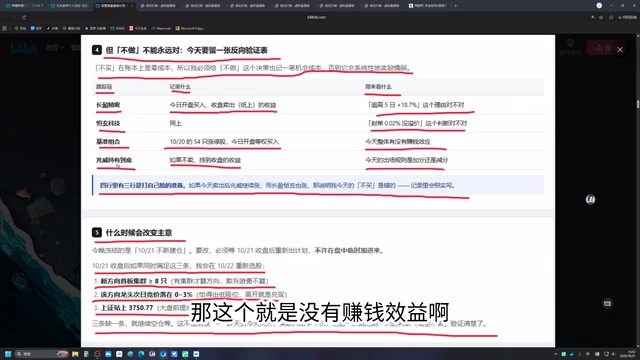
Let me also mention the rule self-iteration mechanism. The creator mentioned that if three conditions are met simultaneously at the close on the 12th, the system will re-select stocks on the 12th. This means the Agent is not executing a fixed set of rules but dynamically adjusting based on market feedback. Three of the four judgment lines are "self-criticism" validation items, and this design gives the system active learning characteristics rather than mindless repetition.
A reverse validation table is a tool used to counteract trading psychological biases. Traditional trading records only focus on executed buys and sells, while a reverse validation table specifically records "unexecuted" decisions and their subsequent price movements: if an unbought stock rises later, it means an opportunity was missed and the judgment was off; if it falls, it means discipline was effective. This approach makes opportunity cost explicit, forcing traders to confront that "not buying" is also a decision, thereby reducing impulsive trades driven by fear of missing out, and in the long run helps optimize rules and improve discipline.
Zero-Basics Deployment Path: From Zip Files to a Runnable Agent
The creator packaged the entire solution into two zip files: one is the project signature package (containing all pre-run data), and the other is the capability package, which contains the methodology for scraping Taoguba data and a quantitative backtest—comparing a well-known blogger's historical statements with actual stock price movements. Due to sensitivity, the backtest data was not fully shown in the video.
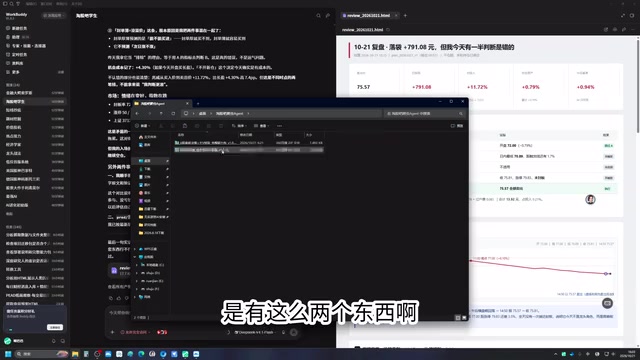
The deployment process is roughly three steps: first, create a new task, drag in the zip file, and enter "deploy" to let the system complete the capability installation; second, create a new window, drag in the project package, and enter "continue running this project"; third, select a model and enable browser control permission. The creator used the DBCQV4.1 model and emphasized turning on "let Ukubaddy control the browser" in settings, with at least one of the three browser options enabled, otherwise you won't be able to log into Taoguba later.
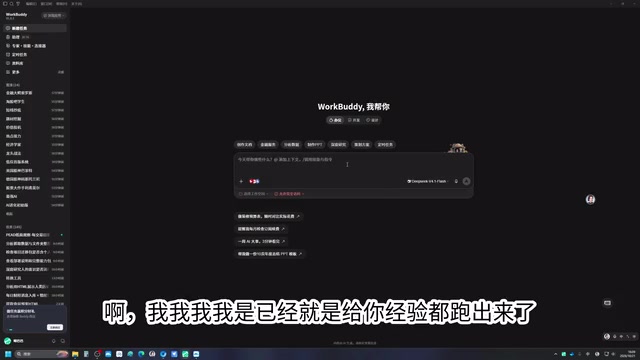
Prompt design also matters. The creator does not recommend directly saying "generate tomorrow's operation plan," but rather using a higher-ceiling question like "what do you plan to do tomorrow." The reason is that being too restrictive makes the model focus entirely on the pre-market plan, while open-ended questions can inspire more comprehensive consideration. For review, use "review today," and if no report is generated, add "continue."
Browser control permission is a key capability for AI Agents to achieve automated operations. In the deployment solution, the Agent needs to simulate human operations to log into Taoguba and scrape page data. After enabling this permission, the Agent can automatically complete actions such as clicking, typing, and page-turning without manual intervention. But this also brings security risks, so it is recommended to enable it only in trusted environments and follow the principle of least privilege. The creator emphasized enabling at least one browser option, otherwise the Agent cannot access the target website and the entire data collection process will be interrupted.
The Actual Value and Boundaries of This Solution
From the demonstration, the core competitiveness of this Agent is transforming hot money's qualitative judgments into backtestable quantitative rules, then using rules to constrain execution. What it solves is not the problem of "predicting ups and downs" but the problem of "not acting impulsively during the session." The creator repeatedly mentioned that retail investors lose money because of "improvised decisions during the session," and pre-set rules are exactly the right remedy.
But there are several boundaries that need clear recognition. First, the backtest data is based on comparing historical statements with stock prices, and the sample size and time span are not disclosed, so it cannot be directly extrapolated. Second, scraping Taoguba content involves platform rules, and the creator also mentioned that "avoiding detection" was one of the pitfalls he encountered; actual deployment requires self-assessment of compliance risks. Third, the credit consumption for model selection and the configuration of browser control permissions still pose a certain threshold for zero-basics users; the creator said it "consumed a tremendous amount of energy" to get it running.
Overall, this is an Agent application sample worth studying: it demonstrates how to use scrapers plus LLMs to turn unstructured community content into structured trading rules, and use reverse validation tables to counteract human weaknesses. As for whether the 11.72% return can be sustained, the creator's own attitude is also "a bit surprised," so readers might as well treat it as a methodological reference rather than a return promise.
One-line Summary
AI Agent scrapes Taoguba hot money discussions to generate pre-market plans, achieving 11.72% returns and sharing deployment methods.
Paragraph Summary
This article dissects an AI Agent trading system based on Taoguba data: scraping hot money discussions via crawler, extracting key judgments to generate pre-market plans, and achieving an 11.72% return on October 21. The system's core is rule-first—using opening price as a switch condition to avoid emotional operations during the session; it also sets up a reverse validation table to record the opportunity cost of "not buying," counteracting human weaknesses. The article also provides a zero-basics deployment path, including two zip files (project package and capability package), model selection, and browser permission configuration, and points out boundaries such as insufficient backtest samples and platform compliance risks. Overall, this is an application sample that transforms unstructured community content into structured trading rules, with return sustainability yet to be observed.
Related articles

Tencent WorkBuddy Hands-On: How AI Agents Crush Traditional Chat Assistants
WorkBuddy vs Doubao tested: how AI Agents directly operate computers to convert PPT to PDF, archive files and more. Analysis of WorkBuddy's low barrier, domestic ecosystem, pricing and plugin marketplace, plus AI Agent selection advice.

Azure Cross-Tenant Attack Chain: Root Cause Analysis of Five Paths
Binary Security analyzes five full cross-tenant compromise paths in Azure, trending 271 points on HN. This article interprets their shared root cause perspective and offers defense recommendations for cloud tenant isolation and reflections on responsibility boundaries.

Recreating a Real Bubble Tea Station in Isaac Sim: Script-Driven Unitree G1 Brews Tea
Developers recreated a real self-service tea station in NVIDIA Isaac Sim, using scripts to drive a Unitree G1 through a five-step tea-brewing process, exploring whether physics simulation can be a source of synthetic robot demonstration data and discussing contact stability and imitation learning.