Agent Server, Agent OS, or Agent Kernel? The Naming Debate Over AI Agent Infrastructure

The Agent Server vs. OS vs. Kernel debate reflects differing views on agent infrastructure layering.
The article examines the discussion of what to call the infrastructure supporting AI agents, outlining the meanings and limitations of Agent Server, Agent OS, and Agent Kernel. Server emphasizes service-ized runtime and operations but struggles to capture agents' stateful, long-running nature; OS is the most ambitious, implying full resource management and isolation, yet risks misaligned expectations; Kernel points to a minimal execution core with clear boundaries but a higher barrier to adoption. The article notes that the naming disagreement reflects the layering evolution of agent systems and the lack of a consensus vocabulary. For developers, clarifying which layer Agent refers to and avoiding big words that create expectation gaps matters more than picking a fancy term.
Agent Server, Agent OS, or Agent Kernel? The Naming Debate Over AI Agent Infrastructure
When a technology moves from experimentation to engineering, naming often becomes the first thing that needs to be clarified. A recent discussion on social media has raised the question: what should we call the infrastructure that supports AI agents? Agent Server, Agent OS, Agent Kernel, or simply Agent? What looks like a mere matter of wording actually reflects differing understandings of where agent systems sit in the architectural stack.
Where the disagreement comes from
The discussion started simply: a developer asked on social media—"Is agent server a good name?"—and listed several alternatives: agent os, agent, agent kernel. The question is short, but it hits a murky spot in today's AI engineering landscape.
"Agent" itself is already an overused word. It can refer to an LLM application with tool-calling capabilities, a single role in a multi-agent collaboration system, or an autonomous entity running in a specific environment. When we want to describe "the layer that makes agents run," the existing vocabulary clearly falls short.
The essence of the naming debate is a difference in how people understand the layered architecture of agent systems. Different people have different positions in the tech stack in mind when they use these words.
Agent Server: emphasizing service-ization and runtime
"Agent Server" takes an engineering perspective. It implies a server-side runtime—responsible for receiving requests, scheduling agents, managing session state, and connecting to external tools and model APIs. In this context, Agent Server is analogous to an application server in traditional web development.
Proponents of this name usually focus on deployment and operations: agents need to be hosted, monitored, and scaled, and the word Server naturally carries these engineering connotations. Its advantage is directness—developers immediately know this is a service that needs to run on a machine.
The problem is that Server easily evokes a "stateless request-response" model, whereas the core characteristics of agents are precisely stateful, long-running, and potentially involving multi-turn planning and tool calls. The word Server alone struggles to cover these implications.
Agent OS: bigger ambitions, blurrier boundaries
"Agent OS" is the most ambitious of these options. An operating system means resource management, process scheduling, permission isolation, and system call interfaces—it implies a whole abstraction layer for the agent runtime environment.
If agents really need their own "operating system," what resources would it need to manage? Model invocation quotas, tool permissions, memory storage, communication channels between multiple agents—these can indeed be compared to the processes, memory, and file systems managed by an OS. Some cutting-edge projects are already exploring this direction, calling their agent runtime "Agent OS" or similar.
But the risks of this naming are also obvious. OS is a strictly defined technical concept, and borrowing it casually can easily create misaligned expectations. If the so-called Agent OS only provides a tool-calling framework and a context manager, it is still far from an operating system. Using big words to describe small things actually undermines credibility.
An operating system has a clearly defined boundary in computer science: it manages hardware resources (CPU, memory, storage, peripherals), provides process scheduling, memory allocation, file systems, device drivers, and system call interfaces, and implements isolation and protection between multiple user programs. The key to judging whether a system can be called an OS is whether it performs exclusive management and abstraction of some underlying resource. Applying this standard to the agent context, a layer of software is closer to the semantics of an OS only when it truly unifies the scheduling of model invocation quotas, tool execution permissions, memory storage space, and multi-agent communication resources, and provides a stable system-call-style interface upward. Otherwise, its more accurate positioning is a runtime framework or middleware.
Agent Kernel: a lower-level metaphor
"Agent Kernel" pushes the analogy further down. The kernel is the core of an operating system, responsible for the most fundamental abstractions and scheduling. Calling something an Agent Kernel means it is a minimal agent execution kernel—containing no UI, no upper-layer orchestration, only the most core reasoning loop and tool-calling primitives.
The appeal of this name lies in its precision. It does not promise a complete runtime environment, only kernel-level abstraction. For framework authors, the word Kernel helps define boundaries: what I provide are basic primitives; how you combine them at the upper layer is up to you.
But Kernel also has a cognitive barrier. Most application-layer developers do not directly deal with kernel concepts, so this name may be less intuitive to spread than Server or OS.
The kernel sits at the innermost layer of the operating system architecture, interacting directly with hardware and providing core mechanisms such as process management, memory management, interrupt handling, and system calls, while leaving user interfaces, file management, and network services to user-space programs. So-called "kernel-level abstraction" emphasizes minimal completeness: exposing only the primitives necessary for upper-layer construction, without presupposing application forms. In the agent field, an Agent Kernel usually contains only indivisible foundational capabilities such as the reasoning loop, tool-calling protocol, and context window management, and is not responsible for session persistence, multi-tenant authentication, or visual orchestration. The benefit of this layering is that the kernel can remain stable, while upper-layer frameworks freely compose Servers or complete applications; the cost is that application-layer developers need to fill in a large amount of engineering capability themselves.
Behind the naming: agent infrastructure is layering
This discussion is worth attention not because of which word will ultimately be chosen, but because it reveals that agent infrastructure is undergoing layering.
From current engineering practice, at least several layers can be identified: the bottom layer is the primitives of model inference and tool calling (close to the Kernel positioning); the middle layer is the runtime and service-ization framework (close to the Server positioning); and above that are agent applications and multi-agent orchestration for specific scenarios.
As each layer begins to evolve independently, each needs its own name. The problem is that the industry has not yet formed a consensus layered vocabulary, and different projects use the same word for different layers, or different words for the same layer.
This terminology confusion is normal in the early stages of a technology. Words like HTTP Server, Application Server, and Web Container also went through similar semantic drift, eventually settling through practice and community consensus. Naming in the agent field will likely follow the same path—not decided by a single discussion, but by which projects survive and which words are used repeatedly.
Middleware is a useful reference for understanding agent layering. In traditional enterprise architecture, middleware sits between the operating system and applications, providing common capabilities such as message queues, transaction management, and connection pools—belonging neither to the kernel nor to business applications. The agent runtime framework is in a similar position: it calls model inference and tool execution primitives downward, and provides session state management, concurrency scheduling, observability, and permission control for agent applications upward. Clarifying this middleware positioning helps avoid mistakenly calling a runtime framework an OS or Kernel, and also explains why the same project may be classified into different layers in different documents—it actually spans multiple middleware responsibilities.
Practical implications for developers
If you are building agent-related infrastructure or applications, this naming discussion offers at least two practical takeaways.
First, clarify in documentation and architecture diagrams which layer your "Agent" refers to. Is it a single agent instance, an agent runtime, or the entire agent system? Being clear about the layer matters more than choosing a fancy word.
Second, don't be held hostage by big words. Agent OS sounds cool, but if your project is actually just a tool-calling framework, honestly calling it a framework or Server is more likely to earn trust. The value of naming lies in reducing communication costs, not creating expectation gaps.
As for which word will ultimately win, no one can give a definitive answer right now. What is certain is that as agents move from demos to production systems, the name of this infrastructure layer will be repeatedly refined in practice, until some word becomes as natural as "database" or "compiler."
One-line Summary
The debate over Agent Server, OS, and Kernel reflects differing understandings of how agent infrastructure is layered.
Paragraph Summary
The article centers on the discussion of "what to call the infrastructure that supports AI agents," sorting out the respective connotations and limitations of three names: Agent Server, Agent OS, and Agent Kernel. Server emphasizes service-ized runtime and deployment operations, but struggles to cover agents' stateful, long-running characteristics; OS is the most ambitious, implying a complete resource management and isolation environment, yet it easily creates misaligned expectations through over-borrowed concepts; Kernel points to a minimal execution kernel with clear boundaries but a higher barrier to spread. The article notes that the essence of the naming disagreement is that agent systems are evolving in layers, while the industry has not yet formed a consensus layered vocabulary. For developers, clarifying which layer Agent refers to in documentation and avoiding big words that create expectation gaps matters more than choosing a fancy word.
Related articles
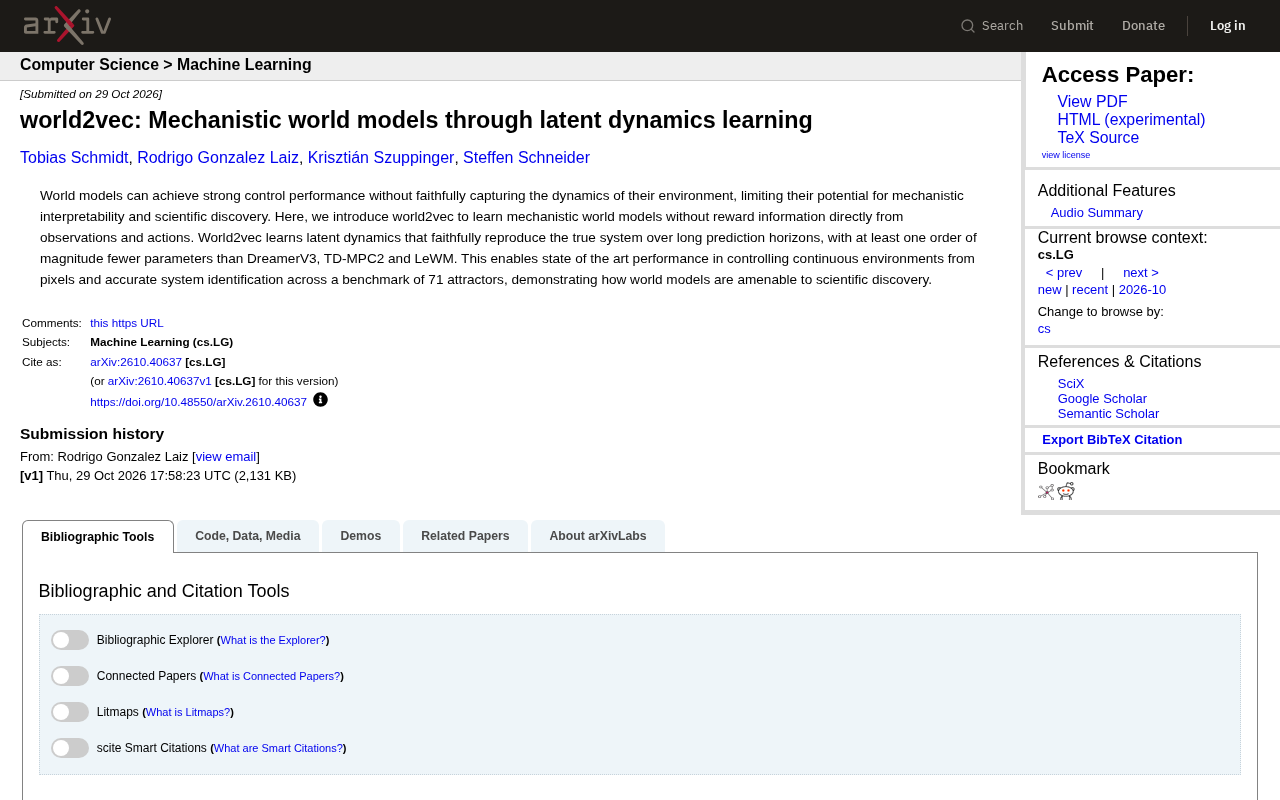
world2vec: Building Mechanistic World Models with Latent Dynamics Learning
world2vec proposes a reward-free method for learning mechanistic world models via latent dynamics, faithfully reproducing systems over long horizons with at least an order of magnitude fewer parameters than DreamerV3, TD-MPC2, and LeWM, and achieving accurate system identification on 71 attractor benchmarks.

A New KL-DRO Paradigm: Adaptive Scenario Generation Around a Learned Density Model
KL-DRO research proposes centering the KL ball on a learned density model instead of the empirical distribution, with adaptive scenario generation guiding sampling toward the worst case. Experiments show lower cost under distribution shift when records are scarce and the model can extrapolate, with comparable in-distribution cost.

ODE Samplers for Discrete Diffusion Models: Exponential Residual Flows Accelerate Generation
Discrete diffusion models lack deterministic ODE sampling? This article introduces Exponential Residual Flows (ERFs), which introduce continuous residual variables per token to construct piecewise ODEs for deterministic sampling and support consistency distillation acceleration. Superior to prior methods on code and text generation tasks.