Agent Skills: Bringing Production-Grade Engineering Capabilities to AI Coding Agents

agent-skills gives AI coding agents production-grade engineering capabilities via modular skill packages.
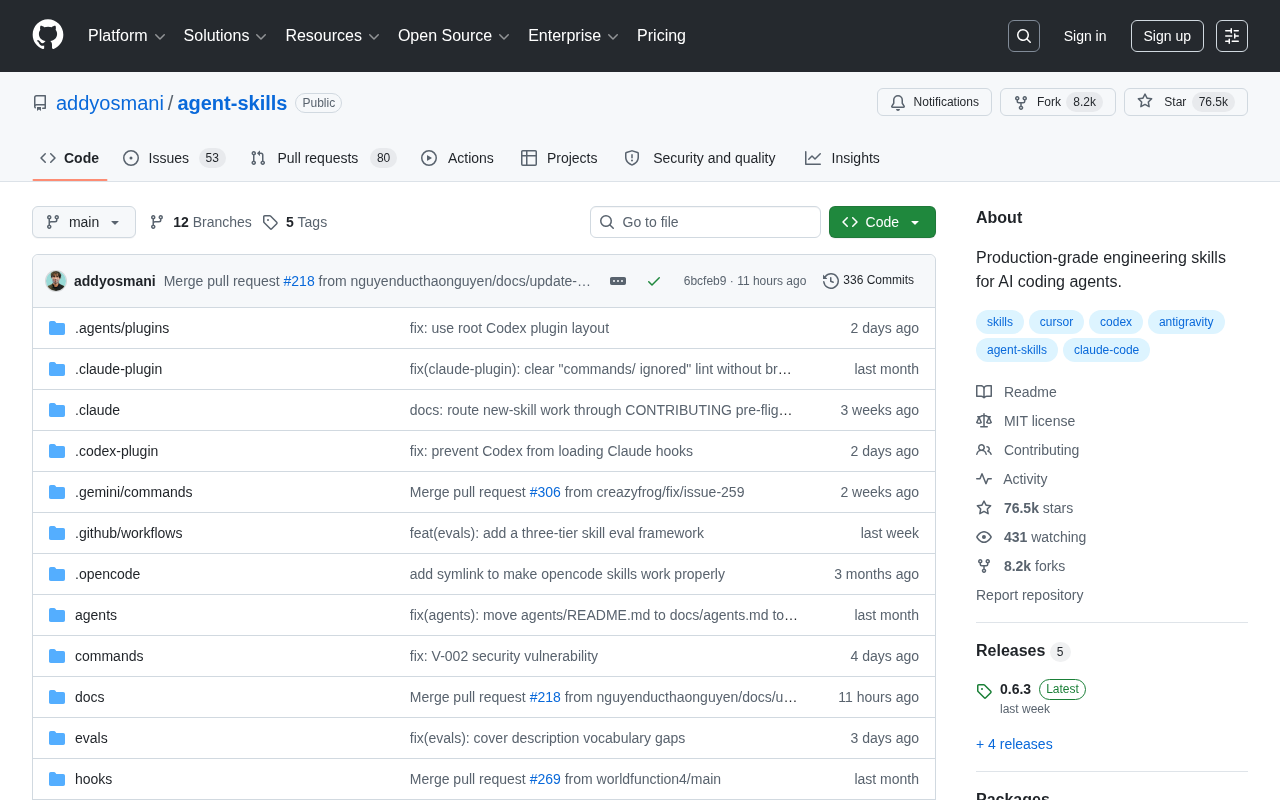
Addy Osmani's agent-skills project has rapidly gained over 76,000 GitHub stars by addressing a core gap in AI coding agents: the lack of engineering judgment. Rather than relying on stronger models alone, it injects structured, reusable skill packages — covering performance, security, and code standards — into AI agent workflows, pushing AI-assisted development from code generation toward true engineering practice.
Project Overview
Addy Osmani, a Google engineer and renowned frontend expert, recently open-sourced a project that has captured widespread attention — agent-skills. The project quickly went viral on GitHub, amassing over 76,000 stars, with a single-day peak of 1,114 new stars and over 8,000 forks. As a long-time technical leader deeply invested in web performance and engineering practices, Osmani has now turned his focus to one of the hottest areas in tech: AI Coding Agents.
AI coding agents are autonomous programming systems built on large language models (LLMs). They can understand requirements, plan tasks, generate code, and execute multi-step workflows. Unlike simple code completion tools such as GitHub Copilot, coding agents are context-aware, capable of tool invocation (e.g., file I/O, terminal commands, browser control), and able to iteratively self-correct — functioning more like a virtual developer who can independently get things done rather than a smart autocomplete. This is precisely why ensuring the quality of what this "virtual developer" produces has become a core engineering challenge.
The project's positioning is clear: provide production-grade engineering skills for AI coding agents. It aims to answer an emerging critical question — how do we get AI agents to produce not just "working" code, but code that meets engineering standards, is maintainable, and is ready for deployment?
Why Do AI Agents Need "Engineering Skills"?
With the rise of AI coding tools like Claude Code, Cursor, and GitHub Copilot, code generation itself is no longer the bottleneck. The real challenge is that AI-generated code often lacks depth in engineering considerations — error handling, performance optimization, security practices, test coverage, and architectural consistency are all common weak points.
This phenomenon has deep technical roots. Large language models are trained to "predict the next token," making them adept at mimicking code syntax and common patterns, but poor at internalizing the tacit judgment engineers develop over years of practice — questions like "will this interface become a bottleneck under high concurrency?" or "will a new team member be able to understand this logic three months from now?" This gap is arguably the deepest divide between current AI coding agents and real production environments.
From "Can Write Code" to "Understands Engineering"
The difference between a junior developer and a seasoned engineer often isn't whether they can implement a feature, but how they handle edge cases, manage maintainability, and uphold best practices. AI agents currently fall noticeably short on this "engineering intuition."
agent-skills addresses this by structuring and modularizing proven engineering expertise into "skill packages" that are injected into the AI agent's workflow. Developers can configure agents to actively invoke predefined capabilities — such as "performance review," "security audit," or "code refactoring standards" — when executing tasks, significantly raising the quality floor of the generated output.
At its technical core, this "skill package" mechanism is a combination of structured prompt engineering and toolchain encapsulation — encoding domain experts' tacit knowledge into reusable modules, similar to giving the AI a professional set of "checklists" and "decision trees." Whenever an agent performs a code generation task, relevant skill modules kick in to enforce normative constraints on the output — much like adding quality gates to a CI/CD pipeline, except these gates operate at generation time rather than review time.
Technical Positioning and Ecosystem Significance
The project is written in JavaScript, aligning with Osmani's long-standing focus on frontend and web technologies. From a broader perspective, agent-skills represents an important trend in the evolution of AI coding tools: a shift from relying on general-purpose LLM capabilities toward domain-specific, specialized skill accumulation.
The Rise of the Skills Paradigm
The evolution of AI coding tools can be broken into three distinct phases: the code completion phase (typified by early Copilot, focused on line/function-level autocomplete), the conversational generation phase (typified by ChatGPT code features, where developers describe requirements and AI returns complete code snippets), and the autonomous agent phase (typified by Claude Code and Devin, where AI can independently plan and execute multi-step tasks). We're currently in the maturation of this third phase — and as autonomy increases, standardizing output quality becomes more critical than ever. The more autonomous the agent, the more easily an absence of engineering discipline can silently accumulate technical debt. agent-skills arrives at precisely the right moment with a systematic solution.
Leading organizations like Anthropic are also actively advancing the concept of "Agent Skills" — extending AI agent capabilities through composable, reusable skill units. Osmani's open-source project is a concrete community implementation of this paradigm, externalizing the tacit knowledge in experienced engineers' heads so that AI can work on the shoulders of expert experience.
For teams, this also offers a path to standardize AI collaboration workflows: different projects and team members adopting a unified skill specification, ensuring consistency and reliability in AI-assisted development. This closely mirrors software engineering's own historical journey from "if it runs, ship it" to code standards, CI/CD, and architecture reviews — whenever a new programming paradigm matures, engineering infrastructure inevitably follows.
The Industry Signal Behind the Rapid Rise
Accumulating over 76,000 GitHub stars in a short period is itself a statement about the developer community's intense hunger for "production-grade AI coding." It reflects a concrete reality: as more and more engineering teams bring AI agents into actual production environments, code quality and engineering standards have become the most pressing pain points.
Notably, there's a deeper industry anxiety lurking behind this demand. As the proportion of AI-generated code rises rapidly, codebase maintainability is becoming a new breeding ground for technical debt. According to post-mortems from multiple engineering teams, a significant share of bugs introduced by AI-generated code are not logic errors, but security oversights, edge case omissions, and architectural inconsistencies — precisely the kinds of failures caused by a lack of "engineering intuition," and exactly the domain agent-skills aims to systematically address.
Relying solely on stronger foundation models is unlikely to fully close this gap, and solutions like agent-skills — which productize and toolify engineering best practices — are well-positioned to fill that void.
Summary and Outlook
The emergence of agent-skills marks a shift in AI coding from a "show-off phase" to an engineering maturity phase. It reminds us that the value of AI agents lies not only in the speed of code generation, but in the quality and reliability of what is produced.
For developers and teams looking to use AI coding tools reliably in production environments, this project is well worth watching. As more "engineering skill libraries" emerge, AI may genuinely become a trusted "senior engineering partner" rather than just a code completion tool. That said, the real-world effectiveness of these skill packages, their breadth of coverage, and their compatibility with mainstream AI tools remain to be validated through ongoing use in actual projects.
Related articles

Transformer²: Achieving Co-Design of Robot Morphology and Control with a Unified Architecture
Deep dive into how Transformer² uses a unified Transformer architecture to integrate robot morphology design and motion control into one model, enabling task-driven end-to-end co-design for embodied AI.

Tutorial: Installing Tailscale on a Jailbroken Kindle to Create a Private Network Node
Learn how to deploy Tailscale on a jailbroken Kindle, turning an idle e-reader into a private network node. Covers cross-compilation, power optimization, and risk considerations.
Tutorial: Installing Tailscale on a Jailbroken Kindle to Create a Private Network Node
Learn how to deploy Tailscale on a jailbroken Kindle to turn an idle e-reader into a private network node. Covers cross-compilation, power optimization, and risk considerations.