Agent Skills Explained: Plug-and-Play Skill Packs for AI

Agent Skills let AI agents dynamically load and unload modular skill packs for on-demand capabilities.
Agent Skills is a lightweight open-source format that extends AI agents with plug-and-play capability modules. Instead of fine-tuning models or deploying multiple agents, developers can package professional knowledge and workflows into reusable Skill packs. The architecture uses progressive disclosure to efficiently manage context window resources and differs fundamentally from Multi-Agent systems by keeping a single agent at the core.
Introduction: The Next Key Design for AI Agents
If 2024 was the year of explosive large model capabilities, then the Agent Skills architecture that emerged in the second half of 2025 is quietly transforming how AI applications are built. Released as an open standard in mid-October 2025, Agent Skills aims to foster an entirely new ecosystem for Agent development.
From an industry evolution perspective, the emergence of Agent Skills is no accident. It's a natural extension of the AI Agent development paradigm's progression from "prompt engineering" to "tool use (Function Calling)" to "modular skills." In 2023, OpenAI introduced the Function Calling mechanism, enabling large models to invoke external APIs. In 2024, Anthropic released the MCP (Model Context Protocol), attempting to standardize how models interact with external tools. Agent Skills takes this a step further—it's not just about tool calling, but about packaging complete workflows, strategic knowledge, and execution resources into a self-describing module. This design philosophy draws from the "plugin architecture" concept in software engineering, similar to VSCode Extensions or WordPress Plugins.
This article starts from a beginner's perspective and systematically covers what Agent Skills are, what problems they actually solve, the core mechanism of progressive disclosure, and the fundamental differences from Multi-Agent architecture—helping you truly understand this technology that's been called a "paradigm-shifting design."
What Are Agent Skills
The official definition states: Agent Skills is a lightweight, open-source format that extends the capabilities of AI Agents with specialized knowledge and workflows.
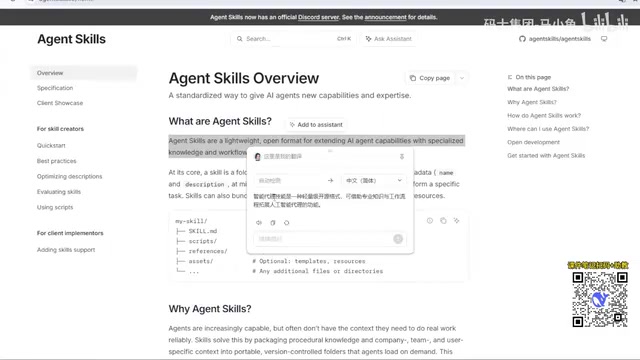
From a technical structure standpoint, a Skill is essentially a folder containing a SKILL.md file, along with metadata, strategy instructions for the agent to complete specific tasks, and scripts, reference materials, templates, and various resources.
It's worth diving deeper into the SKILL.md file, which is written in Markdown format—a choice with deep technical reasoning behind it. Markdown is one of the most common structured text formats that large language models encounter during pre-training, giving models a natural advantage in understanding its syntax. A SKILL.md file typically contains the following key fields: skill name, version number, description, applicable scenarios, execution steps, input/output specifications, and reference paths to dependent resources. This "Text-Centric Design" keeps the barrier to creating Skills extremely low—anyone who can write Markdown can author a Skill, no programming ability required. It also means Skills can be managed by version control systems (like Git), supporting collaborative development and community contributions.
But this official description isn't exactly beginner-friendly. In plainer terms:
Agent Skills = Agents built on a Skills architecture
When developing an Agent project, you can choose different architectural approaches—single agent, multi-agent, or "agent + Skills" modular architecture. Agent Skills refers to giving an Agent the ability to load different skill packs.
Skills Are Modular Capability Extensions
The core of Skills lies in "modularity." Each Skill packages instructions that large language models can understand, metadata, and optional resource files. The Agent automatically loads and uses them when needed, and can unload them to free up resources once the task is complete.
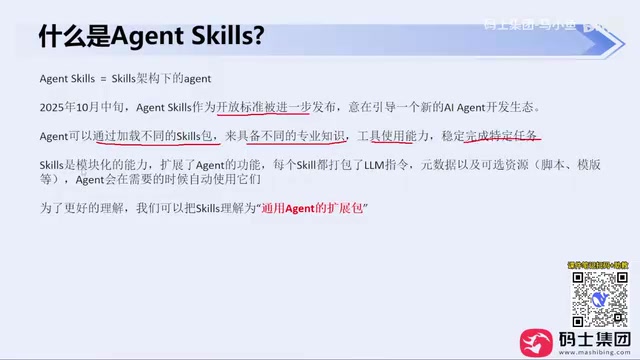
Think of a Skill as a "quick skill pack" for a general-purpose Agent. Just as programmers acquire development capabilities by learning different languages and frameworks, an Agent now only needs to load the corresponding Skill to instantly gain a specialized ability—no need to "learn" from scratch.
What Problems Do Agent Skills Solve
This is the key to understanding the value of Agent Skills. Let's use a very relatable example to illustrate.
The Dilemma of a "Capable Secretary"
Imagine you're a company owner with a very capable secretary. They have solid general knowledge but fall short in specialized domains:
- Ask them to draft a contract, and they don't know much about law;
- Ask them to design a poster, and they can't use Photoshop;
- Ask them to book flights, and they're unfamiliar with the booking systems.
Faced with these gaps, you traditionally have two solutions:
Option 1: Training. Spend months sending the secretary to professional training institutions—law school, Photoshop courses, etc. The downside is that it costs enormous time and effort. In AI terms, this is equivalent to fine-tuning or continual pre-training of a model, requiring massive domain-specific data, GPU compute, and engineering investment.
Option 2: Hiring. Bring on a lawyer and a designer directly. The downside is additional headcount costs. In AI terms, this corresponds to a Multi-Agent architecture—deploying independent Agent instances for each specialized task.
The "Third Way" That Agent Skills Provide
Agent Skills introduce a brand-new third approach: instead of training people or hiring new ones, package various professional capabilities into plug-and-play plugins.
- Need to handle a lawsuit? Load a "Legal Expert" skill pack onto the Agent;
- Need to create a poster? Mount a "Photoshop Design" skill pack;
- Need to arrange a business trip? Mount a "Ticket Booking" skill pack.
Once the task is complete, unload the skill pack to free up resources. Summing up the core essence of Agent Skills in one sentence:
Load what you need, unload when you're done.
This design delivers three core advantages—modularity, low cost, and high flexibility. This also explains why more and more Agent products are integrating various Skills capabilities.
The Core Mechanism of Skills: Progressive Disclosure
Progressive Disclosure is the underlying logic that makes Skills run efficiently, and it's one of the most elegant aspects of this architecture's design.
To understand why this mechanism is necessary, you first need to grasp a key technical constraint: the Context Window. The context window is the maximum number of tokens a large language model can process in a single inference. For example, GPT-4 Turbo has a context window of 128K tokens; Claude 3.5 Sonnet supports 200K tokens. While these numbers seem large, in real-world Agent applications, system prompts, conversation history, tool descriptions, RAG (Retrieval-Augmented Generation) content, and more all compete for this limited resource. If an Agent loads the full content of 50 Skills simultaneously, the skill descriptions alone could consume tens of thousands of tokens, severely compressing the space available for reasoning and degrading response quality.
This constraint is precisely what gave rise to the progressive disclosure mechanism. Simply put, the Agent doesn't load all Skills' complete content into the context at once. Instead, it reads them in layers, on demand:
- Layer 1: Load only the Skill's name and brief description (metadata), so the Agent knows "this skill is available";
- Layer 2: Only when the Agent determines it needs to use the Skill does it read the full
SKILL.mdinstruction content; - Layer 3: During execution, scripts, templates, and other resource files are invoked as needed.
This design is essentially a resource scheduling strategy for the context window. It dramatically reduces context window consumption, avoids information overload, and allows the Agent to maintain high performance even with a large number of available Skills. This is strikingly similar to "virtual memory" and "lazy loading" in operating systems—rather than loading all programs into memory at once, they're read from disk only when needed.
Agent Skills vs. Multi-Agent: Key Differences
Many learners easily confuse "Skills architecture" with "Multi-Agent architecture." While both can extend AI's capability boundaries, their design philosophies are fundamentally different.
Multi-Agent: Multiple Independent Agents Collaborating
The Multi-Agent architecture is equivalent to "recruiting multiple experts." Each Agent is an independent entity with its own role, context, and reasoning capabilities. They collaborate and communicate to accomplish complex tasks. This is similar to the "hiring" approach in our earlier example—powerful, but with higher system complexity and resource costs.
From a technical perspective, the complexity of Multi-Agent systems manifests across three dimensions: communication protocol design, state synchronization, and error handling. Multiple Agents require well-defined message-passing mechanisms (such as Google's A2A protocol), each Agent maintaining independent context state means higher memory and compute overhead, and when one Agent fails, the entire collaboration chain can be affected. Typical Multi-Agent frameworks like AutoGen, CrewAI, and LangGraph all require developers to carefully design inter-Agent dependencies and communication topologies.
Agent Skills: One Agent Loading Multiple Capabilities
The Agent Skills architecture is equivalent to "mounting different skill packs onto one capable secretary." At its core, there's still one primary Agent that dynamically loads and unloads Skills to switch between specialized capabilities. It's lighter, more flexible, and easier to maintain. Compared to the distributed complexity of Multi-Agent systems, Agent Skills encapsulates capability management within a single Agent, using Skill loading/unloading to manage capabilities, avoiding the consistency issues and debugging difficulties common in distributed systems.
The two approaches are not mutually exclusive. In complex real-world projects, they're often combined—using Multi-Agent for scenarios requiring multi-role collaboration, and using Skills to supplement each Agent with plug-and-play specialized capabilities. For example, a project management system might include a "Product Manager Agent" and a "Developer Agent" as two independent entities (Multi-Agent), with each Agent loading modular skills like "Requirements Analysis Skill" and "Code Review Skill" respectively.
Conclusion: Why Agent Skills Deserve Your Attention
Agent Skills represent an important evolution in the AI Agent development paradigm. They decouple "capabilities" from the Agent itself, turning them into reusable, shareable, and composable standardized modules. For developers, this means:
- No need to retrain or rebuild the Agent for every new requirement;
- Ability to reuse existing community Skills or create custom ones;
- Significant optimization in system cost and flexibility.
As an open standard, the Agent Skills ecosystem is growing rapidly. Developers can publish their authored Skills to public repositories for others to use, similar to what npm is to JavaScript or PyPI is to Python. This "skill marketplace" model means that a high-quality Skill developed by one team can be reused by thousands of Agents, dramatically reducing redundant development costs. From a business perspective, this is also giving rise to a new value chain—domain knowledge providers can encode their expertise into Skills for distribution, creating a "Skill-as-a-Service" business model.
Understanding and mastering this architecture will become an essential foundational skill for AI application developers. The next learning priority should focus on how to define Skills lists, how to invoke Skills tools, and how to implement them in real-world projects.
Related articles

Maple-Preview: 20B Ternary MoE Model Achieves 120 tok/s On-Device Inference on iPhone
Maple-Preview achieves 120 tok/s inference of a 20B ternary MoE model on iPhone. We analyze ternary quantization, MoE sparse activation, and on-device inference challenges.

AI Powers Over Half of African Cybercrime: An In-Depth Warning from Interpol
Interpol reports AI now powers over half of Africa's cybercrime, with deepfakes and phishing surging. Analysis of AI as a crime accelerator, Africa's unique challenges, and global response strategies.

DiacTag: The Engineering Wisdom of Transforming Diacritic Restoration into a Constrained Classification Task
DiacTag redefines diacritic restoration as constrained classification rather than generation, providing structural guarantees that output never deviates from input through architectural design.