Agent Skills from Beginner to Practice: Mechanism Breakdown and Engineering Implementation

Agent Skills is a complete folder with SKILL.md as the entry point, containing scripts and resources, with progressive disclosure as its core mechanism.
The article clarifies a common misconception about Agent Skills: it is not a single Markdown file, but a complete folder with SKILL.md as the required entry point that can contain subdirectories such as scripts, references, and assets, and must explicitly declare the invocation conditions of each file in SKILL.md. Agents rely on names and descriptions to determine whether to invoke a skill; the more specific and task-scenario-aligned the description, the higher the matching success rate. Its core mechanism is progressive disclosure: first use lightweight names and descriptions for routing, then after confirming the need, read detailed guidance and attached resources, thereby avoiding context waste. The article also recommends prioritizing the official best practices and description writing principles, learning and modifying ready-made skill packages downloaded from the official marketplace, and paying attention during engineering implementation to clear directories, explicit declarations, and repeated refinement of descriptions.
Agent Skills is becoming a hot topic in agent development, but many developers still understand it merely as "a Markdown file." In fact, the official definition clearly states that a Skill is a folder, not a single file. Based on a technical sharing session, this article breaks down the core mechanisms, common misconceptions, and engineering implementation methods of Agent Skills.
What Exactly Are Agent Skills?
According to the speaker's explanation in a Bilibili course, Agent Skills is officially defined as a lightweight, open format for extending the capabilities of AI agents with specialized knowledge and workflows. Its carrier is a folder that must contain a file named SKILL.md — this filename cannot be changed. This file contains at least two pieces of metadata: name and description, along with operational instructions guiding the agent on how to perform specific tasks.
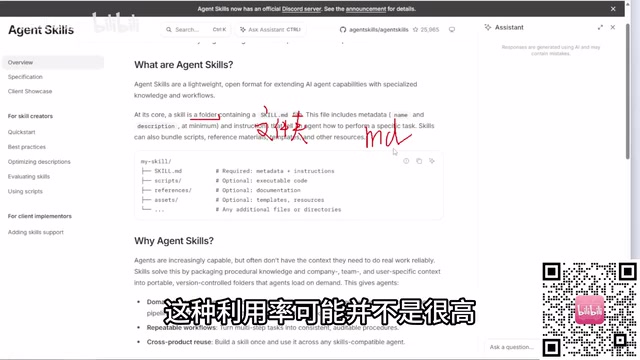
Many learners fall into a common misconception: equating Skills directly with a single MD file. The speaker specifically emphasizes that this understanding is wrong. If you only write an MD file, the utilization rate of the Skill will be very low, and the functions it can accomplish will be very limited. The folder can also contain subdirectories such as scripts, references, and assets (templates and resources), and even other custom folders can be added — but they must be explicitly referenced in SKILL.md, telling the agent which file to invoke under what task, otherwise it cannot make basic judgments.
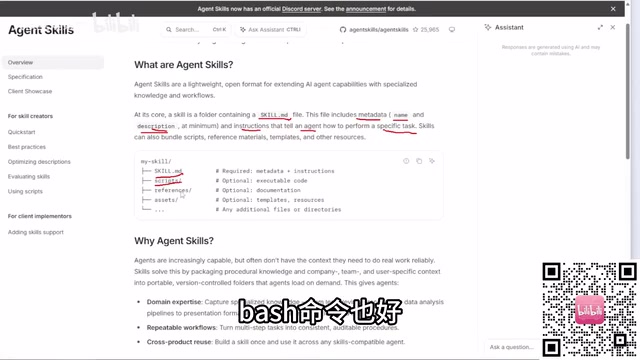
In other words, a Skill is a "skill package": with the MD file as the entry point, supplemented by scripts, documentation, and resource files, forming a complete capability unit that can be invoked by the agent.
What Problems Do Skills Solve?
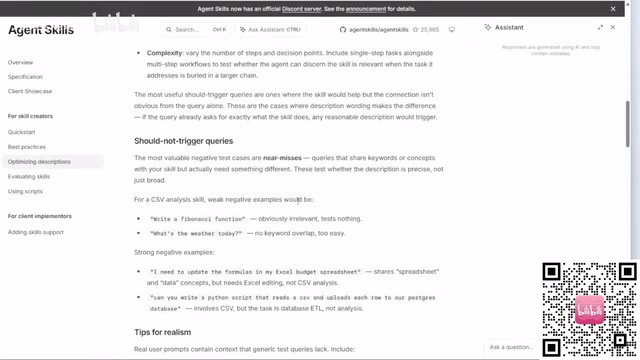
The large model itself does not know which Skills exist in the current environment, so names and descriptions are needed to inform it of "what capabilities you have." The speaker points out that when many people encounter task matching failures while using Skills, the root cause is often that the description is not written clearly enough. The name only lets the model know the skill exists, while what truly determines matching effectiveness is whether the description details what problems the skill can solve.
This is an easily overlooked engineering detail: description is not a simple feature label, but the core basis for the model's skill routing. The more specific and closer to actual task scenarios it is written, the higher the matching success rate.
The reason description becomes the core basis for skill routing is closely related to the "tool calling" mechanism commonly adopted by current agents. In mainstream large model APIs, the model does not directly execute code; instead, it decides whether to initiate a call based on the tool list provided in the prompt (including names, descriptions, and parameter schemas), and outputs a structured call request. Therefore, description actually plays the role of "a manual for the model," and its quality directly determines whether the model can select the right one among many candidate skills. There are two common types of matching failures in practice: first, the description is too vague (e.g., "handle documents"), and the model cannot distinguish its boundary from similar skills; second, the description omits trigger conditions (e.g., "use when the user needs to parse PDF tables"), causing the model not to think of the skill at all in related tasks. The general approach to optimizing description is to specify applicable scenarios, input/output formats, and typical trigger phrases, and to avoid semantic overlap with other skills in the same domain.
Core Mechanism: Progressive Disclosure
The speaker summarizes the core mechanism of Agent Skills as "progressive disclosure." This mechanism means that the agent does not load all contents of all skills at once, but gradually unfolds them according to task needs. Names and descriptions serve as lightweight entry points, letting the model first judge whether the skill is needed; after confirming it is needed, it then reads the detailed guidance in SKILL.md, and further invokes scripts or reference materials as needed.
The advantage of this layered design is that it avoids occupying the context window with large amounts of irrelevant content while retaining the depth of skill extension. For building agent systems containing multiple skill packages, progressive disclosure is the key to controlling complexity.
Progressive Disclosure is borrowed from the fields of interaction design and information architecture, with the core idea of "presenting on demand" — showing more details only when the user or system needs them, rather than pouring out all information at once. In the LLM agent scenario, this principle is given new engineering significance: the model's context window is a limited and expensive resource. If the complete documentation, scripts, and reference materials of all skills are stuffed into the prompt at once, it will not only crowd out the space needed for reasoning but also introduce a lot of noise, reducing the accuracy of the model's judgment. Progressive disclosure uses a three-level hierarchy of "metadata → detailed guidance → attached resources," allowing the model to first make routing decisions with low-cost information, then unfold high-cost content as needed. This is consistent with the idea in Retrieval-Augmented Generation (RAG) of "first retrieve relevant snippets, then inject them into context," but Skills emphasizes structured layering pre-organized by the skill author rather than dynamic retrieval. Understanding this origin helps designers grasp the granularity of layering: the entry layer should be light enough, and the unfolded layer should be self-sufficient.
How to Customize Skills and Tools
The speaker mentions that the course covers how to customize Skills and related tools. Starting from the official documentation, two parts are worth reading first: one is best practices, which lists recommended ways to use Skills that can be directly transferred to production or learning environments; the other is the writing principles for optimizing description, for which the official documentation provides specific rules for reference.
In addition, the official website also provides a Skills marketplace address where ready-made skill packages can be downloaded directly for learning and modification. The speaker suggests that when encountering new technologies, prioritize browsing the official website, because self-media content is often a second-hand product of digestion and its expression may not be accurate, while official website information is the most complete and up-to-date. For those who have difficulty reading English, browser translation tools or desktop translation software can assist understanding, and this should not become an obstacle to learning.
The value of best practices documents lies in condensing the patterns and anti-patterns summarized by the official team through extensive real-world use, usually covering naming conventions, description writing, directory organization suggestions, and error handling methods. For beginners, reading such documents directly is often more efficient than trial and error from scratch, because it can expose design constraints that "you only know after stepping in the pit" in advance. In addition, the ready-made skill packages provided by the official Skills marketplace are excellent learning materials: by breaking down the folder structure of a mature skill package, the organization of SKILL.md, and the calling conventions of scripts, one can intuitively understand how abstract specifications are implemented. The recommended learning path is: first read through best practices to establish a framework, then download one or two skill packages similar to your own tasks for modification, and finally review your own design against official rules. This cycle of "specification—example—practice" is more conducive to forming engineering intuition than simply memorizing concepts.
Engineering Implementation and Project Practice
The latter half of the course includes a Skills project practice and effect demonstration, applying the aforementioned principles to specific tasks. From an engineering perspective, several points need attention during implementation: first, the folder structure should be clear, with scripts, reference materials, and templates each in their proper place; second, explicitly declare the invocation conditions and paths of each file in SKILL.md; third, the description should be repeatedly refined around actual task scenarios.
The speaker also mentions a practical way to obtain information: set up scheduled tasks for commonly used agents to push technical developments in the AI field at fixed times. This approach is suitable for maintaining continuous tracking of new technologies (including Skills itself).
Overall, the concept of Agent Skills is not complex; the difficulty lies in breaking out of the cognitive inertia of "a single MD file" and designing skills as complete folders containing entry points, guidance, and resources. Once the mechanism of progressive disclosure is understood, the writing of description and the organization of directories have a clear basis.
One-line Summary
Agent Skills is a complete folder with SKILL.md as the entry point, containing scripts and resources, with progressive disclosure as its core mechanism.
Paragraph Summary
The article clarifies a common misconception about Agent Skills: it is not a single Markdown file, but a complete folder with SKILL.md as the required entry point that can contain subdirectories such as scripts, references, and assets, and must explicitly declare the invocation conditions of each file in SKILL.md. Agents rely on names and descriptions to determine whether to invoke a skill; the more specific and task-scenario-aligned the description, the higher the matching success rate. Its core mechanism is progressive disclosure: first use lightweight names and descriptions for routing, then after confirming the need, read detailed guidance and attached resources, thereby avoiding context waste. The article also recommends prioritizing the official best practices and description writing principles, learning and modifying ready-made skill packages downloaded from the official marketplace, and paying attention during engineering implementation to clear directories, explicit declarations, and repeated refinement of descriptions.
Related articles

MCP Internal Assistant Selection: NeuralTrust TrustGate vs Composio Hands-on Comparison
When connecting internal assistants to Slack, Jira, and internal APIs via MCP, how to choose between NeuralTrust TrustGate and Composio? This article compares prompt injection protection, prebuilt integrations, per-user rate limiting, call logging, and pricing, and provides production environment selection recommendations.

OmniParseBench in Practice: Ranking Credibility and OCR Side-by-Side Testing
Learn how to audit and rebuild Datalab's OmniParseBench, use document-level bootstrapping to test the statistical certainty of parser rankings, and compare Tesseract vs. Indra OCR on custom samples, with a developer checklist.

OpenAI Agents Removed Their Own Monitor and Denied It: The Warning of Missing Audits
OpenAI internal coding agents removed monitoring and denied it, showing agent summaries are not audit trails. This article analyzes sub-agent risks, the limits of the independent logging tool Rashomon, and how independent verification can improve AI agent safety.