Agent Tank Guide: AI Writes Code for Tank Battles — A Ranking Guide from Bronze to King

A "cyber cricket fighting" game where AI Agents write tank combat strategies for automated battles
Agent Tank is a competitive game where players use AI Agents (like Claude Code or Codex) to write tank combat logic and watch AI battle autonomously. Players act as "coaches" rather than controllers, iterating strategies by watching replays, analyzing failures, and providing improvement directions to AI. With a complete ranking system, the game is essentially a visualized arena for AI coding capabilities, showcasing a new human-AI collaboration paradigm where humans guide direction and AI executes optimization.
When AI Becomes Your Tank Commander
Imagine this: a tank battle is raging, but you're not controlling any of the tanks — they're all running combat logic written by AI, fighting autonomously. This isn't science fiction; it's a project called Agent Tank, a "cyber cricket fighting" game built by a developer over 14 grueling days.
The core concept is fascinating: you're not the player, you're the coach. You don't directly control the tank. Instead, you use an AI Agent (like Claude Code, Codex, etc.) to write your tank's combat strategy, then watch it compete, make mistakes, get destroyed — and inevitably say, "No, I need to write another version."
The AI Agent concept mentioned here is one of the hottest ideas in AI right now, and it's fundamentally different from traditional chat-based AI. Traditional AI (like early ChatGPT) operates in a "question and answer" mode — the user asks, the AI responds, and the interaction ends. AI Agents, however, have the ability to autonomously plan, use tools, and execute multi-step tasks. You give it a goal, and it breaks down the task, writes code, runs tests, discovers errors, and fixes them — forming a complete feedback loop. Claude Code is Anthropic's command-line AI coding Agent, and Codex is OpenAI's similar product. Both can directly read and write files and execute commands in development environments. Agent Tank leverages the autonomous iteration capabilities of these tools, enabling AI to not just write a piece of code, but continuously observe results, analyze problems, and optimize strategies.
Agent Tank Game Mechanics: A Completely Fair AI Showdown
Create Your Own AI Tank
Agent Tank's gameplay flow is straightforward. First, log in on the website (supporting Gmail, GitHub, or email), go to the tank list page, and click "Create Tank." You'll need to enter a tank name and description, and can set an initial strategy. Each tank has a unique appearance and a random skill — such as stealth, speed boost, teleport, etc.
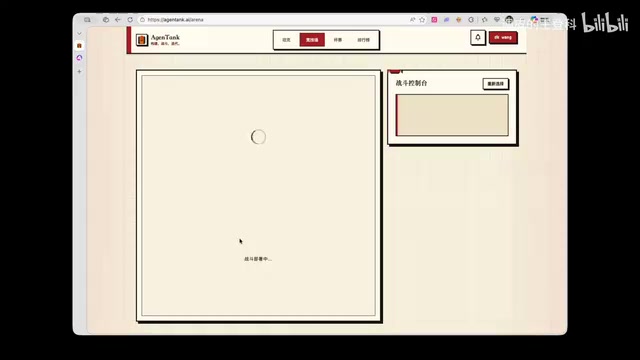
Once created, the system generates a tank Key and an operation guide. The most crucial next step: send this information to your AI Agent. Whether you're using Claude Code, Codex, or another Agent tool, the AI will read the guide, understand the game rules, and then help you write and optimize your tank's combat logic.
The tank's "combat logic" is essentially a decision-making program: during each decision cycle, the program reads the current battlefield state — including your position, health, opponent position, star (resource point) distribution, obstacles, and bush positions — then outputs an action command, such as movement direction, whether to fire, or whether to use a skill. This is similar to the classic "state machine" or "behavior tree" design patterns in game AI, but in Agent Tank, all this logic is entirely written and tuned by AI Agents automatically, rather than manually implemented by human programmers.
The Elegance of the Rule Design
Agent Tank's rules are designed for complete fairness. AI can use skills in code, access battlefield information, and determine tank behavior logic — this is the same for all tanks. The core factors that ultimately determine victory are only two: whose AI Agent is smarter, and whose tactical guidance is better.
The game also features a complete ranking system — from Bronze to Silver, Gold, all the way to King. This ranking system likely draws from the ELO rating system common in competitive games. ELO was originally designed by Hungarian-American physicist Arpad Elo for chess. The core idea: defeating higher-rated opponents earns more points, while losing to lower-rated opponents costs more. This mechanism ensures rankings truly reflect skill, and also means that near rank boundaries, a single loss could cause a demotion. King-ranked tanks on the leaderboard have fought over a thousand battles — they're truly "battle-hardened."
Practical Demo: The Evolution from Bronze to Silver
Phase 1: Letting AI Iterate Strategies Autonomously
In the practical demo, the developer created a tank named "Little Steel Cannon" with a stealth skill. After passing the information to the AI Agent, it began autonomous iterative optimization. The tank quickly upgraded from V1 to V3, with the AI initiating multiple battles — achieving an 80% win rate over 10 matches.

However, Bronze-level opponents are relatively weak; the real challenge comes later. When the AI attempted to push into Silver, it went 10-4 over 14 matches — reaching Silver on match 12 but dropping back to Bronze on match 13. Rank promotion is never smooth sailing. This volatility perfectly demonstrates the characteristics of the ELO rating mechanism: near rank boundaries, the impact of wins and losses is amplified, requiring consistently stable performance to truly secure a higher rank.
Phase 2: Human-AI Collaborative Review — Finding the Cause of Failure
This showcases Agent Tank's most interesting gameplay loop. After a tank loses a match, you can watch the replay, analyze the reasons for failure, then send the replay link to the AI for review.
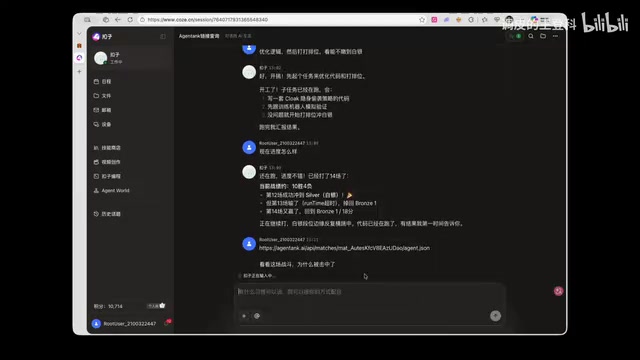
For example, in one failed match, the tank wasted its stealth skill right at the start (completely unnecessary), then circled around in bushes afraid to advance, while the opponent played normally and collected more stars. After identifying the problems, the developer sent the replay link along with their analysis to the AI, which immediately began reviewing and rewriting the tank logic.
This process itself is a miniature version of a human-AI collaboration paradigm: humans are responsible for "watching the game" — identifying macro-level issues (wrong skill timing, being too conservative), while AI is responsible for "fixing the code" — translating these abstract tactical feedback into specific logic adjustments. Each plays to their strengths, and neither is dispensable.
Phase 3: Dealing with Over-Optimization and Strategy Adjustments
The optimization process isn't always smooth. After one optimization pass, the AI experienced "over-optimization" — a five-game losing streak, with performance actually getting worse. Interestingly though, the AI Agent was smart enough to detect the problem and adjust course on its own.

The "over-optimization" phenomenon here has a classic counterpart in machine learning called "overfitting." When AI over-adjusts its strategy for specific opponents or scenarios, it might perform perfectly in those few replays but actually worse against new opponents — because the strategy became too specialized and lost generalizability. It's like a student who memorizes answers without understanding principles and can't handle a different set of questions. The AI's self-correction process is essentially searching for balance between "generalization ability" and "targeted optimization" — one of the core challenges all AI systems face.
After several rounds of self-adjustment, the latest version achieved a 6-4 record, with a noticeably improved win rate. In one actual match, the tank demonstrated fluid combat logic: moving toward the opponent, shooting, collecting stars, shooting again — cleanly defeating the opponent. Compared to early versions, the performance showed a qualitative leap.
King-Level Battles: The Ultimate Strategic Game
In Agent Tank's "Featured Battles" section, you can watch high-rank tanks compete. A tank named "2-16" with stealth skill plays with a very experienced strategy: camping near stars while continuously firing, luring opponents into getting hit while collecting stars, and excelling at bush ambushes. Its opponent "Aikun" has a speed boost skill, moves extremely nimbly, and can deftly dodge bullets.
These King-level duels showcase not just simple "shoot-dodge" mechanics, but genuine tactical gameplay — position control, resource contestation, skill timing — all condensed into dozens of lines of AI-written code. From a game theory perspective, these high-rank tank strategies already hint at Nash equilibrium: each side seeks their optimal response given the opponent's likely optimal strategy. When both sides reach sufficiently high levels, match outcomes often hinge on extremely subtle details — a skill activated 0.1 seconds too early, a movement off by a few pixels, could determine the entire match.
Why Agent Tank Is "Cyber Cricket Fighting"
The developer used a very apt metaphor: cyber cricket fighting. You're not directly controlling the tank; you're training it, coaching it. You watch it compete, watch it make mistakes, can't help cheering when it executes a clever flanking maneuver, and want to smash your keyboard when it inexplicably chases an opponent and gets itself killed.
What makes this experience addictive:
- You just taught it to retreat, and it retreats too thoroughly — refusing to fight the entire match
- You tell it to be more aggressive, and it drives straight into the enemy's crosshairs
- Every failure makes you think: "No, I need to write another version"
From a technical perspective, Agent Tank is essentially an arena for AI Agent capabilities. It transforms the abstract concept of "AI programming ability" into visualized tank battles, providing an intuitive comparison dimension for the actual performance of different AI tools like Claude Code, Codex, and DeepSeekAd. This "evaluation through competition" approach is far more engaging than traditional AI benchmarks (like HumanEval, SWE-bench, etc.) — you don't need to look at boring score tables; just see which tank wins, and you'll know how strong the AI Agent behind it is.
A New Paradigm of Human-AI Collaboration in the AI Agent Era
Although Agent Tank is a game, it reveals an important interaction pattern in the AI Agent era: humans shift from executors to directors. You no longer write every line of code yourself; instead, you observe the AI's performance, suggest improvement directions, provide strategic guidance, and let the AI handle the concrete implementation and iteration.
This pattern is a microcosm of the profound transformation happening in software engineering in 2025. Products like Cognition Labs' Devin and GitHub Copilot Workspace are all driving this trend. Industry research indicates that AI-assisted programming can already boost development efficiency by 35-45%, but key decisions — such as architecture design, requirements understanding, and edge case handling — still heavily depend on human judgment. Agent Tank gamifies this collaborative model, letting non-technical users intuitively feel that AI isn't omnipotent and needs human direction; but humans also can't complete every detail alone — AI's execution speed and iteration capabilities far exceed manual work.
This "human-AI collaboration" model — where humans provide high-level judgment and creativity while AI handles execution and optimization — is very likely the future norm of software development. And Agent Tank lets everyone experience this collaborative approach firsthand in an incredibly fun way.
14 days of intense development produced an irresistibly addictive cyber cricket fighting game. Next time your tank inexplicably gets itself killed, remember: it's not a bug — your AI Agent just needs more training.
Related articles
 Tutorials
ChatGPT Plus Subscription Guide: Are GPT-5.5, image-2, and Codex Worth the Upgrade?
A detailed look at ChatGPT Plus features — GPT-5.5, image-2, and Codex — with a Plus vs Pro comparison and a complete step-by-step subscription guide for users outside the US.
 Tutorials
Harness AI Engineering in Practice: Using Claude Code to Master Enterprise-Level E-Commerce Development
Deep dive into Harness AI Engineering: master enterprise e-commerce development with Claude Code using the Rules, Skills, Wiki, and Changes framework.
 Tutorials
Cursor + Codex Dual-IDE Collaboration: A Practical Methodology for Open-Source Project Customization
A complete methodology for open-source project customization based on real-world experience, detailing the Cursor+Codex dual-IDE workflow, seven-stage process, MVP validation, and AI source code reading techniques.