Agentic OCR: How the Right Amount of AI Reasoning Can End Brittle Legacy Document Recognition

Agentic orchestration — not bigger models — is the key to finally fixing OCR's long-tail problem.
Traditional OCR systems are brittle pipelines that fail on complex documents, but replacing them with frontier LLMs introduces prohibitive cost, latency, and hallucination risks. The real solution is agentic orchestration: dynamically allocating compute to hard regions, building closed-loop error correction, and constructing page-wide semantic structure. This approach balances accuracy and cost in ways neither legacy tools nor raw frontier models can achieve, and serves as a broader model for deploying AI in any legacy-dominated domain.
Why OCR Is a Perfect Landing Zone for AI Agents
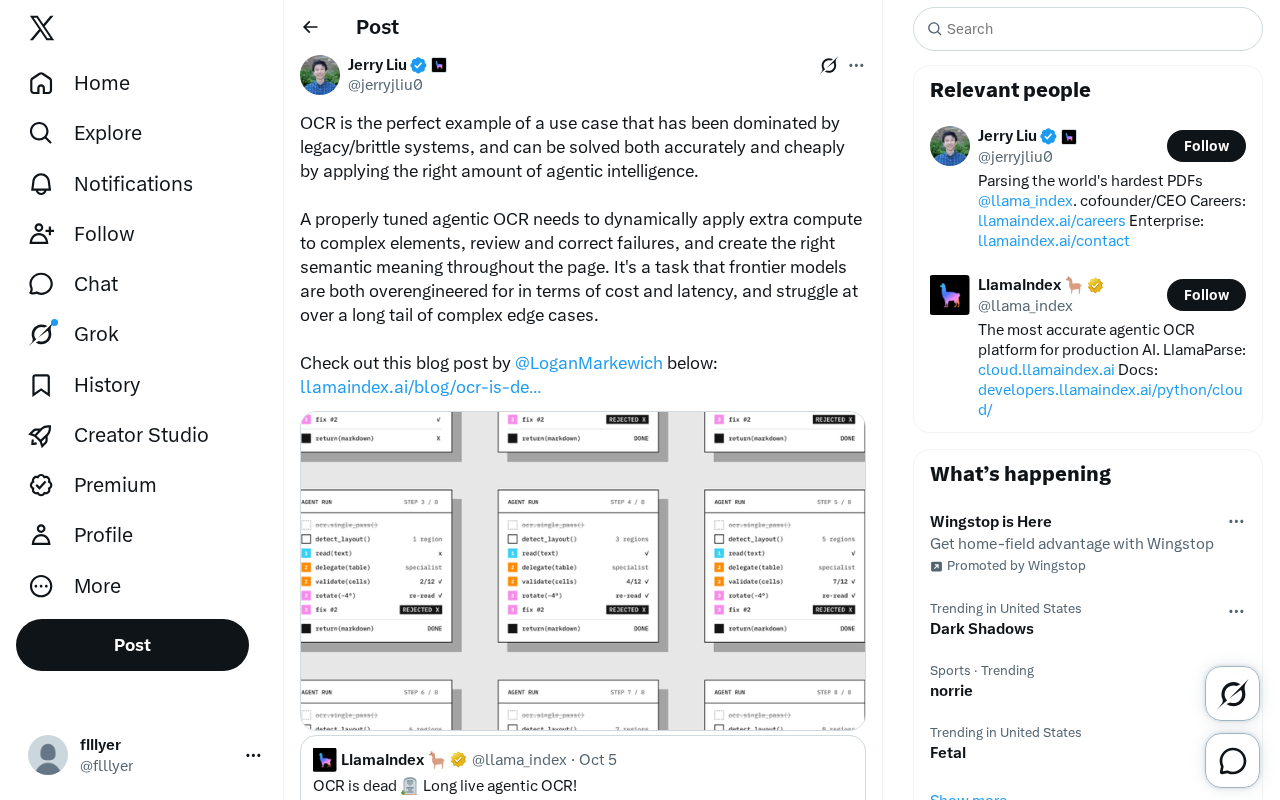
Optical Character Recognition (OCR) has long been considered a "solved" problem — but anyone who has actually used a traditional OCR engine on complex documents knows better. Misaligned tables, missed handwriting, scrambled multi-column layouts, lost semantic context — these issues plague legacy systems to this day. As one widely discussed tweet put it, OCR is exactly the kind of use case "dominated by legacy systems and brittle solutions" that can benefit enormously from applying "just the right amount of agentic intelligence" — achieving both higher accuracy and lower cost simultaneously.
This observation deserves attention because it points to an underappreciated direction in AI deployment: not throwing the most powerful model at every problem, but using agentic orchestration to direct compute precisely where it's needed.
The Fundamental Limits of Traditional OCR
The core problem with traditional OCR systems is that they are brittle — they process pages through fixed rules and rigid pipelines, and they break or produce errors the moment they encounter inputs outside their predefined patterns. These systems have no understanding of content semantics; they cannot tell whether a piece of text is a table header, a footnote, or body copy, and they have no ability to self-correct when recognition fails.
The result: when faced with documents that have complex structures or non-standard layouts, traditional solutions typically require extensive manual post-processing. This drives up real-world costs and reduces "automation" to little more than a label. OCR may look like a mature field on the surface, but it has always had significant blind spots in the long tail of complex edge cases.
It's worth noting that the dominant tools in traditional OCR include Tesseract (open source), ABBYY FineReader, and OCR APIs from major cloud providers. These systems typically rely on convolutional neural networks (CNNs) for character segmentation and recognition, but the overall pipeline is a hardcoded, one-way flow: image preprocessing → layout analysis → character recognition → post-processing. Errors at each stage compound downstream, with no mechanism to assess whether the current output is trustworthy. Academics typically measure OCR quality using Character Error Rate (CER) and Word Error Rate (WER) — metrics that approach human-level performance on standard printed-text datasets. But in real business scenarios — mixed languages, scan noise, non-standard fonts, complex tables — performance drops sharply. This is the origin of the so-called "long-tail problem."
How Agentic OCR Works
What makes a "properly tuned agentic OCR" system distinct is dynamic compute allocation — rather than treating every part of a page the same way. Three key capabilities stand out:
Dynamically Scaling Compute for Complex Elements
Within a single document page, recognizing plain text paragraphs is relatively straightforward, while tables, formulas, and handwritten annotations demand far more reasoning. Agentic OCR can identify which regions are "hard" and direct extra compute there specifically — rather than wasting resources on simple regions while starving complex ones.
Review and Error-Correction Mechanisms
An agentic pipeline isn't a one-shot output. It has the ability to self-review and correct failures. When a recognition result looks suspicious, the system can loop back, re-examine it, and reprocess it. This closed-loop correction is exactly what traditional pipelines lack.
Building Page-Wide Semantic Meaning
The goal of agentic OCR isn't just turning pixels into characters — it's constructing correct semantic structure across the entire page, understanding the hierarchy and relationships among elements. This makes the output actually usable, rather than a pile of unstructured text fragments.
The term "agentic" here borrows from recent AI system architecture concepts. Unlike a traditional single-pass inference call, agentic systems feature a perceive–plan–act–feedback loop: the system can adjust subsequent behavior based on intermediate results, and even backtrack to re-execute a step. In an OCR context, this means the system no longer simply "scans a page and outputs text." It operates more like a self-scheduling processing workflow: first using a lightweight model for initial layout analysis, then calling a more powerful model to review low-confidence regions, and finally performing a semantic-level consistency check across the full document structure. Frameworks like LlamaIndex provide the infrastructure for building such orchestration systems, enabling multi-model collaboration, conditional branching, and result validation to be expressed and executed systematically.
Why Not Just Use Frontier Models Directly?
The natural question is: if frontier models are so capable, why not just use them end-to-end for OCR?
The answer offered is genuinely insightful: frontier models are simultaneously over-engineered and under-capable for this task.
On one hand, using the most powerful large models to process every ordinary document page is a serious waste of resources — a classic case of using a sledgehammer to crack a nut. On the other hand, these same models struggle with the long tail of complex edge cases and cannot guarantee consistently reliable results.
In other words, simply throwing more model capacity at the problem is neither economical nor sufficient to cover all scenarios. The real solution lies in orchestration — using an agentic framework to direct appropriate compute to the right places, striking a balance between accuracy and cost. This approach is elaborated in more detail by LlamaIndex's Logan Markewich in his blog post.
The "frontier models" in question are primarily large vision-language models (VLMs) with native multimodal capabilities — GPT-4o, Claude 3.5, Gemini 1.5 Pro, and their peers. These models perform impressively on individual complex images, but in industrial-scale batch document processing, they face two practical constraints. First, cost and latency: calling top-tier models via API can cost tens of times more per page than a dedicated lightweight model. Second, throughput limits: these APIs typically have rate limits that make it hard to support high-concurrency enterprise document processing. More subtly, the "intelligence" of large models can itself be a liability — they perform inferential completion on image content, which in OCR tasks can lead to "hallucinated recognition," where the model "understands" characters into existence that aren't actually there, rather than faithfully transcribing what is. This fundamentally conflicts with high-fidelity document capture requirements.
Implications for AI Application Deployment
The value of this perspective extends well beyond OCR. It reveals a more general engineering philosophy: in many domains dominated by legacy systems, the breakthrough rarely comes from "replacing everything with a bigger model." It comes from "applying the right intelligence in the right place through agentic orchestration."
Dynamic compute allocation, failure review and correction, and holistic semantic understanding — together, these three capabilities represent the direction AI applications are evolving: from "single model calls" toward "agentic orchestration systems." For any team trying to deploy AI into real business processes, OCR is an excellent reference case. It's concrete enough to be measurable, and it clearly demonstrates the cost and performance advantages of the agentic approach over brute-force model invocation.
It's worth noting that the perspectives in this article are primarily drawn from a Twitter discussion and the blog post it references. Specific technical implementation details and quantitative comparisons should be sought in the original blog content.
Related articles

Gemini 4 Argon Hands-On: AI Builds Board Games, Constructs Temples, and Trains Robots Autonomously
Gemini 4 Argon hands-on roundup: AI autonomously builds a desk racetrack and temple in Blender, writes a ray tracing engine, trains a humanoid robot to sink 7 shots, plus API pricing and developer access.

The Magic Octagonal Coin: Why Only 9% of People Can Predict Its Flip?
Only 9% of people can correctly predict the Magic Octagon coin flip. This article explains its spatial rotation mechanism, common cognitive pitfalls, and a new hypothesis based on Relevance Theory, exploring the limits of human spatial reasoning.

Sam Altman: AI Is Entering the Era of Scientific Discovery — Math Breakthroughs Will Replicate in Biology and Energy
Sam Altman says AI is entering the era of scientific discovery — math breakthroughs will replicate in biology, materials science, and energy to help develop new drugs and energy sources.