AgentScope 2.0 Framework Deep Dive: ReAct, Safety Layers, and Context Management

AgentScope 2.0 is a production-ready Agent framework built around ReAct, three-layer safety, and context management.
AgentScope is an Agent development framework designed to tackle three core engineering challenges: building, safety, and long-context management. Its primary paradigm is ReAct — a loop of reason → act → observe → reason again. For high-permission Agents that pose security risks, AgentScope provides a three-layer defense: tool auditing (can it be done?), human-in-the-loop (will it be permitted?), and sandbox isolation (where can it safely run?). For context bloat caused by long-running sessions, the framework offers systematic context management strategies. Version 2.0 is a near-complete rewrite over 1.0 and is already production-grade — beginners should start here directly. Both Python and Java versions are available.
What Is AgentScope
Before diving into AgentScope, it helps to clarify a fundamental question: what actually separates an Agent from an ordinary chatbot? A regular chatbot simply answers questions — you ask, it responds, and that's it. An Agent, on the other hand, can not only converse but also reason independently, call tools, and execute tasks.
Consider a typical scenario: you hand an Agent the following task — "Analyze today's sales data, generate a report, and email it to the manager." The Agent will read the sales data on its own, invoke Python for analysis, generate the report, and finally use an email tool to send the results. As Agents become capable of doing more, a pressing set of questions emerges: How do we build them? How do we control them? How do we ensure they don't go rogue? And when something goes wrong, how do we trace which step failed?
Agent development frameworks exist precisely to address these challenges, and AgentScope is one of them. In a single sentence: AgentScope is a development framework that helps developers build, deploy, manage, and run Agents.
Why Start Directly with 2.0
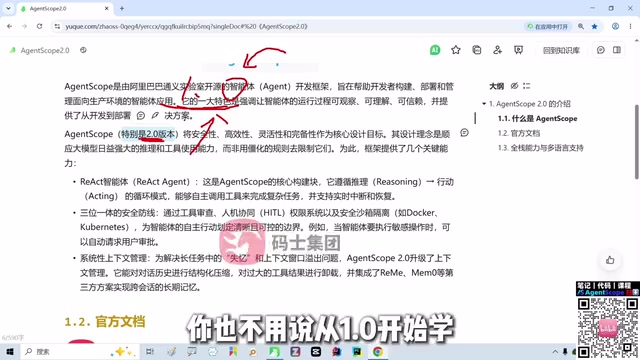
AgentScope originally launched with version 1.0, but 2.0 represents a massive departure — many APIs have been deprecated, and its creators have described the change as "destructively breaking." Learning 1.0 before 2.0 is essentially starting over. For newcomers, there's no reason to begin with 1.0. Jump straight to 2.0, which has already reached production-grade quality.
Core Capability 1: The ReAct Agent
The word "ReAct" might call to mind the frontend framework React, but the two are completely unrelated. Here, ReAct is a portmanteau of Reasoning and Action, representing a loop pattern of "think while doing."
To illustrate: you ask an Agent, "Is it raining in Beijing today — should I bring an umbrella?" The question ultimately falls to a large language model, but the model has no access to real-time Beijing weather. So the Agent starts reasoning — to answer the umbrella question, it first needs to know the weather. After reasoning, it takes action by calling a weather lookup tool. The tool returns "Rain in Beijing," and the Agent reasons again, concluding that the user should be reminded to bring an umbrella, and delivers the final answer.
The full flow is a cycle: reason → act → observe the result → reason again. For complex tasks, this loop repeats many times: reason, call a tool, observe the result, realize a web page needs to be read, observe again, execute a Python snippet to analyze data, and keep going until the task is complete.
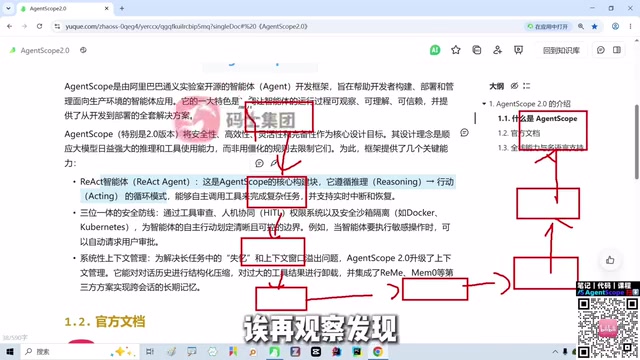
AgentScope treats ReAct as its core Agent-building paradigm, designing around capabilities like tool invocation, streaming execution, and interrupt-and-resume to handle increasingly complex task scenarios.
ReAct was first proposed in 2022 in the paper "ReAct: Synergizing Reasoning and Acting in Language Models" by researchers from Google and Princeton University. The key finding was that purely "thinking" (Chain-of-Thought) is prone to hallucination, while purely "acting" (calling tools) lacks reasoning grounding — interleaving the two significantly outperforms either approach alone. In practice, each iteration of a ReAct loop typically produces three structured outputs: Thought (the model's internal reasoning), Action (which tool to call and with what parameters), and Observation (the result returned by the tool). These three segments are concatenated back into the prompt as input for the next round of reasoning, cycling until the model determines the task is complete and produces a final answer. This transparent structure — where reasoning is observable and actions are traceable — makes ReAct Agents far easier to debug than black-box decision systems.
Core Capability 2: A Three-Layer Safety System
When an Agent can only answer "What's the weather in Beijing?", safety is barely a concern. But as Agent permissions expand — deleting files, executing code, running shell commands, querying databases, sending emails, or even accessing internal enterprise systems — a sharp question arises: would you trust it to run completely autonomously?
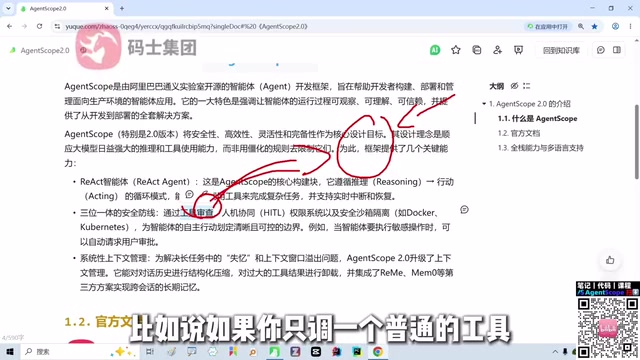
An Agent's judgment will occasionally be wrong. Suppose you ask it to clean up unused files in a project. It misjudges a file as unnecessary, runs rm -rf, and deletes the wrong thing. In a production environment, that could be catastrophic. AgentScope addresses this with three layers of safety mechanisms.
Tool Auditing
Not every tool can be called freely when an Agent invokes it. Routine tools — like a weather lookup — can be executed immediately. But when an Agent is about to call a sensitive tool that might delete database contents, the framework performs a check before allowing it to proceed.
Human-in-the-Loop
The Agent can work on its own, but humans have the final say on critical steps. For example, when the Agent reasons its way to executing a high-risk statement like DELETE FROM ..., it pauses and asks an administrator to approve or reject. Approved means continue; rejected means stop or adjust. This mechanism doesn't prevent Agents from solving problems autonomously — it simply reserves the final call on high-risk actions for a human.
Secure Sandbox Isolation
Even if the human-in-the-loop step approves something incorrectly, or the Agent's own decision is flawed, there needs to be a last line of defense. The sandbox gives the Agent an isolated environment in which to execute code and process files, minimizing any impact on the host system. This capability is common across many Agent frameworks (such as Deep Agent) as well.
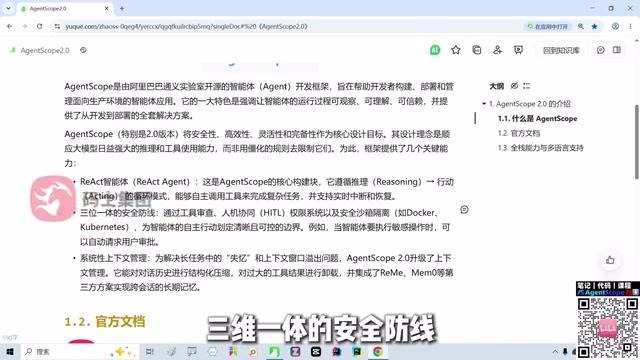
All three layers can be used together: tool auditing governs whether something can be done, human-in-the-loop governs whether it will be permitted, and the sandbox governs where it can be done safely — together forming a comprehensive three-dimensional safety framework.
Sandbox isolation is typically implemented using containerization (e.g., Docker) or OS-level process isolation. When an Agent executes code inside a sandbox, its access to the host's file system, network, and processes is strictly restricted. Even if a destructive command runs, its blast radius is contained within the sandbox container, leaving the host environment unaffected. This design is especially critical when Agents are permitted to autonomously write and run code — Agent-generated code can contain logic errors, unexpected side effects, or even be manipulated into executing malicious instructions via prompt injection attacks. The sandbox doesn't just provide a safety net; it also allows developers to let Agents iterate freely during testing without worrying about polluting the development environment.
Core Capability 3: Systematic Context Management
Imagine an Agent that has been working for two hours — it has searched 20 web pages, called tools 30 times, and read dozens of files. Each tool call returns results that accumulate in the context: 5,000 words the first time, 10,000 words the second, and so on, building into a massive body of text.
The problem is that a large language model's context window is not infinite. As the context grows, important information gets "buried." AgentScope therefore provides systematic context management strategies to handle the challenges of long-context scenarios — specifics that can be explored in depth in later study.
A model's context window refers to the maximum number of tokens it can process in a single pass. Mainstream models have grown from early 4K-token windows to 128K tokens or more today, but every window still has a ceiling, and token count directly affects inference cost and latency. More critically, there's the "Lost in the Middle" phenomenon: research shows that large models are significantly worse at retrieving information from the middle of a long context compared to the beginning or end, meaning key details gathered early in a long Agent run may effectively be ignored. Common context management strategies include: sliding window (dropping the oldest messages), summarization compression (using the model to compress conversation history into a brief summary before continuing), and vector-retrieval memory (storing history in a vector database and injecting relevant snippets into the context on demand). AgentScope's systematic context management provides framework-level support for exactly these kinds of strategies.
Framework Positioning and Version Selection
To summarize: as Agents become more capable and able to complete complex tasks autonomously, that very autonomy introduces safety risks and long-context challenges. AgentScope is built around these exact problems, providing a complete set of Agent engineering capabilities — a production-ready framework for building intelligent applications.
AgentScope is available in both Python and Java versions; this overview focuses on the Python edition. The official documentation supports both Chinese and English, so developers with strong self-study habits can use the official site to go deeper on any topic.
This section is primarily conceptual with no hands-on exercises. It's recommended to review the three main threads — the ReAct loop, the three-layer safety system, and context management — before moving on to environment setup and multi-agent orchestration in practice.
Related articles

AI Visibility Metrics: Definitions Matter More Than Dashboards
AI visibility measurement tools are proliferating, but the lack of unified definitions makes data incomparable. This article analyzes the mismatch and explores why repeatable methodology matters more than dashboards, and how a shared vocabulary can make AI search measurement truly credible.

Liquid AI Releases LFM2.5-24B-A2B: A 2B Active-Parameter MoE Built for On-Device Agents
Liquid AI releases LFM2.5-24B-A2B, an open-weights MoE model with 24B total and 2B active parameters for on-device agents, scoring 48.09 on LiveClaw and hitting 184 tokens/s on Apple M5 Max.

25 Free Browser-Based Image Design Tools: No File Uploads, Local Processing for Peace of Mind
25 free browser-based image design tools that run locally with no file uploads. Covers image compression, format conversion, color schemes, WCAG contrast checking, EXIF metadata viewing, and more — no registration needed.