AgentsDock: A Dedicated IDE Built for Agentic AI Research
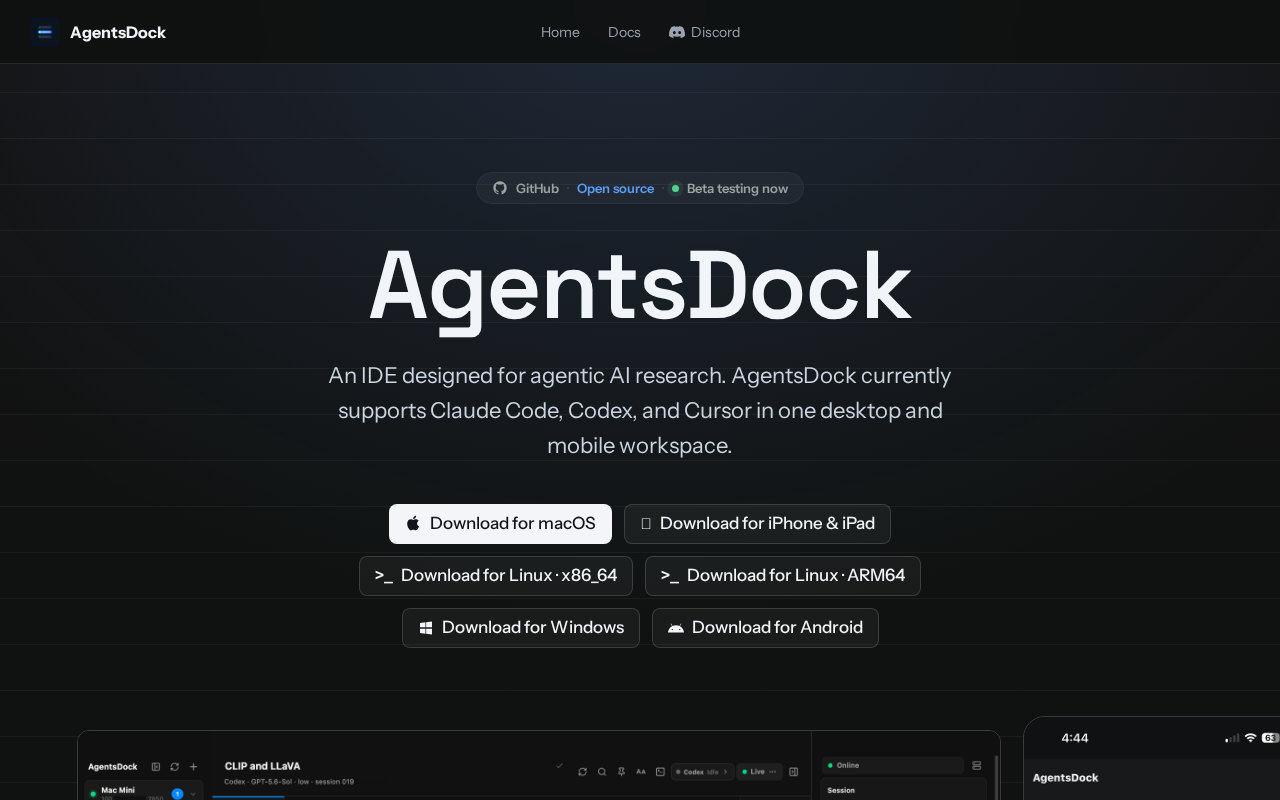
AgentsDock is an all-in-one IDE designed to solve debugging and observability challenges in multi-agent AI systems.
AgentsDock is a developer tool that recently appeared on Hacker News, positioning itself as an "IDE designed specifically for agentic AI research." Unlike existing frameworks such as LangChain and AutoGen, it integrates agent authoring and runtime observation into a single environment — tackling the pain points of debugging and observability in multi-agent systems that traditional editors struggle to address. The project is still in an early stage with limited public details, and its success hinges on compatibility with mainstream agent frameworks and whether it can deliver a development experience that general-purpose editors cannot replicate. AgentsDock reflects a broader industry trend: as agentic applications grow in complexity, dedicated developer tooling is beginning to specialize and diverge.
A Development Environment Aimed at Agent Research
As AI evolves from single models toward multi-agent collaboration, the developer toolchain is undergoing a major transformation. AgentsDock, a project that recently surfaced on Hacker News, positions itself as an "IDE designed specifically for agentic AI research" — aiming to fill the gap that general-purpose code editors leave when handling complex agent workflows.
From the project description, AgentsDock's core philosophy isn't to build yet another general-purpose editor. Instead, it reorganizes the development experience around the "agent" as a specific research object. Traditional IDEs excel at managing source code, setting breakpoints, and handling version control — but when researchers need to observe message passing between multiple agents, state transitions, and tool call chains, those capabilities often fall short. AgentsDock targets exactly this pain point.
It's worth noting that the project currently has limited traction on Hacker News (5 upvotes, 2 comments) and is still in an early exposure stage with limited public information. This analysis is based on its stated positioning and the broader industry context of agent development; specific feature details are yet to be disclosed by the project team.
Why Agent Development Needs a Dedicated IDE
Agentic AI is fundamentally different from traditional single-turn, question-and-answer models. A typical agent system involves multiple stages — planning, memory, tool calls, multi-round reflection — and multiple agents may form cooperative or adversarial relationships. The complexity of such systems is no longer measured in lines of code, but in dynamic runtime behavior.
For researchers, the biggest challenge is observability. When an agent's output goes wrong, the issue could lie in the prompt design, tool return values, context management, or the scheduling logic between agents. Tracking down such problems with traditional log statements and breakpoint debugging is extremely inefficient. An agent-focused IDE should ideally provide more intuitive runtime visualization — such as a timeline of agent conversation flows, input/output snapshots of tool calls, and a state change tracking panel.
The name "AgentsDock" (Dock, as in a harbor dock or docking station) also hints at its product philosophy: providing a unified space for various agents to dock, be orchestrated, and be observed — rather than switching between scattered scripts and terminals.
The concept of Observability originates from distributed systems engineering — it refers to the ability to infer a system's internal state from its external outputs. In traditional software, observability is typically composed of three types of data: logs, metrics, and distributed tracing. In agent systems, this challenge is amplified, because agent behavior is often probabilistic and non-deterministic — the same code can produce completely different outputs in different contexts. Researchers need to know not just "what happened," but "why the model made this decision at this step." This demand has given rise to tools like LangSmith, Weights & Biases Weave, and Arize Phoenix — all purpose-built for LLM and agent workflow observability — but most exist as standalone platforms and have yet to be deeply integrated into coding environments.
Differentiation from Existing Tools
The current agent development ecosystem already includes a range of tools: frameworks like LangChain, AutoGen, and CrewAI, as well as observability platforms like LangSmith. Most of these exist as libraries or cloud services, requiring developers to write code in their own editor and then switch to a separate interface to view runtime results.
By choosing to build an IDE, AgentsDock is betting on integrating "writing" and "observing" into a single environment. The advantage of this all-in-one approach is reducing context-switching overhead; the downside is that it must maintain strong compatibility with existing frameworks — otherwise researchers won't easily abandon the workflows they already know. The project's success will largely depend on how well it supports mainstream agent frameworks and whether it delivers unique value that general-purpose editors simply can't replicate.
LangChain is currently the most widely used LLM application development framework, providing abstraction layers for chaining calls, tool integration, and memory management. AutoGen, developed by Microsoft Research, focuses on multi-agent dialogue and collaborative orchestration. CrewAI features a "role-playing" style of agent definition, making it well-suited for rapidly building agent teams with clear task divisions. These frameworks address the question of how to build agent systems, while observability platforms like LangSmith address how to monitor them. For AgentsDock to truly differentiate itself, it needs to find a third angle between the two — how to understand and correct agent behavior in real time during development — which is precisely where the IDE form factor holds the most imaginative potential compared to libraries and cloud platforms.
Observations on an Early-Stage Project
For developer tools this early in their lifecycle, it's premature to pass a definitive judgment on their value. What truly deserves attention is whether it can solve a specific and pressing problem: making the debugging and iteration of agent systems as controllable as debugging ordinary programs.
If you're working in multi-agent systems, automated workflows, or agent research, AgentsDock may be worth adding to your watch list. Keep an eye on whether it goes open source, how complete its documentation becomes, and what the community feedback looks like — these factors tend to reflect a tool's true maturity far more accurately than its initial feature marketing.
Overall, AgentsDock represents an emerging niche: as agentic applications grow in complexity, the supporting developer tooling will inevitably undergo differentiation and specialization. Whether it will become the defining product in this space still requires time and more public information to determine.
Related articles
Recurrent Looped Transformers: A New Architecture That Teaches Models to "Think Again"
Recurrent Looped Transformers repeatedly apply the same Transformer block to decouple compute from parameters, enabling variable reasoning depth without scaling model size.
"Everyone Else Should Slow Down AI — Except Me": The Double Standard Trap in Big Tech
A viral Hacker News quip — "Everyone should slow down AI, except me" — exposes the double-standard at the heart of the AI race. We unpack why it's a Prisoner's Dilemma, not mere hypocrisy, and why institutions matter more than moral self-discipline.
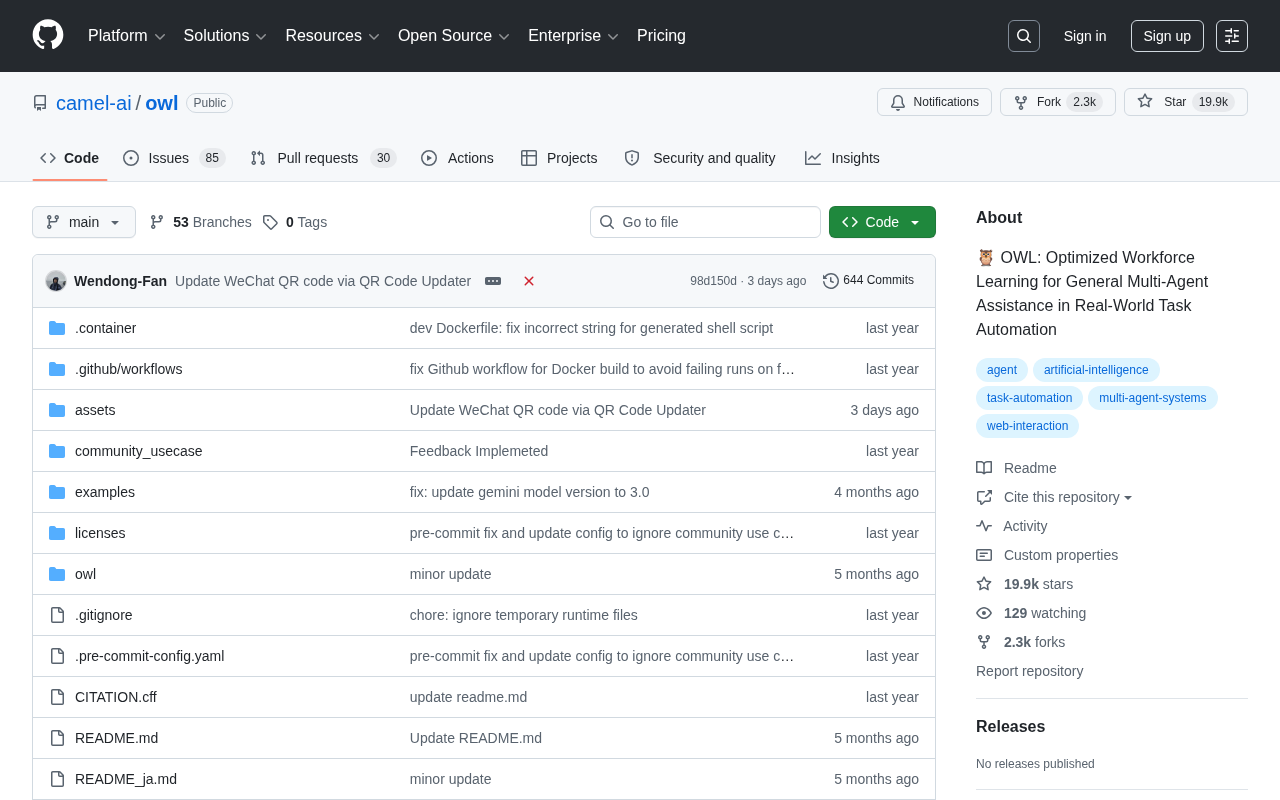
OWL: An Open-Source Multi-Agent Framework for Real-World Task Automation
OWL (Optimized Workforce Learning) is an open-source multi-agent framework by camel-ai for real-world task automation, with 19K+ GitHub Stars. Learn how it works.