AgentSSL: Can MLE Agents Leverage Unlabeled Data?

AgentSSL models SSL as program search; agents' generation surpasses human baselines, but a selection bottleneck causes up to 47% performance drop.
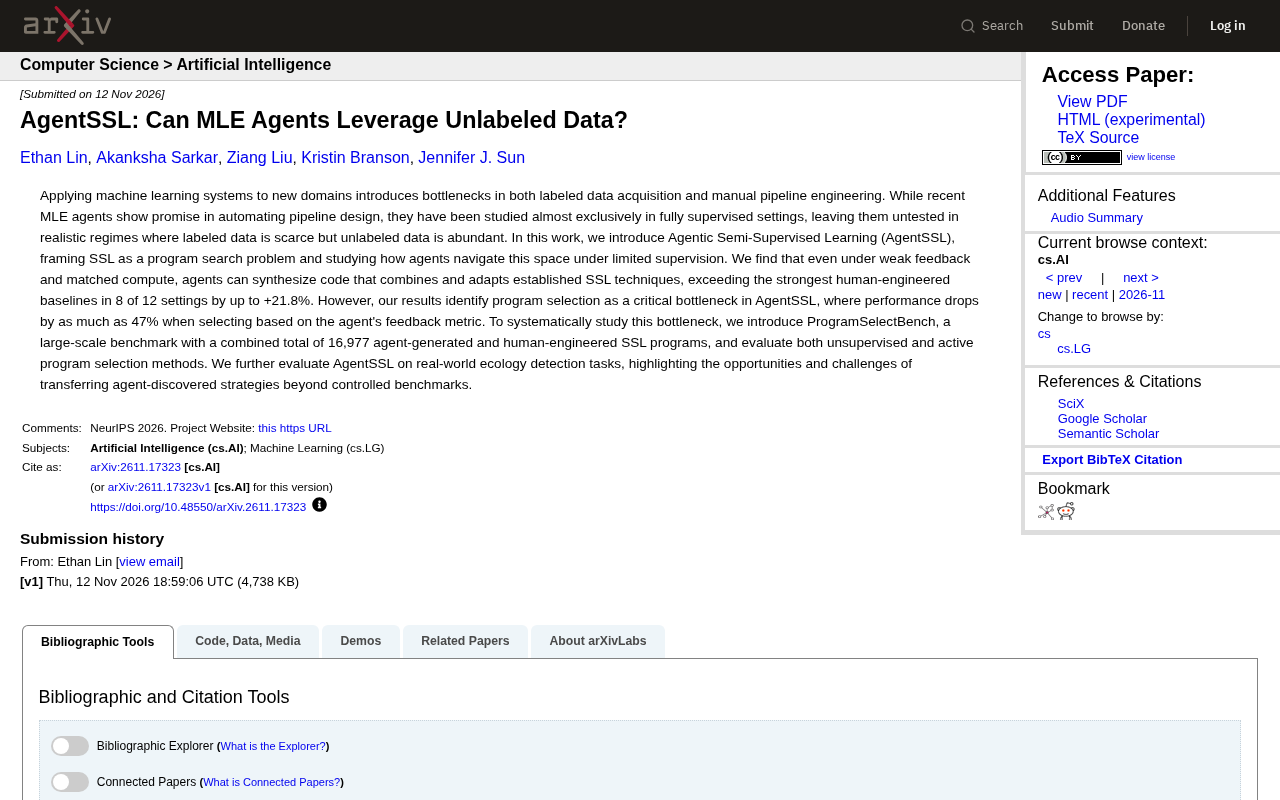
AgentSSL is the first to formalize semi-supervised learning as a program search problem, letting MLE agents autonomously explore the SSL solution space under weak feedback and matched compute. Experiments show agents outperform the strongest human baseline in 8 of 12 settings, with gains up to +21.8%, demonstrating combinatorial innovation in SSL techniques. However, the research reveals program selection as the core bottleneck: when agents choose the final program based on their own feedback metrics, performance drops by up to 47%. The authors build ProgramSelectBench, containing 16,977 agent-generated and human-designed SSL programs, to systematically evaluate unsupervised and active selection methods. Experiments on real ecological detection tasks further reveal both opportunities and challenges for strategy transfer.
When machine learning systems enter new domains, they are often constrained simultaneously by two bottlenecks: acquiring labeled data and designing human workflows. Recently emerging MLE (machine learning engineering) agents have shown promise in automating workflow design, but the vast majority of research has focused on fully supervised settings. For the realistic condition where labels are scarce but unlabeled data is abundant, there had been almost no systematic answer as to whether such agents can still be effective. A work titled "AgentSSL: Can MLE Agents Leverage Unlabeled Data?" is the first to model semi-supervised learning (SSL) as a program search problem, letting agents autonomously explore the solution space under weak supervision signals.
Under Weak Feedback, Agents Still Surpass Human Baselines
The researchers' core finding is that even under weak feedback signals and matched computational resources, agents can still synthesize code that combines and adapts multiple classical SSL techniques. Across 12 experimental settings, agents outperformed the strongest human-designed baseline in 8 of them, with a maximum improvement of +21.8%. This result shows that agents are not limited to reproducing known human workflow templates; they possess the ability to combine and innovate within the relatively complex SSL paradigm.
Methodologically, formalizing SSL as a program search problem is a key abstraction. Traditional SSL methods (such as pseudo-labeling, consistency regularization, and contrastive learning) each have their own applicable conditions and hyperparameter spaces. Agents need to select among a set of candidate techniques and adjust implementation details, which is essentially searching a vast program space. Weak feedback means agents cannot rely on complete validation set signals and can only use limited labels or proxy metrics to judge direction—and experiments show this constraint does not prevent them from finding effective solutions.
Semi-supervised learning (SSL) refers to a class of methods that leverage unlabeled data to assist model training when labeled data is scarce and unlabeled data is abundant. Classical techniques include: pseudo-labeling (using model predictions on unlabeled data to generate pseudo-labels for retraining), consistency regularization (applying perturbations to the same input and requiring the model's outputs to remain consistent), and contrastive learning (pulling representations of similar samples closer and pushing dissimilar ones apart). These methods each have their own applicable conditions and hyperparameter spaces, and typically need to be combined according to task characteristics. AgentSSL models SSL as a program search problem precisely to let agents automatically explore and implement these candidate techniques and their combinations.
MLE (machine learning engineering) agents refer to AI systems capable of autonomously writing, debugging, and optimizing machine learning pipeline code, typically built on large language models and iteratively improving solutions through interaction with the environment (e.g., running code, viewing feedback metrics). Unlike assistants that merely generate code, MLE agents possess closed-loop search capabilities: proposing candidate programs, executing them, and adjusting based on feedback. Prior research on such agents has mostly focused on fully supervised settings, where a complete labeled validation set is available for evaluation; AgentSSL places them under weak supervision to examine whether they can still effectively search the program space when feedback signals are incomplete.
Program Selection Is the Real Bottleneck
While the synthesis capability is encouraging, the research also reveals a more intractable bottleneck: program selection. When agents select the final program based on their own feedback metrics, performance drops by up to 47%. In other words, agents can "write" good SSL programs but may not "choose" the best one correctly.
The significance of this finding is that it shifts AgentSSL's core challenge from the generation side to the evaluation side. In label-scarce settings, the lack of reliable selection signals is structural—if a perfect validation set existed, semi-supervised learning itself would lose most of its meaning. The misalignment between the feedback metrics agents rely on and true performance becomes the key obstacle to deploying the entire paradigm.
ProgramSelectBench: Turning Selection into a Researchable Object
To systematically study this bottleneck, the authors built ProgramSelectBench, a large-scale benchmark containing a total of 16,977 SSL programs generated by agents and designed by humans, and on this basis evaluated two categories of methods: unsupervised selection and active selection. The value of this benchmark lies in elevating "which program to choose" from an incidental engineering detail to an independent research problem, providing a reproducible comparison platform for future work.
The scale of the benchmark also reflects the complexity of the search space: nearly seventeen thousand programs means the number of candidate solutions agents produce on SSL tasks far exceeds what human design can cover, and the quality of selection mechanisms will directly amplify or offset the gains from generation capability.
Program selection refers to the process of choosing the final deployment solution from the many candidate programs generated by agents. In label-scarce settings, a complete validation set cannot be used to evaluate candidate programs, and one can only rely on proxy metrics or unsupervised criteria. Common methods fall into two categories: unsupervised selection (e.g., ranking based on program complexity, consistency, or proxy metrics) and active selection (e.g., actively labeling a small number of samples to distinguish candidates). The misalignment between selection signals and true performance is the core difficulty—if a perfect validation set existed, the value of semi-supervised learning itself would be greatly diminished. ProgramSelectBench isolates this problem, providing a large-scale candidate program set for systematic comparison of different selection strategies.
From Benchmarks to Real Ecological Detection Tasks
The paper further applies AgentSSL to real ecological detection tasks, examining whether strategies discovered by agents can transfer beyond controlled benchmarks. Results show that real-world scenarios bring both opportunities and challenges: strategies discovered by agents show transfer value in some cases, but distribution differences in real data and the degree of feedback scarcity also test selection methods that were effective on benchmarks.
The contribution of this work is not to claim that agents have solved semi-supervised learning, but to clearly delineate the capability boundary: considerable progress has been made on the generation side, while the selection side remains an open problem. For teams hoping to deploy MLE agents in domains where labeling is expensive, the evaluation signal design pointed to by ProgramSelectBench may be more urgent than improving agents' code synthesis capabilities themselves.
Practical Implications
If you are considering using agents for domain tasks with scarce labels, this research offers two pointers. First, do not underestimate agents' ability to combine existing SSL techniques—weak feedback does not mean unusable. Second, a reliable evaluation mechanism must be designed separately for program selection; otherwise, the gains from generation capability may be substantially offset by poor selection. In real-world scenarios, the design of selection signals should be planned alongside the availability of task feedback, rather than left to the end.
Related articles

Jensen Huang Returns to Nvidia: The Power Game Behind an "Aggro Reset"
Nvidia's board reappointed Jensen Huang as CEO less than two weeks after his scandal-driven resignation. This analysis explores the board's decision-making, Trump's political intervention, media power failure, and market reaction behind the dramatic return.

Why Voice AI Can't Understand Kenyans' Everyday Conversations
Swahili speech recognition hits 3.24% error on read text, but everyday Kenyan speech mixes English, Sheng slang, and accents—leaving mainstream voice AI struggling.

Data Centers Build Their Own Natural Gas Plants: AI Compute's Breakout Around a Decade-Long Grid Wait
Grid interconnection approvals can take a decade, so xAI and others are building off-grid natural gas plants to power AI clusters. This article analyzes the drivers, costs, and impact of behind-the-meter generation on AI infrastructure.