AGPL or MIT? How Open Source Licenses Affect Project Contributions and Community Activity

How AGPL and MIT licenses differently impact open source project contributions, enterprise adoption, and community growth.
This article explores the fundamental philosophical differences between AGPL and MIT open source licenses, examining how each affects project contributions and community engagement. While AGPL's copyleft requirements deter enterprise contributors, and MIT's permissiveness lowers barriers, the article argues that license impact is often overestimated—project value, documentation, and maintainer responsiveness matter more. It provides strategic guidance for choosing licenses based on project goals.
A Real Open Source Dilemma
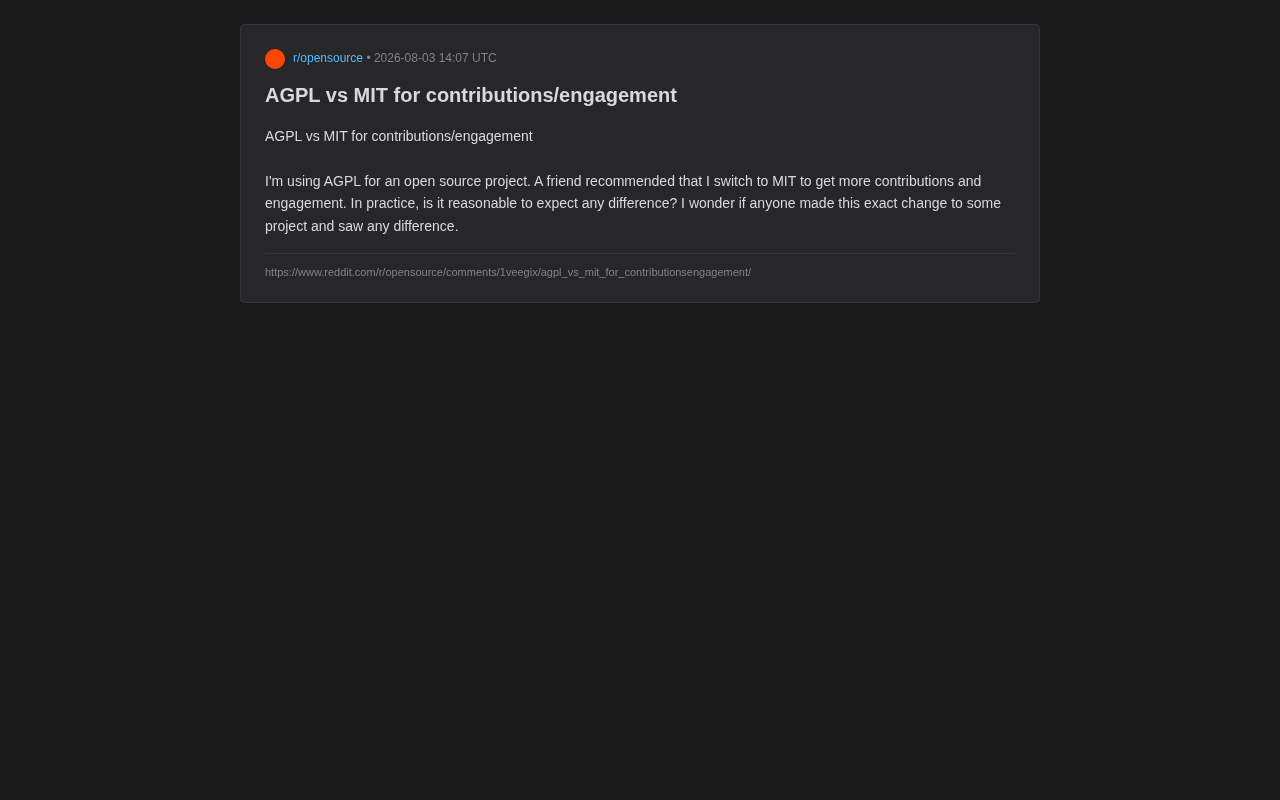
In the open source community, choosing the right software license is often one of the most underestimated decisions during a project's early stages. Recently, a developer posed a highly representative question on Reddit: they had chosen the AGPL license for their open source project, but a friend suggested switching to MIT, arguing it would attract more contributors and community participation.
The developer's question cuts to the heart of the matter: In practice, does the choice of license truly have a significant impact on a project's contribution volume and activity level? Has anyone actually made such a switch and observed real differences?
Behind this seemingly simple question lies a complex set of trade-offs spanning open source philosophy, business strategy, and community ecosystems.
AGPL vs. MIT: Two Fundamentally Different Open Source Philosophies
To understand the differences between these two licenses, you first need to grasp the most fundamental philosophical divide in the open source licensing world—the opposition between Copyleft and Permissive Licenses. Copyleft is a core concept in the free software movement, proposed by Richard Stallman in the 1980s. Its philosophical foundation is that "free software should remain free forever." Copyleft licenses require that any derivative work based on the original code must also be released under the same license terms—this is the so-called "viral nature." This mechanism ensures that once code enters the free software ecosystem, it cannot be "privatized." The GPL family (GPL v2, GPL v3, AGPL v3) represents the most typical Copyleft licenses, while MIT, BSD, and Apache 2.0 belong to permissive licenses, allowing derivative works to adopt any license, including closed-source proprietary ones. The opposition between these two philosophies fundamentally reflects a disagreement over the definition of "freedom": the Copyleft camp believes true freedom requires institutional safeguards, while the permissive license camp believes maximum freedom means imposing no restrictions.
MIT License: Ultimate Permissive Freedom
MIT is one of the most popular open source licenses today, characterized by its extreme permissiveness. Anyone can freely use, copy, modify, merge, publish, distribute, and even sell copies of the software—the only requirement is preserving the copyright notice and license text.
This means that whether you're an individual developer, a startup, or a tech giant, you can integrate MIT-licensed code into your products without hesitation, even using it in closed-source commercial software without disclosing modifications. This "zero-burden" characteristic is precisely why it's so widely adopted.
AGPL License: The Strong Copyleft Guardian for the Network Era
AGPL (GNU Affero General Public License) stands at the opposite end. It's an enhanced version of GPL, specifically designed to address the "network service loophole." Its core clause requires: if you modify AGPL software and provide services through it over a network, you must disclose your modified source code to users.
This clause closes an important "backdoor" of the SaaS era—traditional GPL only triggers open source obligations when software is "distributed," while cloud service providers can run GPL software on their servers to offer services externally without it counting as "distribution." The so-called "SaaS loophole" or "ASP loophole" (Application Service Provider Loophole) refers to the fact that under traditional GPL license frameworks, source code only needs to be provided to users when software is "distributed" to them. But in the cloud computing era, SaaS providers deploy software on their own servers, and users access software functionality through network interfaces—the software binaries are never transmitted to users, so it doesn't constitute legal "distribution." AGPL v3 was released in 2007, adding Section 13 to the GPL v3 foundation, explicitly stipulating that providing services through network interaction also triggers the source code disclosure obligation, thereby filling this legal gap.
The Real Impact of Licenses on Project Contributions and Engagement
The Psychological Barrier Is Real
Returning to the developer's core question, the answer is: licenses can indeed affect contributions, but the direction and magnitude of impact requires case-by-case analysis.
For enterprise users and commercial developers, AGPL's viral clauses are a clear deterrent. Many companies have explicit policies prohibiting employees from using or contributing to AGPL-licensed projects at work, fearing "contamination" of their proprietary codebase. This is especially common among large tech companies—Google has publicly placed AGPL on its internal "banned licenses" list.
Specifically, Google classified AGPL as "not allowed" (Category X) in its internal open source compliance policy, which was publicly disclosed around 2011. Google's concern is that since nearly all its products are delivered as network services, AGPL's network interaction clause could require Google to disclose vast amounts of internal code. Similar policies exist at other large tech companies, including Apple and some financial institutions. The existence of such corporate policies objectively creates a systemic disadvantage for AGPL projects in obtaining enterprise contributions and enterprise adoption. However, it's worth noting that some companies (like Grafana Labs) actively choose AGPL as their product license, converting enterprise avoidance of AGPL into a source of commercial licensing revenue.
Therefore, if a project's goal is to maximize contributor count—especially attracting enterprise developers—MIT indeed offers a lower barrier to entry.
But the Impact of Licenses Is Often Overestimated
However, the impact of licenses on contribution volume is frequently overestimated. In practice, many factors determine whether an open source project can achieve an active community, and the license is just one of them—often not the most important one:
- The project's inherent value: Does it solve real pain points? Does it have a sufficient user base?
- Documentation quality: Clear documentation and contribution guidelines lower participation barriers more than licenses do
- Maintainer responsiveness: Are PRs reviewed promptly? Are issues taken seriously?
- Community atmosphere: Are newcomers welcomed? Are discussions friendly?
For most small to medium individual projects, switching from AGPL to MIT would likely produce negligible growth in contributions, because these projects already have a very small contributor base, and the bottleneck is usually visibility rather than licensing.
How to Choose the Right License for Your Open Source Project
Clarify Your Project Goals First
License selection is fundamentally a strategic decision that depends on where you want your project to go:
If your goal is to maximize spread and adoption, wanting code to be used as broadly as possible (including integration into commercial products), then MIT is the more suitable choice. This is why a large number of foundational libraries, frameworks, and tools adopt MIT or Apache 2.0.
If you have commercialization considerations, such as planning to adopt an "Open Core" model or offer commercial licensing, AGPL is actually a protective strategy. It can prevent cloud vendors from directly using your code to offer competing services, while you can sell commercial licenses to enterprises that need closed-source usage. Companies like MongoDB and Elastic have employed similar licensing strategies to protect their commercial interests.
Open Core is currently one of the most popular open source commercialization models. It works by releasing the project's core functionality under an open source license (typically a strong Copyleft license like AGPL or SSPL), while providing advanced features, enterprise-grade capabilities, and management interfaces under a commercial license. Typical examples include: GitLab (Community Edition CE under MIT, Enterprise Edition EE under proprietary license), Elastic (switched from Apache 2.0 to SSPL/Elastic License), and MongoDB (switched from AGPL to SSPL). The advantage of this model is that it can enjoy the user base, brand effects, and community contributions that open source brings, while establishing sustainable commercial revenue through differentiated features or license restrictions. However, this model is also controversial—community members sometimes question the authenticity of the "open source commitment," and OSI (Open Source Initiative) has explicitly stated that licenses like SSPL do not conform to the open source definition.
The Real Cost of Switching Licenses
It's worth noting that switching from AGPL to MIT isn't without cost. Once external contributors' code has been merged into the project, you need consent from all contributors to change the license—otherwise it may constitute infringement. This is why many projects require contributors to sign a CLA (Contributor License Agreement) early on—it preserves flexibility for future license changes.
CLA (Contributor License Agreement) is a legal document that requires external contributors to sign before submitting code to a project, granting the intellectual property of their contributions to the project maintainer or organization under specific terms. CLAs typically come in two forms: "Copyright Assignment," where the contributor fully transfers copyright of the code to the project; and "License Grant," where the contributor retains copyright but grants the project broad usage rights, including the right to republish under different licenses. The latter is more common. Organizations like the Apache Software Foundation, Google, and Microsoft all require contributors to sign CLAs. However, CLAs themselves are controversial—some developers feel they increase contribution barriers and may be exploited by companies to "privatize" community contributions, which is why some projects opt for the lighter-weight DCO (Developer Certificate of Origin) as an alternative.
Therefore, if your project is still in its early stages with few contributors, now is the easiest time to make this decision.
Conclusion: A License Is a Tool, Not a Silver Bullet
For that conflicted developer, a pragmatic suggestion is: Don't expect a license switch alone to bring a leap in contributions.
If you don't have clear commercial protection needs and want to lower any potential participation barriers, MIT is a safe and friendly default choice. But if you've had commercialization goals or concerns about cloud vendors freeloading from the start, AGPL's strict clauses serve as a valuable moat.
What truly determines the success or failure of an open source project is always the value it creates, the maintainer's dedication, and community building—the license is merely the starting point of all this, not the destination.
Related articles

VICE Platform: An AI Security Scanning Tool Review for Indie Developers
VICE Platform scans web app vulnerabilities from an attacker's perspective, with open-source CLI and GitHub Action integration. Covers leaked secrets, Supabase RLS misconfigs, and exposed APIs for indie developers.

ScreenMark: A Mac Screen Annotation Tool with iPhone Remote Control for Freer Presentations
ScreenMark is a macOS menu bar screen annotation tool with live drawing, zoom, whiteboard overlay, recording, and a free iPhone remote app for teachers, presenters, and developers.

Switchy: One-Click Switching of Magic Keyboard, Mouse, and Trackpad Between Multiple Macs
Switchy is a macOS menu bar tool that lets you switch Magic Keyboard, Trackpad, and Mouse between multiple Macs with one click—no manual Bluetooth re-pairing needed.