AI Accelerating Science and Medicine: How Technology Can Serve Society

AI is shifting from general model competition to deep deployment in science and medicine, where real-world impact is the true measure of value.
A brief tweet reflects a significant pivot in AI development: technology leaders are moving focus from the general-purpose model race toward real-world deployment in high-value fields like science and medicine. The article examines the structural reasons behind this trend — life sciences are data-intensive with long research cycles, making AI-driven efficiency gains enormously valuable. Protein structure prediction, drug screening, and medical imaging are prime examples. Yet a significant gap remains between technical demonstration and reliable deployment, with explainability, safety, and regulatory compliance posing unavoidable challenges in medical settings. True value should be measured by clinical outcomes and earlier diagnoses, not benchmark scores.
AI Is Reshaping the Paradigm of Scientific and Medical Research
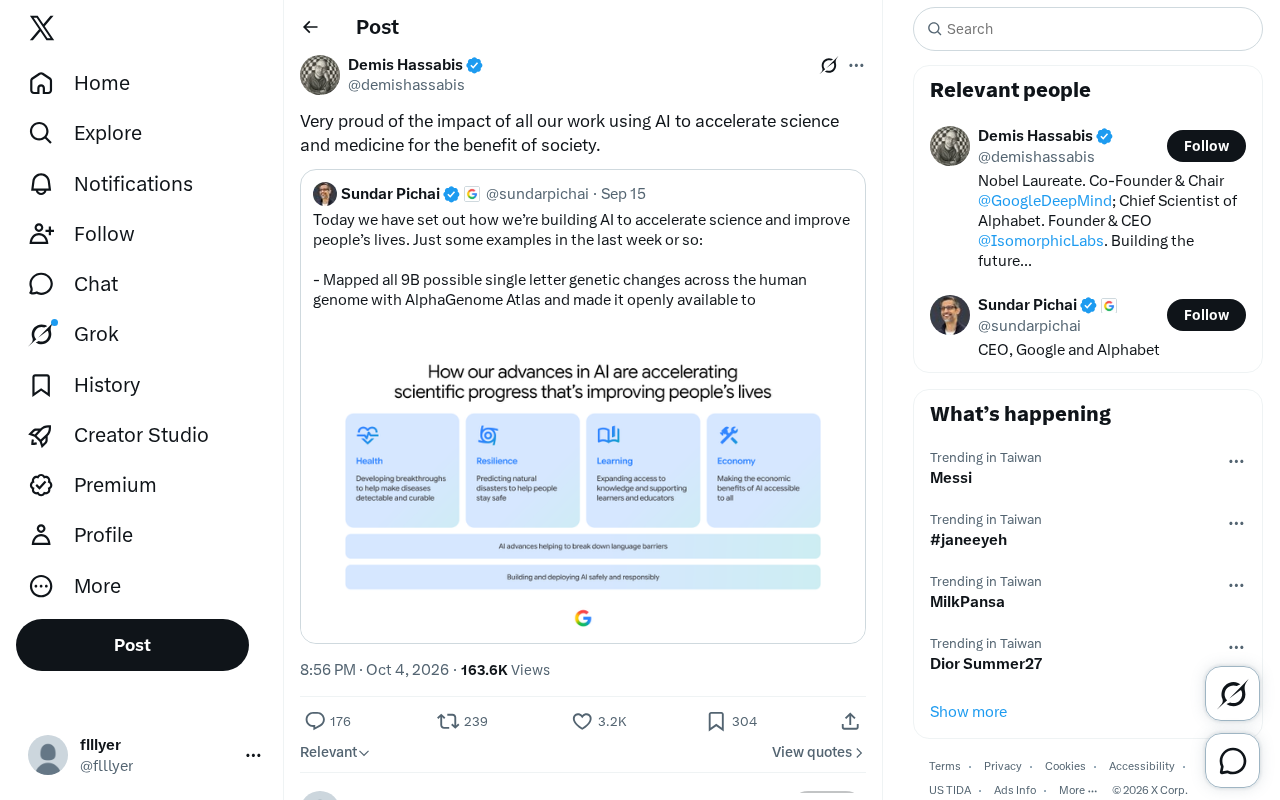
A brief tweet from the tech world has been drawing attention: "Very proud of the impact of all our work using AI to accelerate science and medicine for the benefit of society." Short as it is, this statement reflects an important trend in AI development today — a shift from the capability race among general-purpose models toward deep deployment in high-value domains like science and healthcare.
In recent years, AI breakthroughs in the life sciences have moved well beyond laboratory concepts. From protein structure prediction to drug molecule screening, from medical imaging analysis to genomics research, machine learning models are dramatically compressing research timelines that once took years or even decades. These achievements are worth celebrating precisely because they directly affect human health and well-being — not merely because they improve technical benchmarks.
Why Science and Medicine Have Become AI's Core Battleground
Scientific research and medical diagnosis are, at their core, processes of modeling and reasoning over complex data — exactly where modern deep learning excels. The enormous volumes of data embedded in biological systems — protein sequences, compound structures, clinical records, imaging data — provide AI with rich training material.
At the same time, the high barriers to entry and long timelines in these fields mean that any efficiency gains can deliver enormous social value. A new drug can take more than a decade and billions of dollars to bring to market. If AI can improve hit rates during early screening and reduce failed experiments, the savings go beyond money — they translate into time for patients waiting for treatment.
The phrase "for the benefit of society" in the original tweet also reflects a shift in how leading AI organizations frame their value proposition. Tying technical achievements to public benefit is both a response to social responsibility and a strategy for building long-term credibility — a departure from purely commercial narratives.
Protein structure prediction stands as the most emblematic example of this trend. DeepMind's AlphaFold2 dominated the CASP14 competition in 2020, essentially solving a 50-year-old biological puzzle: predicting a protein's three-dimensional structure from its amino acid sequence. Previously, this required experimental methods such as X-ray crystallography or cryo-electron microscopy, and a single protein could take years to characterize. After AlphaFold2's release, DeepMind openly shared predicted structures for approximately 200 million proteins, covering nearly the entire proteome of known organisms — dramatically accelerating drug target discovery, enzyme engineering, and infectious disease research. This breakthrough earned the 2024 Nobel Prize in Chemistry, marking the first time an AI-generated scientific result received the highest academic recognition, and instilling in the broader field a paradigm-level confidence that "AI can genuinely solve hard scientific problems."
The Gap Between Technical Capability and Real-World Impact
It's worth reflecting carefully on what "impact" actually means here. The true value of AI in science lies not in benchmark scores or publication counts, but in whether it drives real-world progress: whether new drugs have entered clinical trials as a result, whether diseases are being diagnosed earlier, whether researchers now have better tools at their disposal.
This is one of the central debates in the AI industry today. Many technical demonstrations are impressive, but a significant gap remains between demonstration and reliable, scalable deployment. In a field like medicine — where the margin for error is extremely low — model interpretability, safety, and regulatory compliance are unavoidable challenges. Being able to speak confidently about "impact" implies that the work in question has moved beyond pure research and is beginning to generate verifiable outcomes in real-world settings.
The issue of explainability in medical AI is particularly critical. Deep learning models are often called "black boxes" — they can produce predictions but struggle to articulate the reasoning behind them. In imaging diagnostics, a model might identify a tumor based on textural features that human physicians would never consider, and those features sometimes reflect dataset biases rather than genuine biological markers. The U.S. FDA and the EU's MDR impose requirements for performance validation, bias assessment, and post-market surveillance on AI medical devices, which means the path from research prototype to clinical deployment remains lengthy. Common mitigation strategies in the industry today include attention visualization techniques (such as Grad-CAM), SHAP value explanations, and "human-in-the-loop" design — where AI provides advisory outputs while final decision-making authority remains with clinicians — striking a balance between regulatory compliance and practical efficiency.
The Industry Signals Behind a Short Tweet
Because the original source material is a single brief tweet, we cannot know the specific projects it refers to. But the statement itself carries several clear industry signals: the intersection of AI and fundamental science is moving from the margins to the mainstream; technology leaders are increasingly defining success through "social value" rather than purely "technical superiority"; and science and medicine are becoming critical proving grounds for AI's real-world capabilities.
For practitioners and observers following AI's development, signals like this are a reminder to look beyond the noise surrounding general-purpose chatbots and pay attention to the underlying applications that are genuinely transforming research and healthcare workflows. These applications may not be as flashy as consumer-facing products, but their long-term impact on human society may prove far more profound.
Related articles

JobRunner MCP Server: AI Agents Can Now Fix Failed Java Jobs
JobRunner launches an open-source MCP server enabling AI agents to view cluster status, diagnose failures, and recover Java jobs—incident response from any cloud coding environment or existing agent.

MLAI Digital Launches 9 Security Agents: MCP Server Safeguards the Full Lifecycle of Agentic AI
MLAI Digital launches Security MCP Server with nine built-in specialized security agents covering vulnerability discovery, attack simulation, prompt injection detection, API and infrastructure assessment, and accelerated remediation—embedding security validation across the full Agentic AI lifecycle from development to production.

Running Isaac Lab on H100 GPUs: Exploring Better Approaches
Exploring optimization methods for running Isaac Lab on NVIDIA H100 GPUs, including MIG configuration, mixed precision, TensorRT acceleration, and community experience to improve robotics simulation and reinforcement learning efficiency.