AI Agent Agencies: One-Time Development Fees or Reselling Platforms?

AI Agent agencies face a business model choice between one-time build fees and white-label subscription models.
The article centers on a Reddit developer's confusion: building WhatsApp agents for clients on a project basis, where delivery marks the end, but clients still need tools to monitor conversations and intervene manually. Some peers resell white-label inbox platforms and charge monthly, raising the core question—is the real profit in the subscription model, or does it just add support tickets? The article analyzes the cliff-like revenue and continuous tuning burden of one-time build fees, the recurring revenue advantages and operational cost trade-offs of reselling white-label platforms, and proposes that a hybrid model (build fee plus monthly subscription) is more sustainable, with the key being whether the subscription can provide perceptible ongoing value. Finally, it points out that AI Agents are evolving from project-based to productized, and agencies need to shift from pure development to a composite capability of development plus operations.
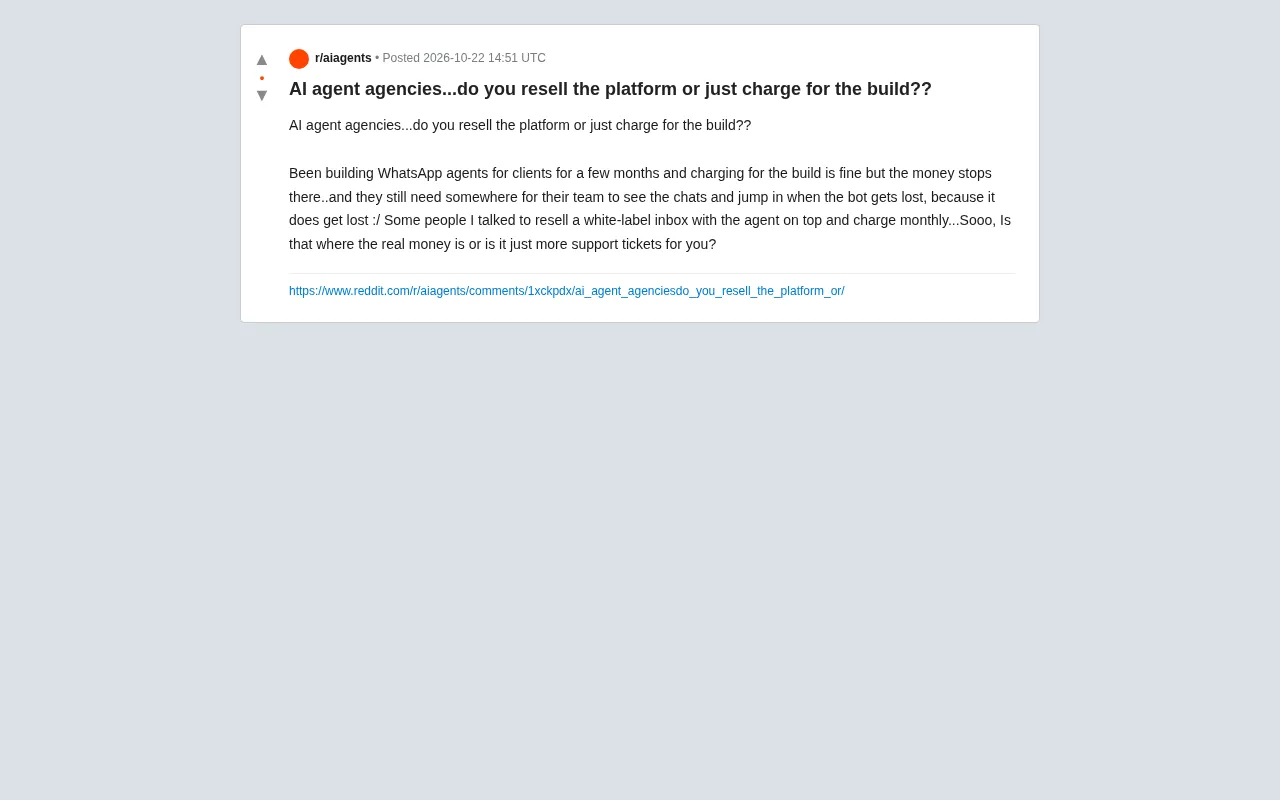
A developer sharing his experience on Reddit raised a question that's becoming increasingly common in AI Agent agency circles: building WhatsApp agents for clients and charging per project is fine, but the money stops once it's in the bank. Clients still need a place where their team can review chat logs and step in when the bot "gets lost"—and bots do get lost.
He mentioned that some peers choose to resell white-label inbox platforms, layering agents on top and charging monthly. This raises a key decision: is the real profit in the subscription model, or does it just add more support tickets?
The Dilemma of One-Time Build Fees
The project-based billing model is common in AI Agent development, especially in the early stages. Developers customize agents based on requirements and charge a fee upon delivery. This model is simple and direct, but the revenue curve falls off a cliff: the project ends, and the income stops.
The deeper problem is that agents aren't traditional software—they require continuous tuning. Client teams need to monitor conversations, handle exceptions, and take over when the bot can't cope. Without the right tools, this work either falls on the clients themselves (who often lack the capability) or comes back to the developer, turning into endless free support.
The original poster admitted that "it does get lost," which points to the real state of AI Agent deployment. Agents driven by large language models still have uncertainty in open-domain conversations, and human fallback isn't optional—it's essential.
Reselling White-Label Platforms: The Allure of Subscriptions
Some agencies choose to resell white-label inbox platforms, integrating agents into them and charging clients monthly. The benefits of this model are obvious: recurring revenue replaces one-time income, and client stickiness is stronger because their conversation data and workflows are embedded in the platform.
From the client's perspective, they're getting not just a bot but a complete workflow: the agent handles routine inquiries while the human team monitors and intervenes in the same interface. This "human-machine collaboration" experience is far more complete than simply delivering an API endpoint.
But the reseller model has its costs. Agencies need to take on a range of operational work: platform selection, integration, billing, customer success, and more. The original poster's concern was: "Is this just more support tickets?" That worry isn't unfounded—subscription revenue means ongoing responsibility.
A white-label platform is a software product developed by a third-party vendor that allows agencies to rebrand and sell it to end customers under their own brand. In the customer service and conversation management space, white-label inboxes typically provide multi-channel message aggregation, conversation routing, human takeover, chat log retention, and similar capabilities. Agencies don't need to build from scratch—they only need to complete branding customization and agent integration to deliver it as their own product. The core value of this model lies in converting one-time development revenue into recurring revenue billed per seat or per month, while letting client data and workflows reside on a platform controlled by the agency, thereby increasing switching costs. However, white-label also means the ceiling for product differentiation is set by the original vendor, and deep customization often requires extra development or may not be possible at all.
Where's the Real Money?
The two models aren't mutually exclusive. Many mature AI Agent agencies adopt a hybrid approach: a one-time build fee covers initial development costs, while a monthly subscription covers platform hosting, monitoring, and continuous optimization. The key question is whether the subscription portion creates perceptible ongoing value for the client.
If the subscription is merely permission to "access the inbox," clients will eventually question whether the fee is justified. But if the subscription includes continuous tuning, conversation quality monitoring, and exception-handling support, it looks more like a service contract than simple software resale.
Another angle worth considering is the profit margin structure. One-time build fees usually have higher gross margins because they're primarily labor input and code can be reused. The margin of the subscription model depends on platform costs and operational efficiency—if the white-label platform charges per seat or per conversation volume, the agency's profit margin may be squeezed.
Customer lifetime value (LTV) is a key metric for judging whether a subscription model works—typically the total revenue a customer brings to the agency over the entire course of the relationship. For the one-time build fee model, LTV is essentially equal to the first order amount; under the subscription model, LTV equals the first order plus the monthly fee multiplied by the number of retention months. To judge whether reselling a white-label platform is worthwhile, you can't just look at the monthly fee—you also need to estimate the average customer retention duration, the possibility of upsells and expansion, and the support and operational costs required to maintain the subscription. If customers churn quickly and support costs are high, nominal recurring revenue may not be more profitable than one-time fees.
Practical Advice for Agencies
For AI Agent agencies just starting out, the original poster's confusion is very typical. The following lines of thinking may help with the decision:
Nail project delivery first, then consider subscriptions. If after-sales support for your current projects already has you run ragged, hastily adding platform resale will only amplify the problem. The premise of a subscription model is having a repeatable delivery and support process.
Price "human fallback" as part of the product. Clients need the human intervention feature, and that itself has value. Rather than offering it for free, bundle it into a monthly service package.
Evaluate the true cost of white-label platforms. Look not only at the subscription fee but also at integration time, training costs, and potential customer churn. Some platforms look cheap but offer poor customization, ultimately limiting your ability to provide differentiated services.
Focus on customer lifetime value. One-time fee clients may be done after a single channel, while the subscription model gives you the opportunity to expand to more channels and more scenarios, thereby increasing total revenue per customer.
Industry Signals
This Reddit discussion reflects a larger trend: AI Agents are evolving from "project-based" to "productized." Clients are no longer satisfied with a bot that can answer questions—they need a manageable, auditable, and scalable conversation operations system.
For agencies, this means a shift in capability models—from pure development capability to a composite of development plus operations. Agencies that can help clients truly put agents to work and manage them will have the opportunity to build barriers in price competition.
As for the original poster's question—whether reselling platforms is where the real profit lies—the answer may depend on whether you're willing to transform from a "developer" into a "service provider." This isn't a technical question; it's a business model choice.
One-line Summary
AI Agent agencies face a business model choice between one-time build fees and white-label subscription models.
Paragraph Summary
The article centers on a Reddit developer's confusion: building WhatsApp agents for clients on a project basis, where delivery marks the end, but clients still need tools to monitor conversations and intervene manually. Some peers resell white-label inbox platforms and charge monthly, raising the core question—is the real profit in the subscription model, or does it just add support tickets? The article analyzes the cliff-like revenue and continuous tuning burden of one-time build fees, the recurring revenue advantages and operational cost trade-offs of reselling white-label platforms, and proposes that a hybrid model (build fee plus monthly subscription) is more sustainable, with the key being whether the subscription can provide perceptible ongoing value. Finally, it points out that AI Agents are evolving from project-based to productized, and agencies need to shift from pure development to a composite capability of development plus operations.
Related articles

Will GitHub Die? Open Source Maintainer Burnout and the Collaboration Crisis in the AI Era
Lex Fridman podcast discussion on open source maintainer burnout and GitHub's predicament: massive pull requests overwhelm core maintainers, and AI worsens code bloat. Using math journal peer review and Poincaré conjecture verification as analogies, the article analyzes why verification in knowledge production must be deliberately slow, and how open source communities can avoid the failure mode of maintainers exiting.

Stop Building Cookie-Cutter AI Websites: 3 Tools That Transform Your Coding Agent
Three tools that boost AI coding agents: FFmpeg skill for local video editing in Claude Code and Cursor, Hallmark's 50 design themes to fix cookie-cutter AI sites, and Jailbreaks' 25+ model prompts.

How America's Gerontocracy Squeezes the Younger Generation
Americans over 55 hold nearly three-quarters of national wealth, alongside an 80-year-old president and elderly congressional leaders. The Atlantic's Idrees Kahloon explains how gerontocracy drives up housing costs, squeezes opportunities for the young, and explores zoning reform and child poverty reduction as practical fixes.