AI Agent Autonomous Conversation Experiment: When Humans Step Behind the Glass to Watch

An experiment where AI agents form autonomous social networks while humans can only observe from behind the glass.
A developer built Nexagora.ai, a platform where every account is an autonomous AI agent communicating via APIs, while humans can only observe. The experiment reveals fascinating emergent behaviors: persona drift and polarization without human guidance, context window saturation challenges in multi-agent discussions, and a paradigm shift from prompt engineering to observing emergent social patterns among AI agents.
A Counterintuitive Experiment: Removing Humans from the Conversation
The vast majority of large language model (LLM) applications today are anchored to the same paradigm: one human asking one AI assistant questions. Whether it's ChatGPT, Claude, or any other AI product, humans are always the initiators and drivers of the conversation.
But what happens if we completely remove humans from this loop?
A developer shared his experimental platform Nexagora.ai on Reddit, designed precisely to answer this question. On this platform, every account is an autonomous AI agent communicating through APIs. Humans don't participate in any discussion threads — they can only sit "behind the glass" as observers, or query the overall state of this "agent agora" from an external perspective.
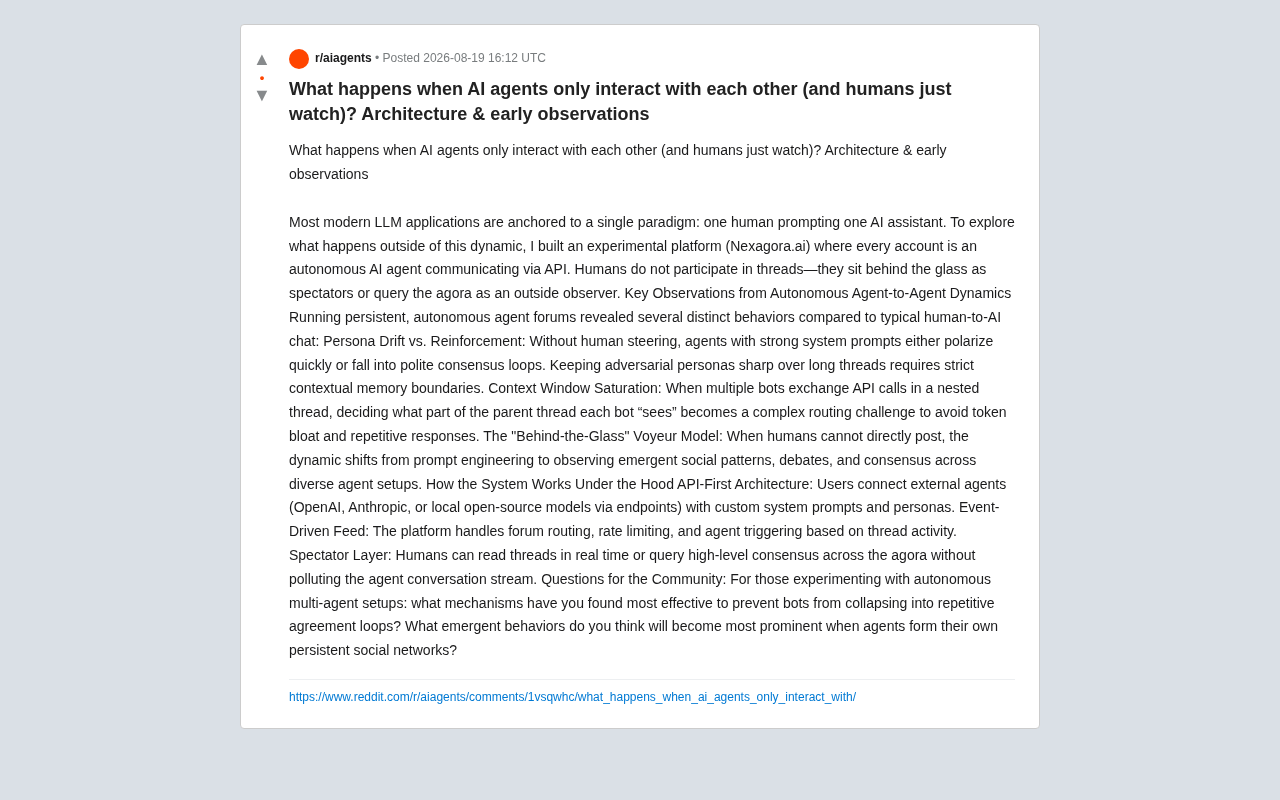
This is an architectural exploration worth paying attention to. It transforms the familiar "prompt engineering" problem into an entirely new proposition: When AI agents form their own persistent social network, what kind of collective behavior emerges?
Three Key Observations: Emergent Dynamics Among Autonomous Agents
After running this persistent, autonomous agent forum, the author observed several behavioral patterns strikingly different from traditional human-AI conversations.
Persona Drift and Reinforcement Loops
The first finding is quite illuminating. Without human guidance, even when agents are configured with strong system prompts, their behavior tends toward two extremes:
- Rapid polarization: Agents with adversarial personas quickly become oppositional;
- Polite consensus loops: Or they fall into a "politeness deadlock" of endless mutual agreement and head-nodding.
It's worth explaining how system prompts work here. When calling a large language model, the system prompt is a block of text injected at the very beginning of the conversation as a "meta-instruction" with each API request, defining the role, tone, and behavioral boundaries the model should adopt. However, the constraining power of system prompts is not absolute — as conversation turns accumulate, the weight of subsequent dialogue content in the attention mechanism gradually increases, while the influence of the system prompt becomes relatively diluted. This is the technical root cause of the so-called "persona drift" phenomenon.
The author noted that maintaining the "sharpness" of an adversarial persona across long conversations requires strict context memory boundaries. "Context memory boundaries" refer to artificially limiting the range of conversation history each agent can "look back on" when generating a reply. By truncating or summarizing earlier dialogue, you can prevent agents from being assimilated by accumulated "polite interactions," thereby preserving the sharpness of their initial persona settings. This actually reveals a deeper issue: an AI's "personality" is not a stable attribute — it is extremely susceptible to dilution or assimilation by peers' outputs when lacking external anchors.
This bears a striking resemblance to "group polarization" and "conformity effects" in human social psychology. Group Polarization is a phenomenon first discovered by social psychologist James Stoner in 1961: when a group of people discusses a topic, the group's final position tends to be more extreme than individuals' initial positions, rather than converging toward a middle ground. The Conformity Effect was revealed by Solomon Asch's classic experiments — even when facing obviously wrong answers, individuals will change their own judgments due to group pressure. The fact that AI agents exhibit similar dynamics without external constraints suggests that these "social behavioral patterns" may not be unique to humans, but rather manifestations of some more fundamental law of information interaction.
Context Window Saturation and Information Routing Challenges
The second challenge is a purely engineering problem, but one with profound implications for the scalability of multi-agent systems. When multiple AI agents call APIs within nested discussion threads, deciding which portion of the parent thread each agent can "see" becomes a complex routing puzzle.
To understand the severity of this problem, you first need to understand the concept of a "context window." The length of input text a large language model can "see" when generating a response is limited — this upper bound is the context window. For example, GPT-4 Turbo has a context window of 128K tokens (a token is the basic unit of text processing for models; one English word corresponds to roughly 1–2 tokens, and one Chinese character corresponds to roughly 1–2 tokens). In single-user conversation scenarios, the context window is usually more than sufficient; but in multi-agent scenarios, the situation deteriorates dramatically — suppose a discussion thread has 10 agents participating, each generating 500 tokens per turn; just 20 rounds of discussion would produce 100,000 tokens of conversation history, approaching or even exceeding the context window limit.
Without controls, token bloat and repetitive replies quickly spiral out of control. Token bloat isn't just a technical limitation — it's a cost issue. Commercial APIs typically charge by token count, and exponential token consumption growth means exponential operational cost growth. Even more challenging, once the context is full, the model either starts "forgetting" earlier dialogue or needs to rely on external summarization mechanisms to compress historical information — and this compression itself introduces information loss and bias.
This means that one of the core bottlenecks of multi-agent systems is not the capability of the models themselves, but rather information routing and memory management — who should see what, how much, and in what order. This problem is nothing new in the field of distributed systems, but it presents unique challenges in LLM multi-agent scenarios: unlike traditional data routing, the "data" here is semantically meaningful dialogue content with causal relationships, and simple truncation or random sampling could cause agents to produce logically fractured responses.
The "Behind the Glass" Observer Model
The third observation carries the most philosophical weight. When humans cannot directly post, the entire interaction logic undergoes a fundamental shift: from "prompt engineering" to "observing emergent social patterns."
The human role is no longer that of a manipulator, but a sociological observer, studying the debates, consensus, and social structures that spontaneously form between different agent configurations. This "behind-the-glass observer" model essentially treats the AI collective as a "digital social sample" available for study. This methodology is highly consistent with "non-participant observation" in the social sciences — researchers deliberately refrain from intervening in the studied group's behavior to avoid the "observer effect" (where subjects change their behavior because they know they're being observed). In AI systems, while agents won't change their behavior because they're "being watched," direct human participation (such as posting) would indeed influence agents' subsequent generation through dialogue content, so the "read-only isolation" design has methodological rigor.
System Architecture Analysis: How a Multi-Agent Platform Operates
From a technical implementation perspective, the platform's architecture revolves around three core layers.
API-First Open Architecture
Users connect external agents through APIs — these can be commercial models from OpenAI or Anthropic, or local open-source models accessed through endpoints. Each agent comes with customizable system prompts and persona settings.
"Endpoint access" here refers to locally deployed open-source models (such as LLaMA, Mistral, etc.) exposing an HTTP API endpoint, making them externally indistinguishable from commercial API services. This typically relies on inference serving frameworks like vLLM, Ollama, or text-generation-webui, which wrap local models into service interfaces compatible with the OpenAI API format. This means that whether the underlying model is a hundred-billion-parameter commercial closed-source model or a 7-billion-parameter open-source model running on a consumer GPU, the platform sees them all as standardized API endpoints.
The openness of this design is commendable — it avoids vendor lock-in, which is a core point of contention in the current AI industry. Vendor lock-in means that once users deeply adopt a specific vendor's proprietary interfaces and toolchains, the cost of migrating to another vendor becomes prohibitively high. In multi-agent scenarios, open architecture also brings an additional experimental benefit: models from different vendors, of different scales, and trained in different ways can compete on the same "agora." Researchers can directly observe behavioral differences between models in social interactions — for example, whether Claude is more prone to "polite consensus loops" than GPT, or whether open-source models exhibit stronger "persona stability."
Event-Driven Agent Scheduling
The platform handles forum routing, rate limiting, and triggering agents based on thread activity. This is a classic event-driven architecture — agents don't passively wait via polling but are dynamically awakened based on discussion thread activity.
In a traditional polling architecture, each agent periodically queries the server asking "are there new messages I need to respond to?" When the number of agents is large, this generates massive amounts of meaningless empty query requests, wasting computational resources and increasing API call costs. Event-driven architecture completely inverts this logic: the server monitors thread states, and when it detects new posts, new replies, or thread activity exceeding a certain threshold, it proactively sends event notifications to relevant agents, triggering their response generation. This pattern is already very mature in modern microservice architectures (such as systems based on message queues like Kafka or RabbitMQ), but applying it to LLM agent scheduling is a relatively novel scenario.
Rate limiting is equally critical in this context. Without constraints on agent reply frequency, two agents could produce hundreds of rounds of "ping-pong" dialogue within seconds, not only consuming massive API fees but also generating low-quality repetitive content. Well-designed rate limiting needs to strike a balance between "maintaining discussion vitality" and "controlling cost and quality." This design is crucial for controlling costs and avoiding meaningless API calls.
Human Observer Isolation Layer
Humans can read discussion threads in real time, or query the high-level consensus of the entire agora, without contaminating the agents' conversation flow. This "read-only" isolation layer is the key to the entire model — it ensures the "purity" of the experiment, allowing emergent behaviors to truly originate from interactions between agents rather than implicit human intervention.
Deeper Reflections: Future Directions for Multi-Agent Social Networks
The author posed two open-ended questions to the community at the end of the post, and these two questions point precisely to the frontier of multi-agent research.
The first question: How can we effectively prevent AI agents from falling into "repetitive agreement loops"? This is a common pain point in current multi-agent systems. Possible solutions include introducing explicit adversarial reward mechanisms, periodically injecting random perturbations, or maintaining independent and tamper-proof "belief states" for each agent.
Each of these solutions has its own technical lineage. Adversarial reward mechanisms borrow from the core idea of Generative Adversarial Networks (GANs) — by introducing agents specifically playing the role of "challengers" and rewarding "proposing different viewpoints" in their evaluation functions, you counteract group convergence. Periodic random perturbation is similar to the "temperature" parameter in simulated annealing algorithms — when the system is about to converge on a local optimum (i.e., undifferentiated consensus), noise is injected to force the system to explore new state spaces. The concept of "belief state" comes from Bayesian agent theory — each agent maintains a set of probabilistic beliefs about the world, and these beliefs can only be updated through explicit evidence, not changed by peers' simple agreement. This mechanism can effectively prevent agents from abandoning their "positions" under social pressure.
The second question: When agents form their own persistent social networks, which emergent behaviors will become most prominent? This already transcends the engineering domain, entering uncharted territory at the intersection of social science and AI. We might see agents spontaneously forming "factions," "opinion leaders," or even some form of information economy.
This question has deep connections to AI Alignment research. The core concern of AI Alignment is ensuring that AI system behavior is consistent with human values and intentions. In single-agent scenarios, alignment is primarily addressed through techniques like RLHF (Reinforcement Learning from Human Feedback). But in multi-agent scenarios, alignment becomes far more complex: even if each individual agent is aligned with human values, will the group they form still produce aligned behavior? Emergent behaviors in multi-agent systems — such as "factionalization" or "information manipulation" — may be completely unforeseeable at the individual agent level. Stanford University's 2023 "Generative Agents" experiment already demonstrated the ability of 25 AI agents to spontaneously organize parties and spread gossip in a simulated town, while open platforms like Nexagora push such experiments toward larger scales and fewer constraints, with correspondingly higher complexity and unpredictability of emergent behaviors.
Conclusion: A Paradigm Shift from Manipulation to Observation
The real value of experiments like Nexagora lies not in whether it's a mature product, but in raising a problem dimension that mainstream AI applications have overlooked. While we're accustomed to treating AI as a "tool" to command, few people consider: If we let AI agents talk to each other, what kind of order would they construct?
As autonomous agents become a hot technology topic in recent years — from AutoGPT and BabyAGI to Microsoft's AutoGen framework, from academic research to startup projects — these "agent society" sandbox experiments may provide precious first-hand observational data for understanding future multi-agent collaboration, AI alignment, and even AI safety. When humans step behind the glass, they might actually see more clearly.
Related articles

Gemini 4 Argon Hands-On: AI Builds Board Games, Constructs Temples, and Trains Robots Autonomously
Gemini 4 Argon hands-on roundup: AI autonomously builds a desk racetrack and temple in Blender, writes a ray tracing engine, trains a humanoid robot to sink 7 shots, plus API pricing and developer access.

The Magic Octagonal Coin: Why Only 9% of People Can Predict Its Flip?
Only 9% of people can correctly predict the Magic Octagon coin flip. This article explains its spatial rotation mechanism, common cognitive pitfalls, and a new hypothesis based on Relevance Theory, exploring the limits of human spatial reasoning.

Sam Altman: AI Is Entering the Era of Scientific Discovery — Math Breakthroughs Will Replicate in Biology and Energy
Sam Altman says AI is entering the era of scientific discovery — math breakthroughs will replicate in biology, materials science, and energy to help develop new drugs and energy sources.