AI Agent Debugging Blind Spots: Why the Root Cause Is Often Not in the Trace

AI Agent bugs often have root causes that live entirely outside the trace — here's why.
This article addresses a common yet overlooked pain point in AI Agent debugging: developers often have detailed call traces but find the true bug root cause lies outside them — in config changes, permission differences, expired caches, database state shifts, or unexpected API behavior. The key distinction is between evidence that is buried (hard to find but present) and evidence that was never captured (a coverage blind spot). The article analyzes three reasons Agent systems are especially prone to this problem and offers practical signals for recognizing when you're looking in the wrong place, ultimately calling for observability designs that proactively snapshot external context.
A Debugging Problem That Drives Developers Crazy
When troubleshooting a strange bug in an AI Agent, have you ever run into this situation: you have a seemingly comprehensive call trace in hand, you analyze it line by line, think it through repeatedly — and then discover that the real problem isn't in that trace at all?
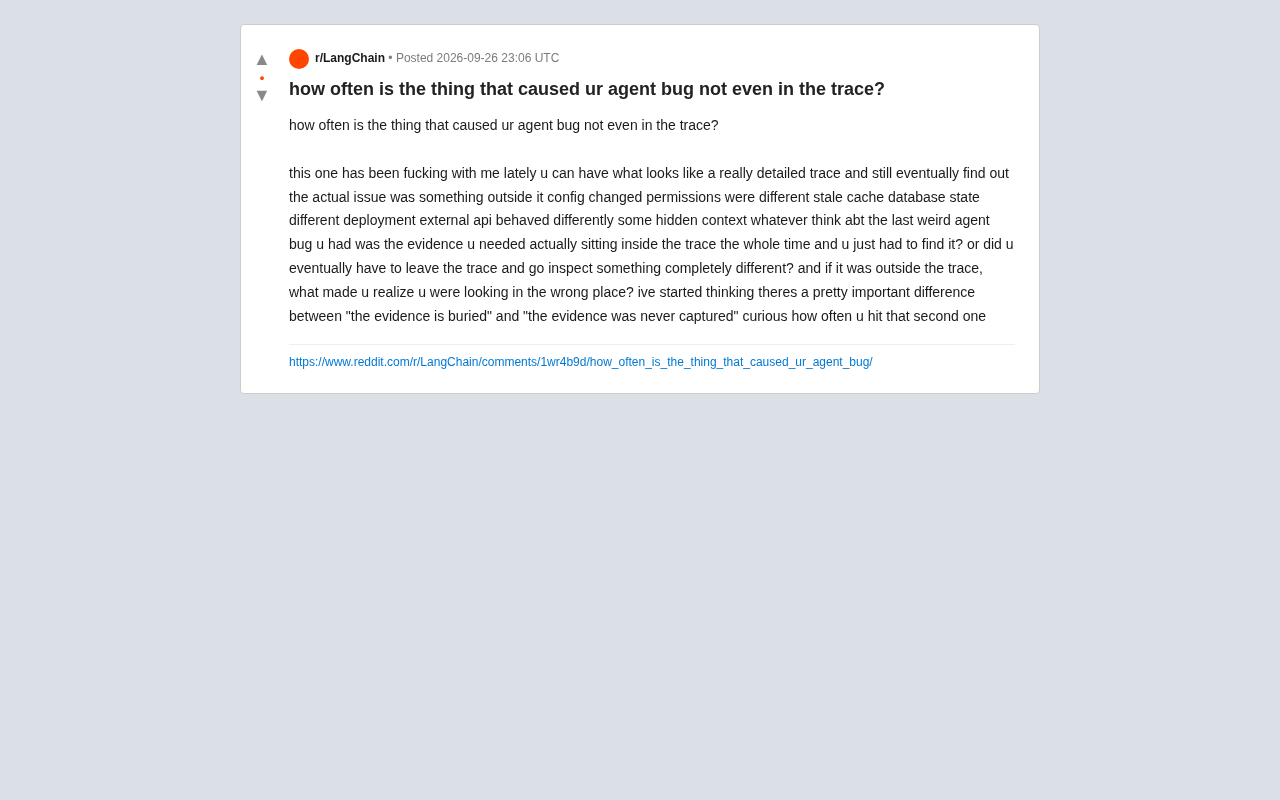
This topic recently sparked a lot of resonance in the Reddit developer community. One developer put it bluntly: this has been "haunting me lately" — you can have a trace that looks incredibly detailed, yet ultimately find that the real issue lies outside the chain: a config was changed, permissions were set differently, a cache expired, a database state shifted, deployment environment differences, unexpected external API behavior, or some hidden context... In short, things the trace never captured in the first place.
"The Evidence Is Buried" vs. "The Evidence Was Never Captured"
The most valuable insight in this discussion is a key distinction between two fundamentally different debugging predicaments:
- The evidence is buried: The clues you need are actually sitting right there in the trace — they're just drowned out by a flood of information. What you need is patience to dig them out.
- The evidence was never captured: The clues you need simply aren't in the trace. No amount of searching will turn them up, because the system never collected that information in the first place.
These two situations are entirely different in nature. The first is a signal-to-noise problem in observability — the data is complete, but hard to locate. The second is a coverage blind spot in observability — the data itself is missing. For AI Agents, which are highly dependent on external environments and dynamic context, the second scenario is probably far more common than we'd like to think.
Why Agent Systems Are Especially Prone to This Problem
Traditional software execution is relatively deterministic — inputs and outputs are controllable. AI Agents, by contrast, are entangled with a large number of external dependencies and implicit states:
The Invisibility of External Dependencies
Agents frequently call external APIs, access databases, and read from caches. Changes in the behavior of these external systems — a subtle tweak to an API response format, a record being modified in the database, a cache hit returning stale data — typically won't be fully reflected in the Agent's own trace. What you see might be "called a certain tool, got a certain result," but you can't see the hidden environmental reality behind that result.
From an observability engineering perspective, this problem is fundamentally about the "boundary of distributed trace coverage." Mainstream tracing frameworks (such as OpenTelemetry) generate Spans by instrumenting code, and those Spans can only record what you explicitly tell them to record. When an Agent calls an external tool, the tracing system typically only logs the call start time, end time, and the top-level return value — it doesn't automatically capture state changes inside that external service. More troublesome still: many external APIs quietly change their behavior without notifying callers — pagination logic adjustments, field format changes, tightened rate limiting — changes that may still return HTTP 200 OK but with substantively different content. This means that relying solely on the Agent-side trace systematically creates a blind spot where "behavior changed but the record shows everything was fine."
The Silent Drift of Configuration and Permissions
The original poster specifically mentioned "configuration changes" and "permission differences." What makes these issues so insidious is that they're silent: no errors, no exception logs — the Agent just "behaves a little differently." When a trace only captures the logical flow without snapshotting the configuration and permission context at the time of execution, these root causes become permanently invisible.
"Configuration Drift" is a classic concept in DevOps, referring to the gradual divergence between a system's actual running state and its intended configuration after repeated manual changes. In traditional web services, these issues are usually exposed through explicit error codes (like 403 Forbidden) and are relatively easy to locate. But in AI Agent scenarios, subtle differences in permissions or configuration often don't trigger hard errors — instead, they quietly alter output in the form of "the model made a different decision" or "the tool call returned a different subset of data." Agent outputs inherently carry a degree of nondeterminism, which actually provides excellent cover for configuration drift — developers find it very hard to distinguish between "this is normal model randomness" and "some configuration was quietly changed." Snapshotting critical configuration and permission scope as Span attributes into the trace is one effective defense against this class of problem.
The Temporal Nature of Environmental State
Caches, databases, and deployment versions all change over time. By the time you're looking back at a trace, the environment may have long since changed — making reproduction impossible and true state restoration from the record infeasible.
How to Tell When You're Looking in the Wrong Place
The original poster raised a very practical question: if the root cause is outside the trace, what makes you realize you've been looking in the wrong place all along?
There are usually a few warning signals worth watching for:
- The internal logic of the trace is completely self-consistent — every step looks "correct," but the overall result is wrong. This often suggests the problem lies at the input or environment level, not the logic level.
- You can't reproduce it reliably: same code, same inputs, sometimes right, sometimes wrong — this strongly points to external state (caches, databases, concurrency) at play.
- Inconsistent behavior across environments: works locally, fails in production — this almost certainly comes down to configuration, permission, or deployment differences, which happen to be the dimensions application-level traces most easily overlook.
When you find that everything in the trace "makes sense" yet still can't explain the bug, it's time to step outside the trace and examine the external world.
Implications for Observability Design
This discussion points to a deeper engineering proposition: Agent observability should not stop at the execution chain itself.
A truly robust tracing system needs to snapshot broader context at key nodes — capturing complete requests and responses when calling external APIs, annotating the data version being read on database access, snapshotting critical configuration and permission states at execution time. In other words, proactively bringing those "prone-to-becoming-blind-spots" external factors into the collection scope, converting as many "evidence was never captured" situations as possible into "evidence is buried but findable" ones.
Because in the world of debugging, the hardest problems to solve have never been the clues buried deepest — they're the clues that never existed in the first place.
This line of thinking aligns closely with the "Wide Events" or "structured logging" philosophy that has emerged in recent years. Traditional observability centers on Metrics and Traces, recording "what actions occurred." Wide Events, by contrast, advocate aggregating as much contextual information as possible into a single record at each key node — including environment variable snapshots at call time, the current user's permission set, dependency service version numbers, and more. For AI Agents, this philosophy is especially important: LLM decision paths are difficult to describe with fixed code flow diagrams, and external context has a far greater influence on final behavior than in traditional deterministic programs. Tools like Honeycomb have accumulated considerable practical experience in this direction and are worth following. Of course, wider events mean higher storage costs, and engineering requires a reasonable trade-off between coverage depth and collection overhead.
Conclusion
This Reddit discussion doesn't offer a definitive answer, but it precisely pinpoints a pain point that every Agent developer will encounter. It reminds us: a trace that "looks very detailed" is not the same as a trace that "captures the truth." When building and debugging AI Agents, rather than burying yourself in analysis of existing records, perhaps the more important habit is to regularly ask yourself — were the clues I actually need ever recorded at all?
Related articles

Huberman's Rational Supplement Guide: A Five-Layer Health Framework and Scientific Decision-Making
Stanford neurobiology professor Huberman proposes a rational supplement framework: behavior and nutrition are the foundation, basic combination supplements serve as insurance, and sleep/hormonal/cognitive directions should stick to single-ingredient experiments. Omega-3 is the top single-ingredient choice, and melatonin is not recommended.

The Unsung Painter Behind Gilded Age Manhattan Interior Design
HN discussion highlights the painter behind Gilded Age Manhattan interiors: he created murals and decorative paintings but was long overlooked as his work was seen as architectural appendage.

Can AI Agents Be Socially Engineered? Understanding Prompt Injection and Tool Permission Risks
Through Invariant Lab's GitHub Issue injection and Brave's AI browser attack, this article analyzes how Prompt Injection induces AI Agents to perform unauthorized actions, and offers protection advice across three layers: least privilege, tool validation, and operation auditing.