AI Agent Development: A Complete Beginner's Guide from Concepts to Practice
A beginner's roadmap covering AI Agent concepts, real-world use cases, and a 3-phase LangChain learning path.
This guide, based on Bilibili creator Tommy's AI Agent tutorial, systematically covers what sets Agents apart from traditional chatbots — namely proactivity and persistent memory — along with key use cases, multi-agent projects like Stanford's Generative Agents and ChatDev, and an honest look at the challenges beginners face. It proposes a three-phase learning path: understanding the AIGC landscape, mastering LangChain fundamentals (including RAG and vector databases), and building real projects. The article maintains a balanced perspective on course-marketing claims throughout.
From Chatbots to Intelligent Agents: The Next Form of AI
When most people think of AI, they picture chatbots like ChatGPT — systems that understand natural language, provide information, and hold conversations. But is that really the ultimate form AI can take?
Bilibili creator Tommy, in his AI Agent tutorial series, references a key observation from Bill Gates: existing software is still quite clunky, and the future of software lies in intelligent agents. Gates believes that everyone will eventually have their own AI assistant, and that every piece of software is worth rebuilding through the lens of Agent-based design. He describes this shift as "the biggest computing revolution since we moved from typing commands to clicking icons."
In simple terms, Agents move AI from "what it can say" to "what it can do for you." Rather than passively answering questions, an Agent is an intelligent system that can execute specific tasks and take actions on a user's behalf. When you tell your device in plain language what you want done, it can draft documents, build spreadsheets, send emails, and chain together actions across multiple applications.
The Core Difference Between Agents and Traditional Tools
The limitations of general-purpose chat tools become especially apparent in enterprise settings. Tommy offers a telling example: a business consulting firm that processes large volumes of data tables every day — cleaning raw data, extracting it into structured formats, running statistical analyses, and deriving business insights. A generic ChatGPT simply can't handle this end-to-end.
The ideal solution is to build a purpose-built Agent using AI capabilities — connecting your database to the Agent, asking it the insight questions you care about, and having a report generated quickly. You can even connect it to an email system so the report gets sent out automatically.
What sets Agents apart from traditional AI tools comes down to two qualities: proactivity and memory. Traditional tools only respond when given a specific instruction, whereas an Agent can proactively offer suggestions before the user even asks. It improves its conversational approach over time, remembers user activity, identifies behavioral patterns and intent, and surfaces content it believes the user needs — while leaving the final decision with the user.
Take travel planning as an example: an Agent that knows your preferences won't just know your travel dates — it can recommend destinations based on whether you like exploring new places or revisiting favorites, plan activities based on your sense of adventure, and book restaurants accordingly. That kind of deep personalization used to require paying a travel agent.
A note on memory and tool use: In technical terms, Agent memory is typically categorized into four types: short-term memory (information within the current conversation context window), long-term memory (information written to an external database and retrievable across sessions), entity memory (persistent tracking of specific people, places, or concepts), and tool call history (logs of past operations). Most chatbots only have short-term memory — once a conversation ends, the state is cleared. A full Agent system, by contrast, can write user preferences and behavioral history to persistent storage and retrieve them in future interactions — which is the technical foundation for the personalized travel planning scenario described above. The Agent's "proactivity" at the engineering level relies on a tool use / function calling mechanism: rather than only outputting text, the model can invoke pre-registered external functions (like search engines, calendar APIs, or database queries) in a structured format, bridging the gap between language understanding and real-world action.
Collective Intelligence: Stanford Town and ChatDev
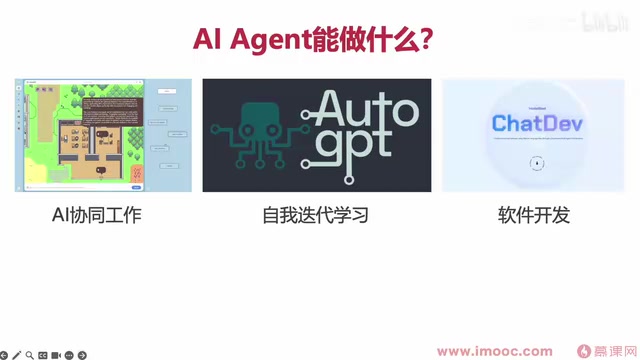
Today's AI Agents are evolving toward greater intelligence and more human-like behavior. Tommy highlights two representative projects: Stanford University's "Smallville" (Generative Agents), which assigns different personalities and role attributes to individual Agents living in a virtual town, allowing them to develop freely within a shared environment and achieve collective coordination.
ChatDev, developed by a Chinese research team, takes a similar approach and virtualizes the entire software development pipeline — turning all roles (product, development, QA, etc.) into AI agents that collaborate to produce results more capable than any single agent could achieve alone. This kind of multi-agent collaboration has found widespread application in software development, making it genuinely possible to write code through verbal instructions.
Beyond these, Agents have also shown strong performance in customer service and data visualization. LLM-powered Agents can effectively handle customer inquiries and provide personalized support in industries like banking and e-commerce; in data visualization, they can transform raw data into interactive charts that make complex information immediately intuitive.
Background on Generative Agents and ChatDev: The Stanford Town project (formally titled Generative Agents: Interactive Simulacra of Human Behavior) was a 2023 research collaboration between Stanford University and Google. Researchers deployed 25 GPT-powered Agents in a Sims-like virtual environment, each equipped with an independent memory stream, reflection capability, and action planning module. The results showed that these Agents could spontaneously generate social behaviors — organizing gatherings, spreading information, forming relationships — without researchers scripting any specific actions. The study validated the feasibility of a "memory + reflection + planning" three-layer architecture for achieving human-like behavior, and established an important reference paradigm for subsequent multi-agent system design. ChatDev applied this thinking to a more productively valuable domain — software engineering — demonstrating through role specialization and conversational collaboration the clear advantages multi-agent systems have over single models when completing complex, structured tasks.
Market Outlook and Why It's Worth Learning
Why is now a good time to learn Agent development? Tommy grounds his argument in market data.
According to Grand View Research, the autonomous AI and AI Agent market has already reached $3.9 billion, with a projected compound annual growth rate of approximately 42.8%. A separate report projects the autonomous AI agent market growing from $5 billion to $29 billion, at a 43% CAGR.
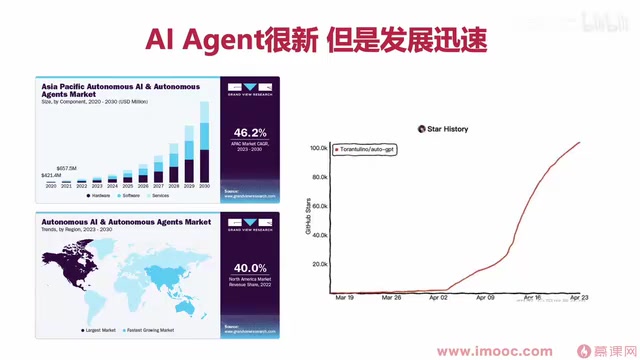
Tommy draws an analogy between mastering Agent technology today and mastering web development during the PC era or app development during the mobile era. Open-source projects like AutoGPT and LangChain saw explosive growth after launch — AutoGPT's GitHub star count skyrocketed, making it a breakout project — reflecting intense interest from the developer community.
On the salary side, Indeed reports that AI-related positions command 20%–30% higher average annual salaries than traditional tech roles. That said, it's worth noting that salary statistics paired with claims like "double your income after completing this course" carry the unmistakable fingerprint of course marketing — readers should exercise their own judgment.
Three Real Challenges in Learning Agent Development
Tommy honestly acknowledges the barriers to learning Agents today — a section that's particularly useful for beginners.
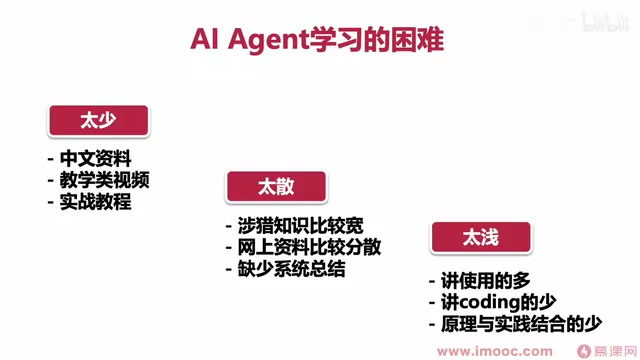
Resource scarcity: AI Agent development is still very new. Chinese-language resources are sparse, and English-language materials change at a rapid pace. Surveys suggest over 60% of beginners identify finding high-quality, up-to-date learning materials as their top challenge.
Fragmented knowledge: Agent development spans a wide range of topics — from large language models to tool use, vector databases, and AI engineering — scattered across different domains with no systematic synthesis, making it difficult to build a coherent knowledge framework.
Limited hands-on opportunities: Most courses on the market focus on how to use tools, with little connection to actual coding. Real project-based practice is scarce, making it hard to validate theory through application.
A Practical Learning Path
Setting aside the course-selling elements, the knowledge framework Tommy outlines is genuinely useful for self-learners. The overall path breaks down into three phases:
Phase 1: Understanding the AIGC Landscape
Start with the history of large model development, use platforms like Hugging Face to explore mainstream LLMs and their limitations, and then introduce fine-tuning and LangChain as solutions — building an understanding of how research papers become real-world applications.
Phase 2: Mastering the Framework Fundamentals
Focus on LangChain to systematically understand the foundational theory of Agent development: running LangChain locally, understanding the Model I/O concept, applying prompt templates, and building core modules including knowledge bases, Retrieval-Augmented Generation (RAG), text chunking, and vector databases.
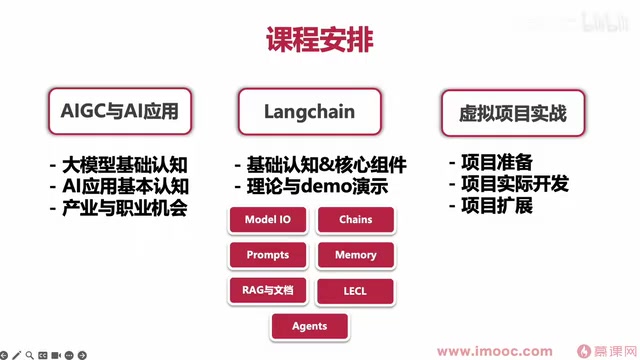
A closer look at LangChain's key concepts: LangChain is one of the most widely used AI Agent development frameworks today, released by Harrison Chase in late 2022 and quickly becoming a standout open-source project. Its core value lies in providing a standardized "chain" abstraction layer that lets developers flexibly combine large models, external tools, vector databases, and memory modules without building every layer from scratch.
A few key concepts are worth highlighting: Model I/O refers to a unified wrapper around language model inputs and outputs, making it easy to swap between different models. RAG (Retrieval-Augmented Generation) is an important technique for addressing large models' "knowledge cutoff" and hallucination problems — it splits a user's private documents and stores them in a vector database, retrieves relevant content at inference time, and then passes that content to the model to generate an answer, enabling the Agent to respond based on real-time or private knowledge. Vector databases (such as Chroma and Pinecone) are responsible for converting text into high-dimensional numerical vectors and supporting semantic similarity search — forming the underlying storage layer of the RAG architecture. Understanding how these modules interact is the critical leap from "knowing how to use tools" to "being able to design architectures."
Phase 3: Hands-On Practice
Apply knowledge through complete projects that cover requirements analysis, architecture design, development, deployment and optimization, plus extended capabilities like digital avatars and AI voice (TTS). The example project in Tommy's course is a "feng shui fortune teller" Agent — complete with its own personality, the ability to call tools for real-time search, email and SMS integration, voice synthesis, and emotional judgment based on user input. This case study illustrates the full capability dimensions a complete Agent should have: personality configuration, tool calling, external integrations, memory and learning, and multimodal interaction.
Final Thoughts
This tutorial's primary value lies in mapping out the conceptual positioning, application scenarios, and learning framework for Agent development — making it a good starting point for anyone who has never encountered Agents before and wants to build a coherent mental model. The core tech stack centers on Python and LangChain, so having a programming background will make the journey smoother.
One line from Tommy is worth holding onto: AI won't replace people — it will replace people who don't know how to use AI. For companies and individuals who have accumulated domain expertise and proprietary data, integrating AI capabilities into their own workflows may be where the true value of Agent technology lies.
Related articles

Structuring Data for AI Agents: Five Approaches and a Selection Guide
There's no single best way to structure data for AI Agents. This article compares semantic models, knowledge graphs, RAG, Markdown+grep, and open formats, drawing on research from dbt, Microsoft, and Chroma to help you pick the right data architecture based on question type.

Fish Audio Drama 3 Open-Source Launch Sparks Debate: The 35B Speech Model's Selling Points and Licensing Controversy
Fish Audio Drama 3 sparks debate with 35B parameters and open weights, ranking first on pronunciation benchmarks with director-style control and word-level inpainting, but its community license restricts commercial resale, API prices are rising, and local runs need ~39GB VRAM.

curl 8.23.0 Fixes 24 CVEs, AI-Assisted Research Contributed 20
curl 8.23.0 fixes 24 CVEs, 20 found by AI-assisted research, including a High-severity HTTP/2 use-after-free that could become RCE. Here's the source, fix details, and upgrade checklist.