AI Agent Development in Go: A Hands-On Guide to ByteDance's Eino Framework and Its Seven Core Capabilities

A hands-on guide to building production-grade AI Agents with ByteDance's Eino framework using pure Go.
This article explores how backend engineers can build production-grade AI Agents entirely in Go using ByteDance's open-source Eino framework. It breaks down seven core capabilities—multi-Agent orchestration, autonomous long-task execution, command approval, RAG knowledge base, MCP integration, Skill invocation, and database reporting—with real-world runtime workflows and engineering insights.
Why Build AI Agents in Go
In the wave of AI Agent engineering, Python has become almost the default language—largely due to decades of accumulation in scientific computing and machine learning: mainstream frameworks like NumPy, PyTorch, LangChain, and LlamaIndex are all built around Python. However, for backend teams whose primary language is Go, introducing Python means maintaining a dual tech stack, increased deployment complexity, and a higher learning curve for engineers. ByteDance's open-source Eino framework offers an alternative answer—agent development with a pure Go tech stack. For backend engineers who already use Go as their primary language, this means they can build a fully functional LLM application from scratch without switching tech stacks.
Go has unique structural advantages in AI Agent scenarios. The lightweight nature of Goroutines (an initial stack of just 2KB that can expand dynamically) makes it possible to schedule thousands of Agent tasks simultaneously, while the Channel mechanism provides type-safe communication primitives for message passing between multiple Agents. Compared to Python's GIL (Global Interpreter Lock) limitations, Go has a natural advantage in high-concurrency task scheduling scenarios. Go adopts the CSP (Communicating Sequential Processes) concurrency model, proposed by computer scientist Tony Hoare in 1978. Its core philosophy is "Do not communicate by sharing memory; instead, share memory by communicating." This philosophy is a natural fit for the message-driven architecture of AI Agents—multiple Agents pass task instructions and return results via Channels, avoiding lock contention while making the flow of data clear at the code level. Benchmarks show that Go's Goroutines consume roughly 100 times less memory than Python threads, which means that on the same hardware, Go can concurrently maintain far more Agent sessions than Python. ByteDance's large-scale internal microservices practice also validates Go's engineering maturity in high-concurrency, low-latency scenarios, and Eino is precisely an engineering effort to extend this accumulation into the AI Agent domain.
Based on hands-on demonstrations with the Eino framework, this article outlines seven core capabilities that a production-grade AI Agent should possess, and analyzes its engineering design approach in the context of specific runtime workflows.
Multi-Agent Orchestration: The Collaboration Mechanism Between the Main Agent and Sub-Agents
The most central architectural concept of the entire project is Agent orchestration. Multi-Agent orchestration is one of the core paradigms in current LLM application engineering. Its essence is to decompose complex tasks into multiple specialized Agents, each focused on a single capability domain, with an Orchestrator (main control Agent) handling task distribution and result aggregation—an approach derived from the microservices architecture concept in software engineering. Research from organizations such as OpenAI and Anthropic shows that multi-Agent collaboration significantly outperforms a single large model's direct output on complex reasoning tasks. The underlying reason for this phenomenon is "cognitive load decomposition": when a single LLM handles complex cross-domain tasks, it must maintain reasoning states across multiple dimensions within a limited context window, which tends to dilute attention. In contrast, a multi-Agent architecture lets each Agent focus only on a narrow task domain, achieving higher context window utilization and consequently improved reasoning quality.
Eino's multi-Agent orchestration uses a Directed Acyclic Graph (DAG) as its underlying scheduling model, where each node represents an Agent or tool, and edges represent data flow. This aligns with the design philosophy of mainstream frameworks like LangGraph and AutoGen, but Eino achieves stronger compile-time safety guarantees under the constraints of Go's type system—mismatches in input/output types between nodes are caught at compile time rather than runtime, which is highly significant for the stability of production-grade systems, effectively avoiding mid-execution crashes caused by type errors during long-chain task execution. The DAG scheduling model also naturally supports parallel execution: after topological sorting, nodes with no dependency relationships can be automatically executed concurrently by the scheduler. Combined with Go's Goroutine model, this can significantly reduce the end-to-end latency of multi-Agent collaboration.
In the demo, a "code repository analysis" main Agent orchestrates multiple sub-Agents to work together, with each sub-Agent encapsulated as a callable tool (ToolCore).
When the user requests to "deeply analyze this project," the execution chain exhibits a clear hierarchy: main Agent starts → Render begins → calls ToolCore (essentially a sub-Agent) → the sub-Agent internally calls specific tools. This "Agent-as-Tool" design allows complex tasks to be broken down, encapsulated, and reused.
The division of labor among three typical sub-Agents is as follows:
- Rapid Analyze: Responsible for producing a complete technical report of the entire project
- Rapid QA: Provides in-depth Q&A explanations for unclear parts of the report
- Flowchart Generation: Uses Mermaid syntax to generate business process diagrams such as pricing and order placement, payment polling, and order state machines
During the main Agent's execution, it displays in real time the call chain, the Token quota and cost already used, and the session history—these are precisely the indispensable observability elements for real-world engineering deployment.
Autonomous Long-Task Execution: Running the Entire Workflow with a Single Sentence
One impressive demonstration involves having the Agent analyze a remote Git repository (similar to the sharding middleware Kingshot). The user enters just a single sentence, and the Agent autonomously completes the entire process: cloning the repository locally → calling repo analyze → invoking tools layer by layer → finally producing a complete report.
The entire process lasts 15 to 20 minutes, with absolutely no human intervention required along the way. This reflects the autonomy a mature AI Agent should have—the ability to continuously make progress in long-chain tasks rather than waiting for user confirmation at every step. From an engineering perspective, this long-task execution capability is backed by Eino's design support for task state persistence and checkpoint resumption, ensuring that in the event of anomalies such as network jitter or model call timeouts, the task doesn't have to start over from scratch. This aligns with the concept of "idempotency design" in distributed systems: each tool call is designed as an atomic operation that can be safely retried, with intermediate states serialized and stored, so that after recovering from an exception, a long task can continue from the checkpoint rather than starting from zero.
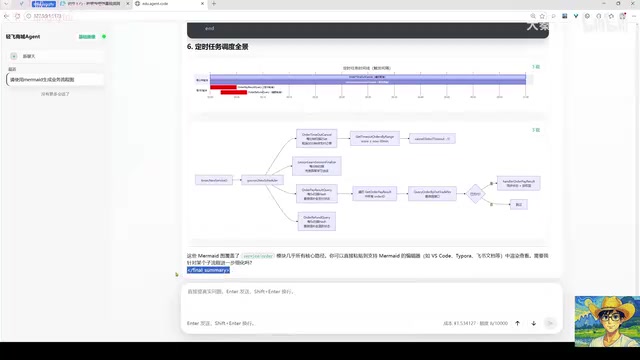
The demo also candidly exposes real-world issues: because the report contains special characters such as quotation marks and semicolons, some Mermaid diagrams failed to render. Mermaid is a text-based diagram description language that uses a concise DSL syntax to generate flowcharts, sequence diagrams, state machine diagrams, and more, and is widely integrated into platforms such as GitHub and Notion. The problem of LLMs producing malformed output when generating such structured text—due to inconsistent quote escaping and special character handling—is known in the industry as the "structured output reliability" problem. Solutions include using APIs that support Structured Output (such as OpenAI's JSON Mode or Function Calling), strengthening format constraints in prompts, and adding a post-processing and format validation layer for the output. In addition, the QA output includes a superfluous "Final Summary." These details remind us that the format stability of LLM output remains a major challenge in Agent engineering.
Command Approval Mechanism: Adding a Human Gate for Dangerous Operations
When an Agent has the ability to execute terminal commands (such as creating or deleting files), a security mechanism becomes indispensable. The security of AI Agent command execution has been a core topic of ongoing industry discussion—since 2023, multiple research teams have documented cases of "Prompt Injection" attacks, where malicious content infiltrates the Agent's context via tool return results, inducing it to perform destructive operations. The danger of prompt injection lies in its highly covert attack surface: an attacker can embed malicious text disguised as system instructions within any external content the Agent reads (web pages, files, database return values), causing the Agent to misjudge it as a legitimate task and execute it. Multiple academic studies in 2024 have shown that current mainstream LLMs still have limited resistance to carefully designed prompt injection attacks, making a mandatory approval mechanism at the framework level a necessary line of defense that cannot rely on the model's own judgment. The Human-in-the-Loop (HITL) approval mechanism is precisely the engineering guardrail for addressing such risks, and it is also a control measure explicitly recommended in the NIST AI Risk Management Framework (AI RMF).
The Eino framework demonstrates a Human-in-the-Loop approval mechanism: by switching the command detection mode to approval-required mode via configuration, any dangerous action triggers a confirmation dialog before execution. Notably, Eino builds the Approval Primitive into the framework layer rather than relying on business code to implement it—this means developers don't need to manually insert approval logic at every tool call; the framework intercepts uniformly, avoiding security blind spots caused by omissions in business code. This is an important design decision for its production security.
A typical workflow is as follows:
- Ask the Agent to create a new
hello.goin a specified directory—anew itemapproval request pops up - After the user confirms, the file is actually created
- Ask the Agent to delete the file—a
remove itemapproval request pops up again - After the user approves, the file is deleted
The design that "dangerous operations cannot be executed without human confirmation" is a necessary guardrail for AI Agents moving into production environments, and it is also an important engineering practice of the Eino framework at the security level.

RAG Knowledge Base: A Complete Implementation of Retrieval-Augmented Generation
RAG (Retrieval-Augmented Generation) was formally proposed by Meta AI in a 2020 paper. Its core idea is to retrieve relevant document fragments from an external knowledge base to inject into the Prompt as context before the LLM generates its answer, thereby overcoming the limitations of the model's training data cutoff date and reducing the likelihood of hallucinations. A typical tech stack includes: text vectorization (Embedding Model), a vector database (such as Milvus or Pinecone), and similarity retrieval (ANN algorithms). RAG and fine-tuning are the two mainstream paths for injecting proprietary knowledge into LLMs, each with its own applicable scenarios: fine-tuning is suitable for scenarios that require changing the model's behavioral style or injecting large amounts of stable knowledge—it is costly but has lasting effects; RAG is suitable for scenarios where knowledge is frequently updated and precise sourcing is needed—it is low-cost and can be updated in real time, making it more common in applications such as enterprise knowledge bases and code repository analysis.
Addressing the frequently asked question of "whether a knowledge base is actually useful and when to use it," the Eino framework provides a complete RAG implementation path.
Preparation includes: deploying Ollama (used to run the Embedding model locally), downloading the embedding model, and enabling RAG in the configuration. At startup, you can choose to build an index automatically, vectorizing all files in a specified directory and storing them in the Milvus vector database. Milvus is an open-source vector database under the Linux Foundation, designed for large-scale vector similarity search, supporting millisecond-level ANN retrieval on billion-scale vectors—its underlying implementation relies on approximate nearest neighbor algorithms such as HNSW (Hierarchical Navigable Small World graph) and IVF (Inverted File index), which achieve an optimal balance between query speed and recall by building multi-layer graph structures. Text is converted by the Embedding model into high-dimensional vectors (typically 768–1536 dimensions) and stored in it; during retrieval, the user's question is likewise vectorized before performing a similarity search to recall the most relevant document fragments. It is worth noting that choosing an Embedding model matched to the business domain is key to RAG effectiveness—for code scenarios, models specifically trained for code semantic understanding, such as CodeBERT, are recommended. These models learn code syntax structures, API call relationships, and comment semantics during pre-training, and the quality of their vector representations for code fragments is significantly better than that of general-purpose language models. Benchmarks show that recall on code retrieval tasks can improve by 20%–40%.
When validating the results, the Agent can correctly recall content such as "common contingency plans" and "special reminders" based on the vector store, and clearly state that the data comes from already-vectorized files. When asked about a nonexistent "special hand line," it can also recognize that the user probably meant "special reminders," demonstrating a degree of semantic understanding.
A more advanced approach is to encapsulate the entire RAG library as a tool. Instead of retrieving immediately when a question is asked, the Agent proactively queries the knowledge base during a tool call only when it finds its own content insufficient. Both modes have their applicable scenarios and can be flexibly combined according to actual needs.
MCP and Skill: Accessing a Standardized External Capability Ecosystem
MCP Protocol Integration
MCP (Model Context Protocol) is a standardized protocol open-sourced by Anthropic in November 2024, aimed at solving the fragmented integration problem between AI models and external tools and data sources. Before MCP, every AI application had to write separate adapter code for each external service, resulting in extremely high maintenance costs. MCP defines a unified communication specification between servers and clients, similar to how the USB interface standardizes hardware devices—a tool provider only needs to implement an MCP server once, and all MCP-compatible AI clients can call it directly, truly achieving "plug and play." At the protocol level, MCP implements client-server communication based on JSON-RPC 2.0, supporting three core capabilities: Tool Discovery, Resource Access, and Prompt Templates. The ecosystem value of MCP lies in the network effect: as of early 2025, there are already hundreds of MCP server implementations covering domains such as browser control, database queries, code execution, and file system operations. Once developers adopt an MCP-compatible framework like Eino, they can directly reuse this tool ecosystem without redundant development, evolving external integration for AI applications from "one-by-one adaptation" to "ecosystem sharing."
The Eino framework integrates DeepWiki, an MCP service used to organize the Wiki documentation of Git repositories. Once enabled in the configuration, giving the Agent a repository address prompts it to automatically call tools such as ask question that come with the MCP service to complete the organization—and these tools require no implementation by the developer; the returned results come entirely from the MCP server. This validates the smoothness of MCP integration—the Agent can extend the external tool ecosystem just like plugging in a plugin.

Skill Invocation
The Skill capability directly reuses Claude's skill system. Once enabled, the Agent comes with various built-in skills such as html, ppt, OpenClaude, and Zhihu.
In the demo, when given the instruction "use a skill to generate a two-page PPT, with the first page saying hello world and the second page saying golang hello," the Agent loads the skill, calls the terminal to write files (triggering approval), and ultimately successfully generates a page-turnable PPT document. As a form of high-level capability encapsulation, Skill significantly reduces the development cost of producing output in specific formats—developers don't need to implement document generation logic for PPT, HTML, etc. from scratch, but can directly reuse validated capability units. From an architectural perspective, the essential difference between Skill and MCP is: MCP is a standardized protocol for accessing external services, focused on tool invocation and solving the problem of "how to connect to the external world"; Skill is a predefined output template and generation workflow, focused on formatted content production and solving the problem of "how to stably output specific formats." The two complement each other, together forming a complete system for extending Agent capabilities.

Database Reporting Agent: Enabling Business Teams to Self-Serve Data
The final demonstration is quite practical—a sub-Agent dedicated to handling database reports (db report agent). Its design principle is: expose the entire database's table structure to the tool, but strictly limit it to read-only operations, prohibiting any write actions. This "Principle of Least Privilege" is a classic database security practice, first systematically articulated by Jerome Saltzer and Michael Schroeder in their 1975 paper on system security. It is especially important in AI Agent scenarios, because LLMs carry the risk of hallucination, and granting write permissions could cause irreversible data corruption. At the implementation level, the read-only restriction is usually achieved by configuring a read-only database account for the Agent (rather than intercepting SQL at the application layer), so that even if the Agent generates SQL for a write operation, the database permission layer will reject it, forming a multi-layered defense. Compared to filtering SQL statements at the application layer, database account permission control is more reliable because it does not depend on parsing SQL statement syntax—SQL injection and detection-bypass variants are endless, whereas the permission control of the database kernel is a truly enforced boundary.
When the user asks to "calculate the total study time for each course," the Agent will sequentially: pull all tables and their descriptions → query the database → provide the statistical criteria, metric definitions, and results (total duration, number of learners, number of records). It can further "calculate duration by day" and generate a downloadable Excel report.
This leads to a pragmatic product design idea: a reporting tool doesn't have to be rigid—it can be made flexible. Business teams generally know what they want to count, so they can just let the Agent query directly; for business teams who aren't good at describing requirements, engineers can pre-build common statistical criteria, and a single button click sends a preset instruction to retrieve data. This dramatically reduces the marginal cost of report development.
Conclusion: The Go Tech Stack Can Also Build Production-Grade AI Agents
ByteDance's Eino framework comprehensively covers seven engineering capabilities: multi-Agent orchestration, autonomous long-task execution, command approval, RAG knowledge base, MCP protocol integration, Skill invocation, and database reporting. It proves one thing: Go programmers don't need to switch to Python to build fully functional, observable, approvable, and extensible production-grade AI Agents from scratch.
The issues exposed in the demo—unstable output formats, failed diagram rendering—realistically reflect the current state in which Agent engineering is still on an uphill climb. These challenges are not unique to Eino, but are common difficulties across the entire field of LLM application engineering. Yet it is precisely this kind of "not shying away from problems" demonstration that makes this practice more valuable as a reference. For backend engineers who want to venture into agent development with a pure Go tech stack, the Eino framework is a path well worth serious evaluation.
Key Takeaways
Key Takeaways
Key Takeaways
Related articles

DeepCell: One-Click AI Generation of Documents, Spreadsheets, and Slides
DeepCell tops Product Hunt with one-click generation of documents, spreadsheets, and slides, using the .deepcell format for linked updates, designed for System 2 tasks like modeling and sales reviews.

Doneas: 15-Minute Daily Accountability Calls That Keep Indie Developers From Procrastinating
Doneas is a daily accountability tool for indie developers: plan tasks on Monday, join a 15-minute call with five builders each day, and log deliveries on a public progress page. This article analyzes its core mechanics, effectiveness, and potential issues around retention and matching.

Fastlane 2.0: Fully Automated AI Ad Campaigns, From Creative to Optimization
Fastlane 2.0 is an AI ad automation tool: enter your website and it learns your brand, generates video and image ads, and runs and optimizes them on Meta, TikTok, Instagram, and YouTube.