AI Agent Interview Focus Comparison: ByteDance vs. Tencent vs. Alibaba — Differences in Approach & Preparation Strategies

ByteDance, Tencent, and Alibaba have vastly different AI Agent interview focuses, reflecting divergent tech roadmaps.
A developer interviewing at ByteDance, Tencent, and Alibaba for AI Agent roles found dramatically different focuses: ByteDance has the highest technical density, drilling into ReAct framework implementation details, RLHF training pipelines, and Agent infinite loop debugging; Tencent emphasizes protocol understanding and ecosystem vision, focusing on the essential difference between Workflow and Agent, plus MCP and A2A protocols. These differences reflect each company's distinct understanding of AI Agent technology roadmaps.
Recently, a developer who interviewed consecutively at ByteDance, Tencent, and Alibaba for AI Agent development roles discovered a noteworthy phenomenon: despite all being AI Agent development positions, the three companies' interview focuses are almost entirely different. This reflects not just differences in interview style, but fundamental divergences in how each company understands AI Agent technology roadmaps.
This article systematically breaks down the interview logic at ByteDance, Tencent, and Alibaba for AI Agent roles, helping developers preparing for these positions study with precision.
ByteDance AI Agent Interviews: Highest Technical Density, Drilling Down on Engineering Implementation
ByteDance's AI Agent interviews have the highest technical density among the three companies. Interviewers won't waste time asking conceptual questions like "What is an AI Agent?" — instead, they directly probe implementation details, testing whether you've truly worked with production-grade Agent systems.
ReAct Framework: No Definitions, Only Implementation
The ReAct (Reasoning + Acting) framework was proposed by Google's research team in 2022. Its core idea is to interleave a large language model's reasoning (Chain-of-Thought) with actions (tool calls) in a unified loop. Unlike pure reasoning chains, ReAct allows the model to execute external actions (such as search, computation, API calls) after each reasoning step, then continue reasoning based on the returned results, forming an iterative closed loop of "Think → Act → Observe." This design enables Agents to handle complex tasks requiring real-time information or multi-step operations, and is one of the core design paradigms in mainstream Agent frameworks (LangChain, AutoGPT, etc.).
Taking the ReAct framework as an example, ByteDance won't ask you to recite definitions. Instead, they'll probe like this:
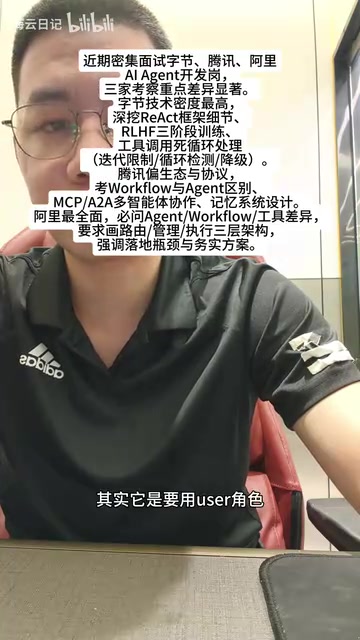
- How do you set up the message format for tool calls? Should the tool's response be passed back with a
userorassistantrole? Why? - The correct answer is to use the
userrole, because it's content returned by an external system (web/API), not generated by the model itself. If incorrectly labeled asassistant, the subsequent reasoning chain will become confused.
These questions may seem minor, but they directly reveal whether you've actually debugged an Agent's message flow hands-on.
RLHF Three-Stage Training
RLHF (Reinforcement Learning from Human Feedback) is the mainstream technical approach for current large language model alignment, systematically proposed by OpenAI in the InstructGPT paper and applied to ChatGPT training. Its three-stage process is: Stage 1 is pre-training the base model (GenericGPT) on massive unlabeled text to learn language patterns; Stage 2 is Supervised Fine-Tuning (SFT), using high-quality human-annotated instruction-response pairs to teach the model to follow instructions; Stage 3 is the Reinforcement Learning (RL) phase, which first trains a Reward Model to simulate human preference scoring, then uses RL algorithms like PPO to optimize the language model so its outputs better align with human expectations.
What ByteDance frequently tests is precisely this GenericGPT → SFT → RL three-stage training pipeline, with follow-up questions on observation handling at each stage, reward model design, and other details. This reflects ByteDance's core technical direction of transferring RLHF capabilities to Agent decision optimization.
Classic Follow-up: How Do You Debug an Agent Stuck in an Infinite Loop?
ByteDance has a classic interview question: Your Agent falls into an infinite loop after calling three tools — what's your debugging approach?
This question tests production-grade Agent fault tolerance design. You need to articulate:
- Maximum iteration limit — Set a hard cap to prevent infinite loops
- Loop pattern detection — Identify repeated tool call sequences
- Exception fallback strategy — Graceful degradation rather than crashing
- Human intervention mechanism — A safety net when automated measures fail
Preparation advice: Interviewing at ByteDance requires solid engineering experience. Focus your preparation on "how to do it" rather than "what it is."
Tencent AI Agent Interviews: Emphasizing Protocol Understanding & Ecosystem Vision
Tencent's interview style is starkly different from ByteDance's, leaning more toward engineering protocols and ecosystem vision, testing your depth of understanding of the entire AI Agent technology ecosystem.
The Essential Difference Between Workflow and Agent
Tencent will ask a question that seems simple but most candidates struggle to answer well: What exactly is the difference between a Workflow and an Agent?
- Workflow is "prescribed choreography" — the control flow is predetermined by code, with fixed execution paths at each step
- Agent is "freestyle gymnastics" — each step is autonomously decided by the LLM, with dynamic planning capabilities
- Best practice is an organic combination of both — use Workflows to ensure determinism in critical processes, and use Agents to handle steps requiring flexible decision-making
MCP Protocol and A2A Protocol
Tencent will also deeply probe your understanding of MCP (Model Context Protocol) and A2A (Agent-to-Agent) protocols. To understand these two protocols, you first need to grasp the problems each solves:
MCP is an open standard protocol released by Anthropic in late 2024, designed to solve the standardized connection problem between AI models and external data sources/tools. Before MCP, every Agent framework had its own tool-calling interface, leading to severe ecosystem fragmentation. MCP defines a unified server-client communication specification that allows any protocol-compliant tool to be called by any MCP-supporting model — similar to a "USB interface standard" for the AI field.
Related articles
 Tutorials
ChatGPT Plus Subscription Guide: Are GPT-5.5, image-2, and Codex Worth the Upgrade?
A detailed look at ChatGPT Plus features — GPT-5.5, image-2, and Codex — with a Plus vs Pro comparison and a complete step-by-step subscription guide for users outside the US.
 Tutorials
Harness AI Engineering in Practice: Using Claude Code to Master Enterprise-Level E-Commerce Development
Deep dive into Harness AI Engineering: master enterprise e-commerce development with Claude Code using the Rules, Skills, Wiki, and Changes framework.
 Tutorials
Cursor + Codex Dual-IDE Collaboration: A Practical Methodology for Open-Source Project Customization
A complete methodology for open-source project customization based on real-world experience, detailing the Cursor+Codex dual-IDE workflow, seven-stage process, MVP validation, and AI source code reading techniques.