AI Agent Memory Architecture Design: Four-Layer Partitioning + Bitemporal Modeling Practical Guide

Production-grade AI Agents need four-layer partitioning, bitemporal modeling, and skill extraction for reliable memory.
This article argues that vector database semantic search cannot handle temporal conflicts and state overwrites, making it unsuitable as the core memory architecture for production-grade AI Agents. It proposes three solutions: a four-layer partitioned architecture isolating transient conversations from deterministic business state using structured JSON as the single source of truth; bitemporal modeling preserving complete history through event time and system write time timestamps; and a skill extraction mechanism compressing successful operation sequences into reusable skill macros, enabling evolution from declarative to procedural memory.
When building LLM applications, the most common engineering approach is to dump everything—user prompts, conversation logs, system events—into a vector database. For simple search-retrieval scenarios, this approach barely works. But for production-grade autonomous Agents, treating semantic search as the core memory architecture will inevitably lead to fatal logical pitfalls.
This article breaks down a proven AI Agent memory system engineering solution, covering three core modules: four-layer partitioned architecture, bitemporal modeling, and skill extraction mechanisms, helping you understand how to give AI Agents truly reliable memory capabilities.
Why Semantic Search Can't Support Production-Grade Agent Memory
Consider a typical business scenario: a user tells the system their car-buying budget is $50,000, then later receives a bonus and updates the budget to $80,000. A vector database handles this by appending the new information right alongside the old. Since semantic search relies on text similarity rather than temporal logic, any query about the budget will pull up both the $50,000 and $80,000 figures simultaneously.
The core principle of vector databases (such as Pinecone, Weaviate, Milvus, etc.) is converting text into high-dimensional vectors via embedding models, then performing Approximate Nearest Neighbor (ANN) search using metrics like cosine similarity or Euclidean distance. This mechanism is naturally suited for handling "semantic relevance"—finding document fragments most semantically similar to a query. But its fundamental flaw is this: there are no "time" or "causality" dimensions in vector space. Two records that are semantically highly similar but logically mutually exclusive (like the old and new budgets) may be very close in vector space, and the search engine cannot determine which represents the current valid state. This is the underlying reason why RAG (Retrieval-Augmented Generation) pipelines frequently fail in scenarios requiring high factual accuracy.
Faced with conflicting data points, language models hallucinate—they simply cannot determine which number represents current reality. In production environments, once the model picks the wrong budget, all downstream automated workflows (credit checks, inventory searches, etc.) will completely break.
The core issue is: production-grade Agent memory is a fundamentally different concept from simple data storage. It requires a dedicated architectural pathway to precisely transform historical inputs into current decision-making evidence.
Four-Layer Partitioned Architecture: From Conversational Context to Deterministic State
The solution is a four-layer stacked architecture that completely isolates transient conversational context from deterministic business state through strict partitioning. This forms the backbone of the entire AI Agent memory architecture.
Layers One and Four: Transient Environment Variables
The top and bottom layers of the architecture handle immediate environment variables. Session metadata captures current technical parameters (user timezone, device info, etc.), while the sliding window retains only raw conversation fragments. Both layers are entirely transient—once their immediate utility expires, raw data is cleared, eliminating computational waste and saving precious token budgets.
Layer Three: Context Summary Compressor
Long-term interactions easily devour context windows, and Layer Three serves as the context compressor. It continuously compresses conversational content into concise bullet-point summaries, providing the model with the precise context needed to continue conversations without reading thousands of words of raw records. Summaries are highly efficient at maintaining conversational coherence but still lack the rigid precision required for executing financial or operational tasks.
Layer Two: Structured Profile—The Core of the LLM Memory System
Absolute precision is guaranteed by Layer Two—the structured profile. It is strictly maintained as a structured JSON object, enforcing the "Single Source of Truth" principle. No guessing, no fuzzy matching.
"Single Source of Truth" (SSOT) is a classic design principle in software engineering, originally widely applied in relational database design and frontend state management (like Redux's global Store). Using a structured JSON object as the SSOT in AI Agent memory architecture essentially borrows from State Machine thinking: the system has only one deterministic state snapshot at any given moment, and all downstream decisions must read from this snapshot. The choice of JSON format also has engineering rationale—it's one of the structured formats that LLMs are natively best at parsing, and compared to XML or Protocol Buffers, JSON offers superior readability and token efficiency in prompt engineering.

Returning to the car-buying budget paradox: the structured layer uses a state overwrite mechanism. When the user updates their budget to $80,000, the system dynamically overwrites the JSON value, permanently erasing the old $50,000 entry. Forcing the model to read explicit JSON arrays fundamentally eliminates logical hallucinations about user attributes.
Autonomous Memory Management: Ledger, Views, and Policy Nodes
Maintaining clean, precise state solves data conflicts, but for an Agent to truly operate autonomously, it must be able to independently read, write, and manage state. This requires three core backend components working in concert.
Ledger: The Immutable Raw Log
The ledger serves as the foundational raw log, following one absolute rule—append-only. Every system event, interaction, and error is infinitely stacked here. Since LLMs inevitably encounter errors or produce flawed logic, immutable raw records provide the precise diagnostic trace needed for rolling back systems and debugging failure points.
Append-only logs are a foundational design pattern in distributed systems, with the most famous implementations including Apache Kafka's Commit Log and database Write-Ahead Logs (WAL). The core advantage of this pattern lies in immutability—once data is written, it is never modified or deleted, providing the system with complete audit trails and deterministic state reconstruction capability. In AI Agent scenarios, this is particularly critical: when an LLM makes an incorrect decision, engineers can replay logs to precisely pinpoint which input step caused the faulty reasoning—a capability nearly impossible to achieve with traditional mutable state storage. The Event Sourcing architectural pattern is based on exactly the same idea—reconstructing system state at any point in time by replaying event sequences.
Views: The Parseable Data Layer
Raw data logs are unreadable for immediate operational tasks. The view layer actively processes the ledger's raw data, distilling it into organized JSON tables and associated knowledge graphs that language models can actually parse and use.
Policy Node: The Control Brain of Memory Workflows
The entire workflow is governed by the policy node. It acts as the control brain, precisely instructing the Agent when to act and when to pause and extract information.
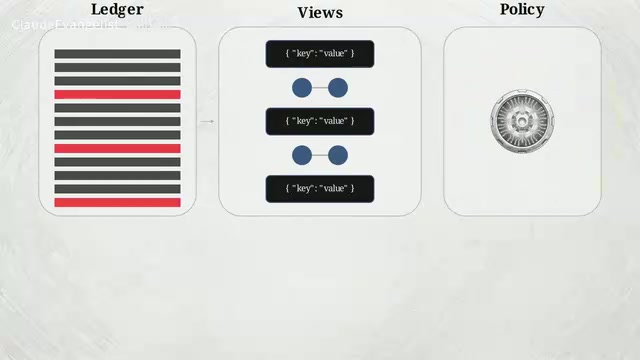
The policy node acts as a gatekeeper, forcing the Agent to use an explicit "System 2 slow thinking" loop. The "System 2 slow thinking" concept comes from Nobel economics laureate Daniel Kahneman's book Thinking, Fast and Slow. System 1 is fast, intuitive automatic processing; System 2 is slow, deliberate logical reasoning. In AI Agent architecture, the "pause-query-verify" loop enforced by the policy node is an engineering simulation of System 2. Current mainstream LLMs' default behavior more closely resembles System 1—generating text quickly based on statistical probabilities, prone to confident but incorrect outputs. By inserting mandatory fact retrieval and state verification steps at critical decision points via the policy node, this essentially embeds an explicit Reasoning Checkpoint within the autoregressive generation process—a concept aligned with recent prompt engineering paradigms like Chain-of-Thought and ReAct, as well as the design philosophy behind OpenAI's o1 series models.
When facing complex tasks, text generation pauses, the policy node dives into the view layer to query the precise facts needed, and injects them into the prompt before the model generates its response. The combination of these three components gives the language model the ability to independently manage its own memory state and verify facts before executing responses.
Bitemporal Modeling: Eliminating Agent Historical Amnesia Once and For All
State overwrite keeps current operations clean, but introduces a specific limitation: the system loses all visibility into historical values.
Here's an example: a user switches jobs from Company A to Company B. Following state overwrite rules, the old employer is erased and replaced with the new one. Problems arise when the system tries to resolve historical queries—searching for "last year's employer" only returns Company B, because Company A's record no longer exists in the primary state.
The database engineering field provides a mature solution for this "historical amnesia"—Bitemporal Modeling.
Bitemporal modeling was first proposed by Richard Snodgrass in the 1980s and later incorporated into the SQL:2011 standard's Temporal Table specification. It has decades of mature application in finance, healthcare, and legal compliance—for example, banks need to simultaneously track "when a transaction actually occurred" and "when the transaction was recorded in the system," because delays or corrections may exist between the two. Introducing bitemporal modeling into AI Agent memory systems solves a more subtle problem: LLMs need to distinguish between "the timeline of world state changes" and "the timeline of system knowledge changes." The separation of these two timelines enables Agents to answer meta-cognitive queries like "what decisions did the system make based on outdated information before we knew the user changed jobs"—crucial for error attribution and decision auditing.
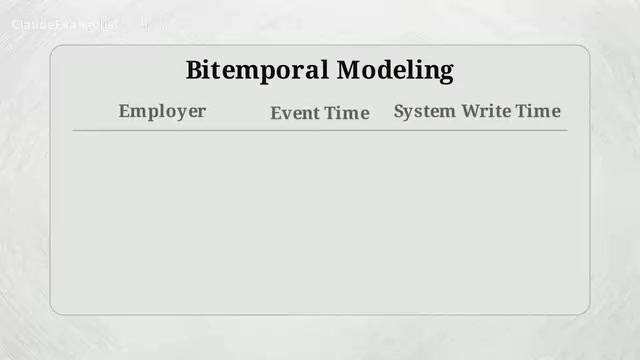
Under bitemporal constraints, every memory written to the system must carry two independent timestamps:
- Event Time: When the event actually occurred in reality
- System Write Time: When the database explicitly recorded the event
Therefore, Company A is never deleted. Both companies exist in separate rows, isolated by their respective temporal boundaries. This explicit time-slicing acts as an instruction set telling the model how to precisely sequence reality, rather than just providing a static data warehouse.
With these two independent timestamps, the model can perfectly isolate past states from current reality. Queries about last year's employer successfully route to Company A without conflicting with Company B. For handling dynamic real-world variables without breaking system logic, bitemporal constraints are an absolutely non-negotiable requirement.
Skill Extraction: Evolving from Declarative Memory to Procedural Memory
Bitemporal modeling and structured profiles guarantee the Agent's declarative memory—precisely knowing what a fact is. But for advanced autonomous operations, knowing facts alone is far from sufficient. The system must also possess procedural memory—knowing how to execute complex operation sequences based on past experience.
The distinction between Declarative Memory and Procedural Memory originates from cognitive psychologist Endel Tulving's long-term memory classification theory proposed in 1972. Declarative memory stores factual knowledge about "what is" (e.g., "Paris is the capital of France"), while procedural memory stores operational skills about "how to" (e.g., riding a bicycle). Once formed, human procedural memory becomes highly automated, requiring no conscious recall of each step. Mapping this cognitive framework to AI Agent design means that Agents need not only a fact database but also a "skill library"—storing verified operation sequences that enable them to execute complex tasks directly like skilled workers, rather than reasoning from scratch every time. This is also highly consistent with the concept of Policy Distillation in reinforcement learning.

Consider a standard Agent debugging loop: Agent encounters a code error → reads documentation → writes a fix → encounters a secondary error → iterates repeatedly until successful output. If the Agent is forced to run through the entire trial-and-error loop every time it encounters the same bug, it produces enormous token waste and drives up computational costs.
This inefficiency is solved through Skill Extraction. The system actively distills chaotic loop trajectories, filters out failures and dead-end documentation searches, and compresses only the final successful sequence into a standalone executable Skill Macro.
The next time the Agent faces the exact same bug, it skips the search phase entirely and deploys the extracted macro for instant resolution. Skill extraction constitutes the core mechanism of Agent procedural memory, ensuring the system truly learns from experience—each successful execution reduces both latency and operational costs.
Conclusion: Agent Memory Is Fundamentally Systems Engineering
Building true AI Agent memory requires rigorous systems engineering thinking, far beyond simply routing text to a vector database:
- Strict architectural partitioning: Strip away transient conversational context and lock deterministic business logic into structured bitemporal arrays
- Policy node governance: Data retrieval must be controlled by strict policy nodes, forcing the system to pause and verify state before acting
- Procedural memory accumulation: Action outcomes must be continuously filtered, compressing successful operations into procedural macros to accelerate future tasks
This memory architecture provides LLMs with the structural foundation needed for autonomous operation—making decisions based on verifiable state rather than semantic probability. As AI Agents move from labs to production environments, the engineering design of memory architecture will become the critical watershed determining system reliability.
Related articles
 Tutorials
ChatGPT Plus Subscription Guide: Are GPT-5.5, image-2, and Codex Worth the Upgrade?
A detailed look at ChatGPT Plus features — GPT-5.5, image-2, and Codex — with a Plus vs Pro comparison and a complete step-by-step subscription guide for users outside the US.
 Tutorials
Harness AI Engineering in Practice: Using Claude Code to Master Enterprise-Level E-Commerce Development
Deep dive into Harness AI Engineering: master enterprise e-commerce development with Claude Code using the Rules, Skills, Wiki, and Changes framework.
 Tutorials
Cursor + Codex Dual-IDE Collaboration: A Practical Methodology for Open-Source Project Customization
A complete methodology for open-source project customization based on real-world experience, detailing the Cursor+Codex dual-IDE workflow, seven-stage process, MVP validation, and AI source code reading techniques.