AI Agent Model Tiered Routing Strategy: Token Cost, Hallucination Mitigation, and Practical Model Selection
Build AI Agents with tiered model routing instead of blindly using the most powerful model.
Blindly using the strongest model when building AI Agents leads to cost explosions, latency spikes, and over-reasoning. This article analyzes four dimensions: Token economics, uncertainty, hallucination risks, and model selection. It shows that Agent Token consumption far exceeds Chat scenarios, Temperature=0 cannot guarantee deterministic output, and hallucinations in Agents translate into erroneous actions. The author recommends a tiered routing strategy that matches different model tiers to task complexity, reducing costs by 50%–70%.
When building AI Agents, many developers' first instinct is to "just use the most powerful model." But in real-world engineering, this seemingly safe choice often leads to cost explosions, latency spikes, and even over-reasoning. This article breaks down Token economics, model uncertainty, hallucination mitigation, and tiered model routing strategies from an Agent engineering perspective, helping you make better model decisions in Agent development.
Token Economics: An Agent's Cost Structure Is Completely Different from Chat
What Are Tokens
The basic unit that large language models process isn't characters or words—it's Tokens. In English, one Token corresponds to roughly 4 characters (about 0.75 words). In Chinese, one character typically maps to one Token, though common words may be merged. You can test this using tokenizer tools from platforms like OpenAI.
Knowing how many Tokens a sentence takes isn't particularly meaningful on its own. What truly matters is understanding how fast an Agent loop consumes Tokens—something Chat scenarios never need to worry about, but something Agent engineers must carefully budget for.
Context Window: Bigger Doesn't Mean Better
The context window is the maximum number of Tokens a model can process in one call. It includes the System Prompt, conversation history, tool definitions, tool return results, and model output—this is a total budget, not separate line items. Current mainstream models vary significantly: Claude Opus reaches approximately 1 million Tokens, Sonnet 4.6 about 200K, and GPT-5.5 is in a similar range.
But there's a critical point to note: according to a benchmark report published by the Kwan Ma team in July 2025, as input Token count increases, nearly all mainstream models show degraded performance on simple tasks, and the degradation curves vary significantly across models—some drop noticeably at 32K, while others hold up to 128K. So a large window doesn't mean you can stuff everything into it.
Agent Token Consumption Grows Exponentially
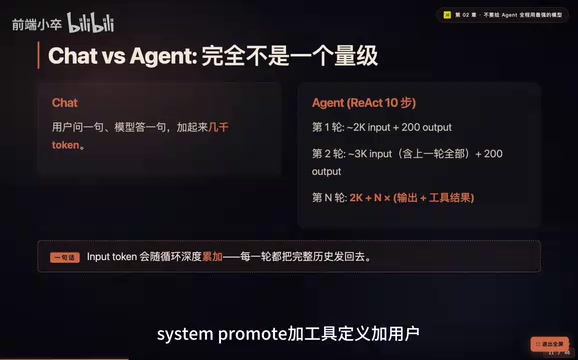
With a Chat application, cost calculation is straightforward: the user asks a question, the model answers, totaling a few thousand Tokens. But Agents operate at an entirely different scale.
In a ReAct-style loop:
- Round 1: Input of about 2,000 Tokens, model output of 200 Tokens, plus tool calls
- Round 2: Cumulative content from the previous round + tool return results + new input, approximately 3,000 Tokens
- Round N: Input Tokens accumulate with each loop iteration, because the full history must be sent back every round
An Agent's total Token consumption can reach 50K–100K, while the same conversation in Chat mode might only need 5K. This is why Token management and Prompt Caching are critical for Agents—an Agent's cost curve is a fundamentally different problem from Chat.
Uncertainty: Temperature=0 Can't Save You
The Nature of the Sampling Process
The process of generating each Token involves three steps: first, computing a score (Logit) for every Token in the vocabulary; then using Softmax to convert scores into a probability distribution; and finally, sampling from that distribution. The third step—sampling—is the root of uncertainty.
The Temperature parameter controls how sharp the probability distribution is:
- Temperature=0: Greedy sampling, always selecting the highest-probability Token
- Temperature=0.7 (default in most SDKs): Slightly smoothed distribution, occasionally allowing suboptimal Tokens
- Temperature=1.0+: Significantly smoothed distribution, more divergent output
Why Temperature=0 Still Can't Guarantee Determinism
Many developers (myself included) assumed when first writing Agents that setting Temperature to 0 equals deterministic output. But in practice, the same input and same code run twice can produce completely different tool-calling paths.
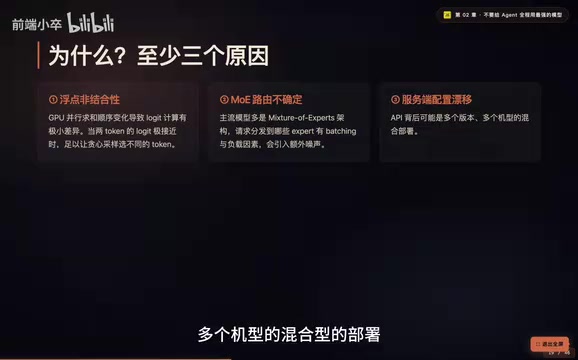
There are at least three reasons:
- Non-associativity of floating-point arithmetic: Differences in GPU parallel summation order cause tiny deviations in Logit calculations
- MoE model routing uncertainty: Expert selection in Mixture-of-Experts models is inherently non-deterministic
- Server-side configuration drift: The API backend may be a mixed deployment of multiple versions and hardware types
OpenAI introduced the Seed parameter in November 2023 to mitigate this, but it's no longer supported in the 2026 Response API. Anthropic is also preparing to deprecate similar functionality.
Practical advice: For Agent loops and tool-calling decisions, set Temperature to 0 or 0.1; for creative tasks (copywriting, diversity testing) use 0.7–1.0; structured output must be paired with Schema validation and retry mechanisms—don't rely on Temperature alone. Remember: Temperature=0 reduces surprises; it doesn't eliminate them.
Hallucinations: In Agents, It's Not Just Saying Wrong Things—It's Doing Wrong Things
The Fundamental Difference Between Agent Hallucinations and Chat Hallucinations
In Chat scenarios, hallucination typically means the model fabricates non-existent facts, like claiming a book was published in 1987. But in Agents, hallucinations directly become erroneous actions:
- Calling a tool that doesn't exist
- Fabricating content from files it never read
- Inventing false information and executing subsequent operations based on it
- Making up function parameter names
The most dangerous are fabricated file contents and invented error messages—they look like normal output, and you only discover they're fake when you actually verify that file or log entry.
The essence of hallucination is that models learn the probability distribution of Tokens given context; "truth" is not a built-in concept. Hallucination isn't a bug—it's a byproduct of how LLMs work. Complete elimination is impossible; you can only mitigate it layer by layer.
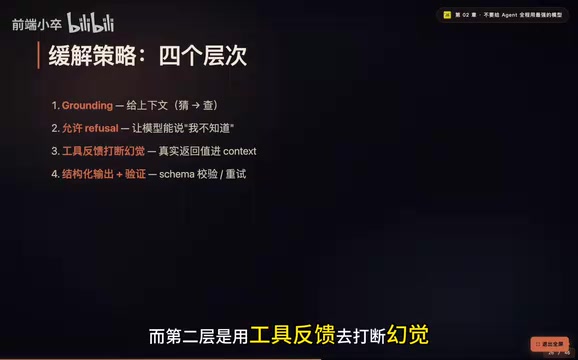
Four-Layer Mitigation Strategy
- Grounding: Feed the information the model needs directly into the Context. For example, if an Agent needs to determine which test framework a project uses, instead of letting it guess, have it read the config file first—turn "guessing" into "looking up"
- Allow "I don't know": Explicitly permit the model in the System Prompt to acknowledge uncertainty. When tools also can't answer, say "I cannot determine this" rather than guessing. The effect is surprisingly good—many models will force an answer without this instruction
- Use tool returns to break the hallucination chain: The core advantage Agents have over Chat is that real tool feedback enters the next round's Context. A model can fabricate a file-read result, but it can't fabricate what it actually sees after a real tool call—as long as the tool call actually happens, hallucinations get corrected by reality
- Structured output + Schema validation: Have the model output structured data conforming to a JSON Schema; retry or fall back on validation failure
Model Selection: It's Not Multiple Choice—It's a Recipe
Six Dimensions for Model Selection
Many people select models based solely on "which is smartest." This might suffice in Chat mode, but in Agent mode you need to consider at least six dimensions:
- Capability ceiling: Upper limit for complex reasoning and long-chain tool-calling decisions
- Tool-calling stability: Does it invent tools? Are parameters correct? Can it call reliably?
- Context length: Actual usable length (not the advertised value)
- Price: Cost per million Tokens for Input/Output
- Latency: Time-to-first-Token + overall generation speed
- Deployment form: Whether API calls, edge deployment, or open-source private deployment are supported
Why You Can't Use the Strongest Model for Everything
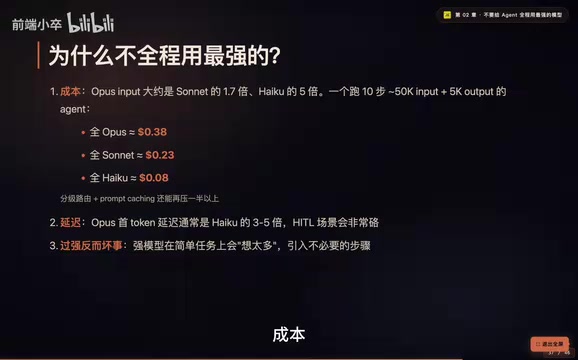
Taking O-Pro (an O3-class reasoning model) as an example, using the strongest model throughout presents at least three problems:
- Cost: O-Pro's input price is roughly 17x that of Sonnet-class models
- Latency: O-Pro's time-to-first-Token is typically 3–5x that of Sonnet
- Over-reasoning: Strong models tend to "overthink" simple tasks, introducing unnecessary complexity. For instance, asking O-Pro to determine "is this message asking a code question" sometimes produces a 200-word analysis before giving the conclusion, while Sonnet directly answers Yes/No
Recommended Tiered Routing Strategy
Allocating different models to different stages based on task complexity is currently the most cost-effective approach in Agent architecture:
- Main loop (planning, tool-calling decisions): Sonnet / GPT-5.5 class—moderate price, strong enough capability
- Simple classification, routing decisions: Haiku / GPT-5.5 Mini class—cheap, fast response
- Extremely complex reasoning, fallback calls: O-Pro / GPT-5.5 Pro class—expensive, slow, but highest capability ceiling
This tiered routing strategy can reduce Token costs by 50%–70% without sacrificing overall Agent capability.
The Debate Around Reasoning Models
There's a clear divide in the industry over whether Agents should primarily use Reasoning models (like the O-series). Proponents argue that having the model reason internally is more elegant than wrapping it in layers of prompt templates. Opponents point out:
- The reasoning process in Reasoning models is a black box, making debugging harder
- Token costs are unpredictable—consumption on simple tasks is 3–10x that of standard models
- Their advantage in tool-calling scenarios isn't as large as imagined
My take: At the current stage, Reasoning models should not be the default choice for Agent main loops—they're better suited as fallback solutions for complex subtasks.
Conclusion
When building AI Agents, your understanding of models should start from these key points:
- Token economics: An Agent's cost curve is completely different from Chat—you must precisely calculate Token consumption for each loop iteration
- Context window: Large window ≠ usable length; model performance degrades with input length
- Uncertainty: Temperature=0 only reduces surprises; debugging and testing systems must be designed for non-determinism
- Hallucinations: In Agents, hallucination equals fabricated actions—mitigate with four layers: Grounding, allowing uncertainty, tool feedback, and Schema validation
- Model selection: It's not multiple choice—it's a recipe. Tiered routing is almost always the better solution
The core principle of model selection comes down to one thing: Use the right model for the right task, not the most expensive model for every task.
Related articles
 Tutorials
ChatGPT Plus Subscription Guide: Are GPT-5.5, image-2, and Codex Worth the Upgrade?
A detailed look at ChatGPT Plus features — GPT-5.5, image-2, and Codex — with a Plus vs Pro comparison and a complete step-by-step subscription guide for users outside the US.
 Tutorials
Harness AI Engineering in Practice: Using Claude Code to Master Enterprise-Level E-Commerce Development
Deep dive into Harness AI Engineering: master enterprise e-commerce development with Claude Code using the Rules, Skills, Wiki, and Changes framework.
 Tutorials
Cursor + Codex Dual-IDE Collaboration: A Practical Methodology for Open-Source Project Customization
A complete methodology for open-source project customization based on real-world experience, detailing the Cursor+Codex dual-IDE workflow, seven-stage process, MVP validation, and AI source code reading techniques.