AI Agent Observability and Evaluation Tools Compared: How to Choose Among 12 Mainstream Solutions

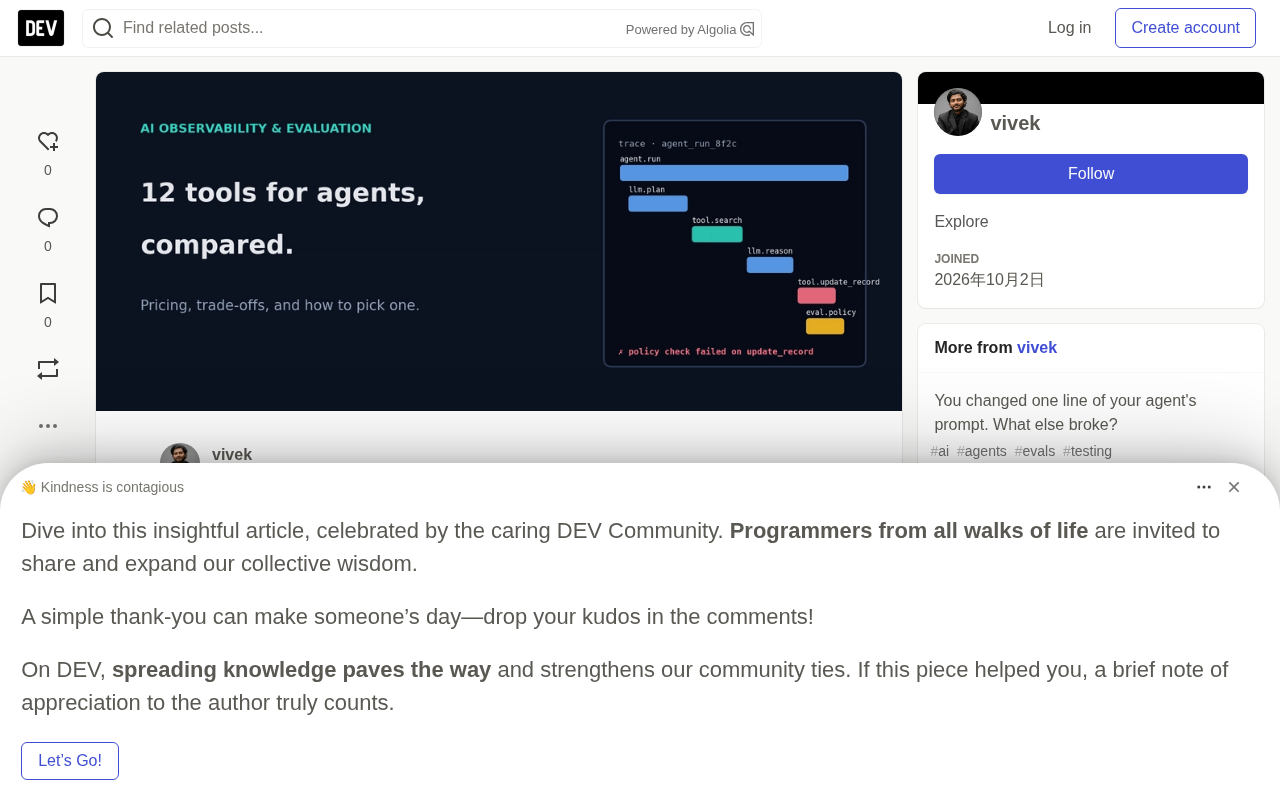
A side-by-side comparison of 12 AI observability and evaluation tools, with selection advice by evaluation, observability, and red teaming.
The article points out that fast, error-free agent responses don't mean the answer is correct—the exact blind spot AI observability and evaluation tools aim to fill. The author categorizes these tools into evaluation, observability, and red teaming, notes most products excel at only one or two, and lays out seven selection dimensions including evaluation depth, agent-level tracing, failure discovery, quality alerting, the production-to-test loop, and team fit. It then compares 12 tools—BotGauge, Braintrust, LangSmith, Langfuse, Arize Phoenix, Galileo, Datadog LLM Observability, Fiddler, and more—by use case, open-source status, and starting price. The core conclusion: evaluation sets only cover scenarios someone thought of, and production traces only reflect failures that have already reached users; agents that merely answer questions can get by with evaluation plus tracing, while agents that take real actions need tools that actively hunt for failures before launch.
An Overlooked Blind Spot: Fast Responses, Zero Errors, but the Answer Is Wrong
Your agent returned a fast, clean, error-free response. The APM dashboard is all green.
But the answer is wrong.
This is exactly the gap that AI observability and evaluation tools are meant to fill. There are already quite a few tools of this kind on the market, but they don't all do the same thing. The practical comparison below covers 12 tools, including pricing and trade-offs, to help you pick the right one for the stage your agent is currently at.
It should be noted that the author of this article works at BotGauge, which is on the list, and has tried to keep the trade-off judgments honest throughout. Pricing information is as of October 2026, and you should confirm with each vendor before purchasing.
Three Different Categories of Tasks
Evaluation, observability, and red teaming solve three completely different problems:
- Evaluation: Scoring outputs against criteria you define.
- Observability: Recording traces, cost, latency, and quality on real traffic.
- Red teaming: Actively attacking the agent to find failure points no one has written tests for yet.
Most tools are strong in only one or two of these directions, and very few cover all three. Figuring out which category of task you need gets you halfway to the decision.
LLM-as-a-Judge is one of the mainstream techniques in evaluation today: using a more capable model (usually GPT-4 level) to score another model's output against a given rubric. Compared with traditional metrics like exact match or BLEU, it can handle semantic judgments for open-ended generation tasks, scales well, and costs less than human annotation. But it also has known biases, such as preferring longer answers, favoring outputs from models of its own lineage, and being sensitive to position. In practice, it's usually combined with a small set of human-calibrated samples, pairwise comparison designs, and multi-judge voting to reduce bias. Understanding this helps you judge whether a tool's advertised "built-in scorers" are preset rule-based metrics or customizable-prompt LLM judges—the two differ greatly in transferability and interpretability.
Red Teaming originated in the security field, originally referring to an organization playing the attacker role internally to actively find system weaknesses. In the LLM context, it takes concrete form as adversarial inputs such as prompt injection, jailbreaking, data leakage inducement, and tool abuse. The biggest difference from conventional testing is this: conventional testing verifies "whether known requirements are met," while red teaming tries to discover "failure modes no one thought of." Adaptive red teaming uses models to automatically generate and evolve attack cases, continuously applying pressure to weaknesses the agent has already exposed. For agents that call external tools, perform write operations, or handle funds, red teaming is often the only means of surfacing risk before an incident occurs.
Seven Dimensions to Consider When Choosing
- Evaluation depth: Scoring for faithfulness, relevance, safety, and goal completion, using metrics, LLM judges, or custom code checks. A trace without scoring can only tell you what happened, not whether the result was good.
- Agent-level tracing: Every prompt, tool call, retrieval, and branch, not just the final answer. Multi-step agents often go wrong in the intermediate steps.
- Failure discovery capability: Test sets can only cover scenarios someone thought of. This matters especially for agents that move money or modify records.
- Quality alerting: Triggering alerts when faithfulness or safety scores drop, not just watching latency and errors.
- Production-to-test loop: Failures found in production should be turned into regression tests that run in CI.
- Team fit: SSO, access control, predictable pricing, and whether product managers and QA can use it directly without relying on engineers.
Side-by-Side Comparison of 12 Tools
| Tool | Best For | Open Source | Starting Price |
|---|---|---|---|
| BotGauge | From red teaming to monitoring, suited to agents that take actions | Not specified | Undisclosed |
| Braintrust | All-in-one evaluation, tracing, and CI gates | No | Free; Pro $249/month |
| Confident AI | Quality checks product managers and QA can run | Metrics library (DeepEval) | Free; Starter $200/month |
| LangSmith | LangChain and LangGraph teams | No | Free; Plus $39/seat/month |
| Langfuse | Self-hosted tracing and prompt management | Yes (core) | Free; from $29/month |
| Arize Phoenix | Notebook-first tracing | Yes | Free; cloud from $50/month |
| Galileo | Low-cost evaluators and runtime guardrails | No | Free; Pro from $100/month |
| LangWatch | Multi-agent and voice simulation | Yes | Free; from €29/seat/month |
| Pydantic Logfire | Unified view of LLM and application traces | Partial | Free; Team from $49/month |
| Latitude | Turning failures into fix PRs | Yes | Free; Pro $99/month |
| Datadog LLM Obs. | Teams already using Datadog | No | Usage-based pricing |
| Fiddler | Regulated enterprises | No | Custom quote |
Quick Reviews of Each Tool
BotGauge runs adaptive red teaming campaigns against agents, then turns findings into evaluations that run on every release, with continued tracing and monitoring after launch. Things to note: the red teaming product is currently waitlist-only, pricing is undisclosed, and there's no LLM gateway or token cost analysis.
Braintrust turns production traces into test cases with one click, has 25+ built-in scorers, and offers a GitHub Action that can block PRs on quality regressions. Things to note: self-hosting is enterprise-only, and $249/month is pricey for small teams.
Confident AI scores every trace with 50+ metrics, alerts via Slack or PagerDuty, lets non-engineers run evaluations, and has a red teaming module. Things to note: GB-based billing takes a while to predict cost-wise.
LangSmith shows the full execution tree of agent runs and offers annotation queues for human review. Things to note: depth drops outside the LangChain ecosystem, and per-seat pricing adds up.
Langfuse is open-source tracing, prompt version management, and cost tracking, self-hostable. Things to note: evaluators are basically bring-your-own.
Arize Phoenix runs locally in a notebook or Docker, and surfaces clusters of degraded traces. Things to note: the interface is less polished than commercial tools.
Galileo uses small, fast evaluation models at a fraction of LLM judge cost, and can turn evaluations into runtime guardrails. Things to note: the platform is young and the community is smaller.
LangWatch is open-source, visualizes multi-agent runs, and can turn production failures into CI simulations. Things to note: it isn't designed for infrastructure-level monitoring.
Pydantic Logfire puts HTTP requests, agent loops, model calls, and database queries in the same OpenTelemetry trace, queryable with SQL. Things to note: evaluation relies more on custom rubrics than preset metrics.
Latitude clusters recurring failures into tracked issues and can hand them to a coding agent to open fix PRs. Things to note: no LLM gateway, and it leans engineer rather than product manager.
Datadog LLM Observability puts LLM spans right next to your existing APM traces and logs. Things to note: evaluation is a secondary feature, and usage pricing is hard to predict.
Fiddler covers classic machine learning and LLMs, with fast guardrails, drift detection, and audit trails. Things to note: custom quotes and an enterprise-level learning curve.
OpenTelemetry (OTel) is the unified telemetry data standard in the cloud-native world, defining collection and transmission protocols for three signal types: traces, metrics, and logs. In the LLM context, it's used to break down an agent run into a traceable span tree: HTTP requests, retrieval, model calls, and tool executions each become a span, with attributes like token count, latency, and cost. Tools that adopt OTel (such as Pydantic Logfire and Datadog LLM Observability) can plug directly into an existing APM system, avoiding the need to build a separate monitoring stack for LLMs; conversely, tools with proprietary protocols have higher migration costs. When choosing, if your team already has a mature observability stack, prioritizing OTel-supporting options is usually more cost-effective.
The Pattern Behind the Choices
Evaluation sets can only measure what someone thought to test, and production traces can only teach you about failures that have already reached users.
If your agent just answers questions from a knowledge base, an evaluation plus tracing platform is usually enough. If it takes real actions, you need tools that can actively hunt for failures before launch.
What do you use to monitor agents in production? What do you wish it did better? Share in the comments.
CI Gate refers to setting a quality threshold in a continuous integration pipeline that automatically blocks merge requests when evaluation scores fall below a baseline. It turns evaluation from an "after-the-fact report" into a "mandatory gate before release," and is a key part of the production-to-test loop. Implementation usually requires three elements: a versioned evaluation dataset, reproducible scorers, and integration with GitHub Actions or GitLab CI. Note that a gate that's too loose is as good as none, while one that's too strict causes frequent false alarms that lead teams to work around the process—threshold settings often take several iterations to stabilize. Tools like Braintrust, LangWatch, and Latitude provide varying degrees of support at this stage.
Related articles

Gemini 4 Argon Hands-On: AI Builds Board Games, Constructs Temples, and Trains Robots Autonomously
Gemini 4 Argon hands-on roundup: AI autonomously builds a desk racetrack and temple in Blender, writes a ray tracing engine, trains a humanoid robot to sink 7 shots, plus API pricing and developer access.

The Magic Octagonal Coin: Why Only 9% of People Can Predict Its Flip?
Only 9% of people can correctly predict the Magic Octagon coin flip. This article explains its spatial rotation mechanism, common cognitive pitfalls, and a new hypothesis based on Relevance Theory, exploring the limits of human spatial reasoning.

Sam Altman: AI Is Entering the Era of Scientific Discovery — Math Breakthroughs Will Replicate in Biology and Energy
Sam Altman says AI is entering the era of scientific discovery — math breakthroughs will replicate in biology, materials science, and energy to help develop new drugs and energy sources.