AI Agent Open-Source Course: 36 Chapters from ReAct to Claude Code Full-Stack Practical Guide

A 36-chapter runnable open-source AI Agent course from ReAct to Claude Code reverse engineering
The GitHub open-source project agent-study provides a systematic 36-chapter full-stack AI Agent course with all chapters presented as runnable Python files, oriented toward interview preparation. The course covers core modules including ReAct loops, Claude Code reverse engineering, MCP and A2A protocols, RAG and DSPy, spanning from foundational Agent design patterns to cutting-edge protocol standards and prompt optimization frameworks, combining both systematic coverage and practical applicability.
Project Overview: A 36-Chapter Runnable Full-Stack AI Agent Course
There's no shortage of learning resources for AI Agent development, but truly systematic, runnable, and practice-oriented courses are rare. The open-source GitHub project agent-study offers a complete 36-chapter full-stack AI Agent course, covering everything from basic ReAct loops to cutting-edge Claude Code reverse engineering. All chapters are presented as runnable Python files and are explicitly interview-oriented.
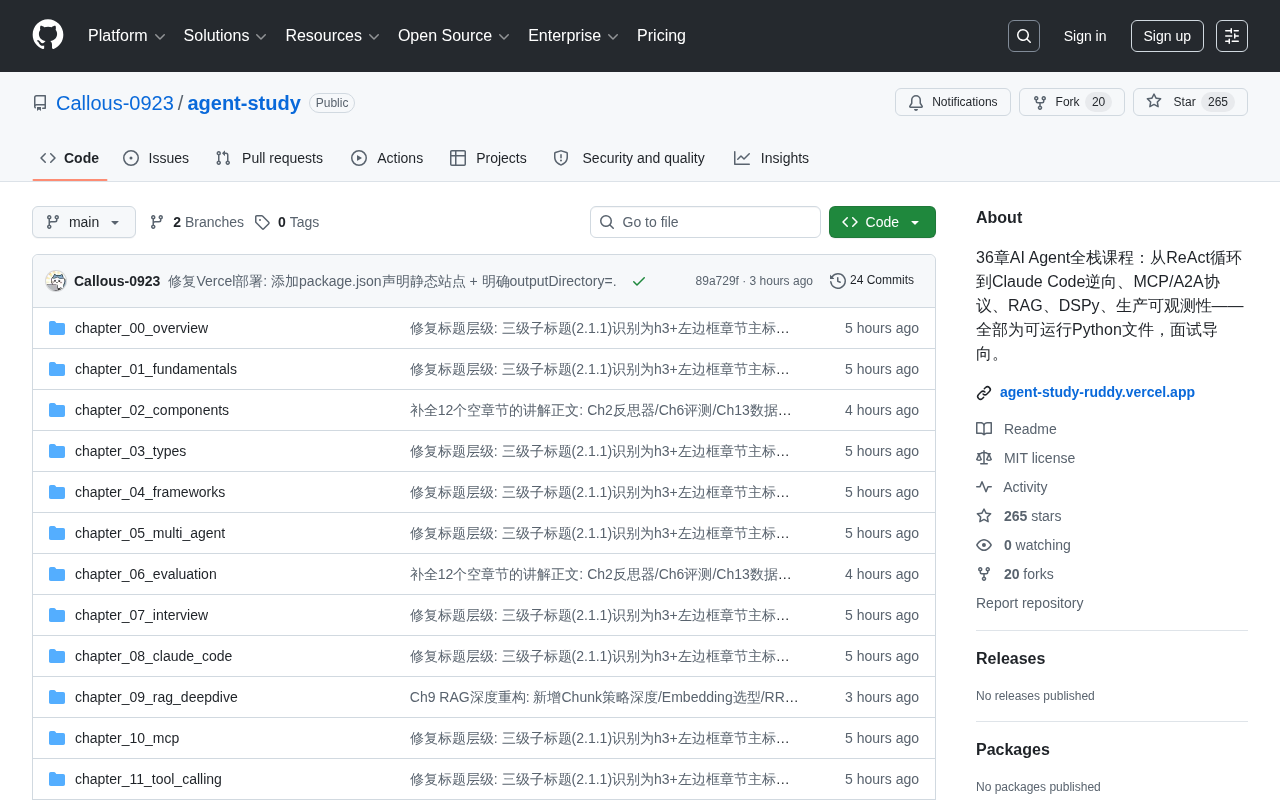
Created by developer Callous-0923, the project has earned 265 Stars so far. While not massive in scale, its systematic design and practicality make it stand out among AI Agent learning resources.
Deep Dive into Core Course Modules
ReAct Loop: Understanding the Core Thinking Pattern of AI Agents
The course begins with the most fundamental design pattern for AI Agents — the ReAct (Reasoning + Acting) loop. ReAct is the theoretical foundation of mainstream Agent frameworks today, enabling large language models to alternate between "thinking" and "acting," iteratively completing complex tasks through observing environmental feedback.
The ReAct pattern was formally introduced by Yao et al. in their 2022 paper "ReAct: Synergizing Reasoning and Acting in Language Models." The core insight is that pure Chain-of-Thought reasoning lacks the ability to interact with external environments, while pure action sequences lack internal reasoning support. ReAct combines both into a closed-loop iteration of "Think → Act → Observe." At the implementation level, in each loop cycle, the LLM generates a natural language reasoning segment (Thought), then outputs a structured tool-calling instruction (Action), and after execution, the result is injected as new context (Observation) into the next reasoning round. This mechanism enables Agents to handle complex tasks requiring multi-step, multi-tool collaboration — for example, combining web search + calculation + code execution. The Agent modules in mainstream frameworks like LangChain and LlamaIndex all use ReAct as their default execution paradigm.
Understanding the ReAct loop means understanding the essential difference between an Agent and a regular LLM call: an Agent doesn't generate an answer in one shot. Instead, it continuously reasons, executes tool calls, observes results, and reasons again within a loop until the task is complete. The runnable code in the course lets you build a minimal Agent loop hands-on, thoroughly grasping this core concept at the code level.
Claude Code Reverse Engineering: Deconstructing the Design of a Top-Tier Agent
One of the most distinctive parts of the course is the reverse analysis of Claude Code. Claude Code is a programming Agent released by Anthropic, widely regarded as one of the most powerful AI coding assistants available. By studying its internal design through reverse engineering, learners can gain deep understanding of:
- How top-tier Agent products design system prompts
- Tool-calling orchestration strategies and error recovery mechanisms
- Context management and conversation state maintenance in engineering practice
This "reverse-engineering the product to infer the design" learning approach develops genuine engineering intuition far more effectively than simply reading documentation.
MCP and A2A Protocols: Standardized Solutions for Agent Interoperability
MCP (Model Context Protocol) and A2A (Agent-to-Agent) are the two most important protocol standards in the 2024–2025 Agent ecosystem.
MCP was officially open-sourced by Anthropic in November 2024, with its design drawing from the success of LSP (Language Server Protocol) — LSP fundamentally transformed the IDE ecosystem by standardizing communication between editors and language servers. MCP similarly adopts a client-server architecture: MCP Servers encapsulate specific tools or data sources (such as file systems, databases, APIs), while MCP Clients (typically LLM applications) communicate with them via standardized JSON-RPC protocol. This means developers only need to implement an MCP Server once for it to be reused by all MCP-supporting AI applications, breaking the previous fragmentation where different frameworks' toolsets were incompatible. As of 2025, hundreds of official and community MCP Servers cover mainstream development toolchains, including GitHub, Postgres, Slack, and more, forming a tool marketplace similar to the npm ecosystem.
The A2A protocol was released by Google in April 2025, aimed at solving scenarios not covered by MCP: when tasks require multiple specialized Agents to collaborate, how do Agents discover each other, negotiate capabilities, and securely pass tasks? A2A introduces the "Agent Card" concept — each Agent publishes a structured capability declaration document describing the task types it can handle, input/output formats, and authentication requirements, similar to API contracts in microservice architectures. At the execution level, A2A supports long-running asynchronous tasks and streaming responses, suitable for orchestrating complex multi-Agent workflows. MCP and A2A are complementary: MCP solves the connection problem between Agents and tools/data, while A2A solves the collaboration problem between Agents. Together, they form the complete standard stack for Agent interoperability.
Including these two protocols in the curriculum reflects the author's accurate judgment of industry trends. Mastering MCP and A2A protocols is crucial for building scalable, interoperable Agent systems.
RAG and DSPy: Retrieval-Augmented Generation and Programmatic Prompt Optimization
RAG (Retrieval-Augmented Generation) has become a standard technology for enterprise AI applications. The course covers not only basic RAG pipeline construction but also introduces DSPy, a cutting-edge framework.
DSPy (Declarative Self-improving Python) was proposed by Stanford University's Omar Khattab and colleagues in 2023. Its core idea is to separate the "structure" from the "parameters" of LLM programs. Developers define program logic using declarative syntax (e.g., "given a question, first retrieve relevant documents, then generate an answer"), while the specific prompt templates and few-shot examples are automatically searched and compiled by DSPy's optimizer (Teleprompter). The revolutionary aspect of this paradigm is that it transforms prompt engineering from a craft dependent on human intuition into a measurable, optimizable engineering problem. DSPy includes multiple built-in optimization algorithms, including BootstrapFewShot and MIPRO, which can automatically find optimal prompt configurations under given evaluation metrics. For Agent systems, DSPy is particularly suitable for optimizing multi-step reasoning chains because it can optimize the entire pipeline end-to-end rather than adjusting individual prompts in isolation.
Including DSPy in an AI Agent course is a forward-thinking choice — it represents the evolution from "prompt engineering" to "prompt programming."
Related articles
 Tutorials
ChatGPT Plus Subscription Guide: Are GPT-5.5, image-2, and Codex Worth the Upgrade?
A detailed look at ChatGPT Plus features — GPT-5.5, image-2, and Codex — with a Plus vs Pro comparison and a complete step-by-step subscription guide for users outside the US.
 Tutorials
Harness AI Engineering in Practice: Using Claude Code to Master Enterprise-Level E-Commerce Development
Deep dive into Harness AI Engineering: master enterprise e-commerce development with Claude Code using the Rules, Skills, Wiki, and Changes framework.
 Tutorials
Cursor + Codex Dual-IDE Collaboration: A Practical Methodology for Open-Source Project Customization
A complete methodology for open-source project customization based on real-world experience, detailing the Cursor+Codex dual-IDE workflow, seven-stage process, MVP validation, and AI source code reading techniques.