AI Agent Production Guide: Four Orchestration Patterns That Actually Work

Four orchestration patterns for deploying AI agents that hold up in real production environments.
Most AI agents fail to survive beyond the demo stage because real production environments are far messier than controlled demos. This article identifies four recurring orchestration patterns that underpin successful agent deployments: cross-system workflow orchestration, policy-constrained action execution, anomaly-driven data validation, and high-load classification and routing—along with the engineering principles that make each pattern work.
Why Most AI Agents Don't Survive the Demo Stage
The buzz around AI agents keeps growing. We've seen countless impressive demos — agents that can plan, reason, execute tasks, and even coordinate across tools. But there's a harsh reality that rarely gets discussed: the real challenge was never about building an agent. It's about keeping one reliably operational in the real world.
This is the widely recognized "Demo-to-Production Gap." Demo environments are controlled, path-constrained, and purpose-built with clean data. Production environments, on the other hand, are riddled with edge cases, noisy data, network timeouts, API rate limits, and permission errors. For AI agents, this problem is especially acute: non-deterministic LLM outputs, context window limitations causing memory loss in long workflows, and the absence of error recovery strategies after tool call failures are all common sources of production failures. Once an agent moves from a demo into a production system, things that worked perfectly suddenly break — often not because the technology is flawed, but because real business problems are deeply complex, full of constraints and interdependencies, and woven together with approval workflows.
Rather than debating what an AI agent "really is," a more pragmatic lens is far more useful: how does an agent actually function once it's embedded in a real system?
The answer may disappoint those chasing "fully autonomous AI": successful agents are rarely independent decision-makers. They function more like an Orchestration Layer — maintaining context, coordinating actions across systems, enforcing established rules, and handing control back to humans at critical moments.
"Orchestration" isn't a new concept. In microservices and distributed systems, orchestration refers to a central coordinator managing the call sequence and state across multiple services — as opposed to the decentralized "Choreography" pattern. Positioning AI agents as an orchestration layer means they carry responsibility for process coordination, not autonomous decision-making. This aligns closely with the core design philosophy of mainstream frameworks like LangChain, AutoGen, and LangGraph.
The Common Challenges of Real-World Agent Systems
Most real-world agent problems share the same core challenges:
- They span multiple systems: Tasks confined to a single system rarely require an agent. The real complexity comes from cross-system coordination.
- They involve policies, approvals, and rules: Real-world business operations are tightly constrained by compliance requirements, permission management, and process standards.
- Humans remain in the decision loop: Agents aren't replacing humans — they're working efficiently within boundaries that humans define.

This is precisely why agents that actually make it to production are designed around integration rather than isolation. They're not AI features built for show — they're well-behaved, predictably designed components within a larger architecture.
Four Production-Grade Agent Orchestration Patterns
After examining a wide range of real deployment scenarios, four recurring agent work patterns emerge across different domains. Together, they form the core skeleton of production-grade AI agent design.
Pattern 1: Cross-System Orchestration of Multi-Step Workflows
The most common pattern: a single event triggers a multi-step, interdependent workflow. New employee onboarding is a classic example — provisioning system access, configuring required resources, scheduling orientation activities, assigning mandatory training, and tracking completion progress. Every step depends on the last.
In this scenario, the agent doesn't replace HR or IT staff. Instead, it uses contextual signals (job title, location, start date) to orchestrate operations across systems, monitor workflow state, and flag any deviations from expected behavior.
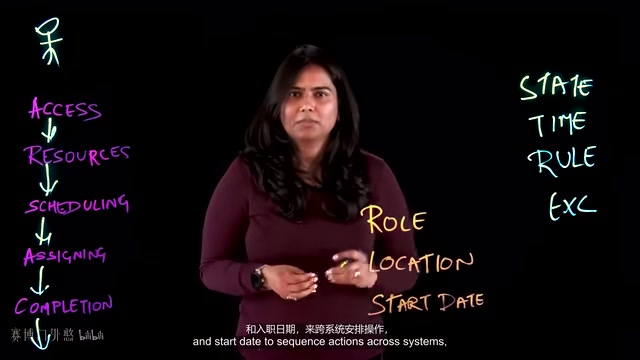
The difficulty here isn't "reasoning capability" — it's reliably coordinating multiple systems while respecting policy and timing constraints. The core technical challenge is State Management: when a workflow spans multiple systems over hours or even days, how do you guarantee persistence of intermediate state? How do you handle a compensating transaction when a step fails? This is the engineering crux. The industry typically leverages frameworks like Temporal or LangGraph, which introduce directed acyclic graphs (DAGs) and state machines to manage agent execution traces, and use idempotency design to ensure retried operations don't produce side effects. This is precisely where traditional process automation falls short — and where AI agents can deliver real value.
Pattern 2: Policy-Constrained Action Execution
The second pattern uses risk rules and access permissions to determine what the system is allowed to do. This appears in any system that handles requests with varying sensitivity levels — the classic example being an IT helpdesk (password resets, hardware/software requests, etc.).
The agent handles all requests flowing through the ticketing system:
- Well-defined, low-risk requests go through automated execution;
- Requests requiring verification, approval, or escalation are evaluated against applicable policies — the permitted portions execute automatically, while ambiguous or high-risk cases get routed to human review.

Technically, this corresponds to an Attribute-Based Access Control (ABAC) model. Unlike simple role-based permissions (RBAC), ABAC allows the system to dynamically determine whether an action is permitted based on requester attributes, resource attributes, and environmental context (time, location, risk level). "Guardrails" mechanisms in the agent layer — such as Nvidia Guardrails and LlamaGuard — perform compliance checks before any action executes. Every high-privilege operation must also leave an auditable Audit Trail to satisfy the observability requirements of enterprise compliance frameworks like SOX and GDPR.
This reflects a key design principle: explicit, controlled boundaries. System behavior is predictable, humans only intervene when rules explicitly require it, and in all other cases the agent operates autonomously within a well-defined process.
Pattern 3: Anomaly Handling and Data Validation
The third pattern is common in invoice processing, order management, and similar workflows. The happy path is straightforward: extract structured data, match against existing records, validate against rules, route for approval, update downstream systems.
But the real complexity lies in handling missing data, mismatched data, or non-standard cases. Data quality issues generally fall into a few categories: completeness gaps (required fields are empty), consistency conflicts (the same entity recorded differently across systems), accuracy deviations (OCR recognition errors, amount format discrepancies), and timeliness problems (outdated vendor information). Traditional rule engines handle this with hardcoded IF-THEN logic — but rule maintenance costs quickly spiral out of control. AI agents shine here by using semantic understanding for fuzzy matching (e.g., recognizing "Microsoft Corp" and "Microsoft Corporation" as the same vendor), and by using few-shot learning to quickly adapt to new types of anomalies. The agent's value is in processing predictable, routine cases consistently, while only escalating genuine anomalies to human review. This frees humans from repetitive work so they can focus their judgment on edge cases that truly need it.
Pattern 4: Classification and Routing Under High Load
The fourth pattern appears in any system that needs to "prioritize under high load" — a customer service center is the most typical example. The agent analyzes and classifies incoming requests, dispatches work to the appropriate teams, and suggests reply content based on historical data.

This scenario involves two core NLP tasks: Intent Classification and Entity Extraction. LLM-based agents implement flexible classification through zero-shot or few-shot prompting, and can simultaneously extract multi-dimensional context including customer sentiment, urgency level, and interaction history. At the system architecture level, high-concurrency scenarios also require a backpressure mechanism — when downstream processing capacity is saturated, message queues like Kafka or RabbitMQ act as a buffer layer to prevent system cascades, while the agent's routing decisions determine which consumer queue a message gets dispatched to.
Note: solving the actual problem still requires a human — but the agent ensures that priority judgment, context handoff, and routing decisions are executed at scale, consistently. That consistency is precisely what's hardest to guarantee with purely manual handling.
Common Characteristics of Production-Grade AI Agents
Looking across these four patterns, regardless of domain, successfully deployed AI agents share a remarkably consistent set of characteristics:
- Focused scope — not trying to do everything; solving a well-defined problem;
- Cross-system orchestration — connecting multiple systems and tools to work in concert;
- Policy-driven — acting within policy constraints, not freelancing;
- Maintaining human involvement — returning control at critical decision points;
- Designed for integration — existing as an architectural component, not an isolated experiment.
Point 4 corresponds in engineering terms to the mature Human-in-the-Loop (HITL) design pattern — which originated in control systems theory, was later adopted into machine learning, and has now evolved into a critical safety mechanism in AI agent architecture. Implementation typically relies on a "Confidence Threshold": when an agent's confidence in a decision falls below a preset value, it automatically routes to a human review queue. The related concept of "Human-on-the-Loop" lets humans asynchronously review agent behavior as supervisors rather than direct participants — suitable for scenarios with tighter latency requirements.
Closing Thoughts: Strength Comes from Fit, Not Autonomy
The real-world deployment of AI agents offers a counterintuitive but deeply valuable insight:
The true power of an AI agent lies not in its autonomy, but in how well it fits with real workflows, constraints, and control frameworks.
When we stop obsessing over building "fully autonomous decision-makers" and instead design agents around collaboration and orchestration, they stop being lab experiments and start running as reliable components in production systems. That's what it actually takes to make AI agents work in the real world.
Key Takeaways
Related articles

Disaster and Glory of the Apollo Program: The History We Must Revisit Before Returning to the Moon
From the fatal Apollo 1 fire to Apollo 8's daring lunar orbit to Apollo 11's successful landing—revisiting the disasters, fears, and compromises of the Apollo program and their lessons for today's return to the Moon.

Netflix Trust Exercise Turns Into Firing Trap: Where Are the Boundaries of Corporate Trust?
A Netflix employee was fired after sharing private info in a trust exercise. We analyze the risks of corporate trust exercises and how employees can protect themselves.

AMD CDNA5 Architecture Deep Dive: Technical Evolution and the AI Computing Competition Landscape
Deep analysis of AMD's CDNA5 architecture covering Chiplet packaging upgrades, HBM memory evolution, and low-precision compute optimization, examining how AMD challenges NVIDIA's AI chip dominance.