AI Agent Security Guardrails in Practice: Permission Control, Input/Output Validation, and Risk Isolation

A practical guide to AI Agent security guardrails covering middleware hooks, deterministic and model-driven protection strategies.
As AI Agents integrate into real business systems, security guardrails become essential. This article breaks down guardrails into three layers — input violation blocking, sensitive data desensitization during execution, and output content detection — all powered by a middleware hook mechanism. Two complementary protection strategies are covered: deterministic guardrails using regex for structured data like phone numbers and ID cards, and model-driven guardrails that leverage LLM semantic understanding to catch subtle compliance risks and prompt injection attacks.
AI Agent Security Guardrails in Practice: Permission Control, Input/Output Validation, and Risk Isolation
As AI Agents become integrated into real business systems, they're no longer just chatbots — they're executors capable of querying databases, invoking tools, and accessing sensitive information. This means security has shifted from a "nice-to-have" to a critical line of defense. Drawing from hands-on tutorials by Mashi Group, this article breaks down the core mechanisms, implementation principles, and two categories of protection strategies behind AI Agent security guardrails.
What Are Security Guardrails?
Guardrails, as the name suggests, refer to a set of safety mechanisms woven throughout the entire conversation pipeline of an AI Agent. The core problems they address can be broken down into three stages.
The first is blocking violations on the input side. User messages may contain prohibited words or offensive content — for instance, the tutorial uses "Xiaoming" as a hypothetical banned keyword. Once a user's input matches a rule, the system can intercept the message before it ever reaches the Agent.
The second is desensitizing sensitive information during execution. Agents often query business data through MCP tools, and the results may include users' phone numbers, ID card numbers, bank card numbers, and other sensitive details. These must be masked or filtered before being presented to the user.
The third is detecting model output on the response side. Even when the model itself isn't faulty, it can still generate logically flawed, misleading, or harmful answers. Guardrails can run safety checks on model outputs and handle them accordingly.
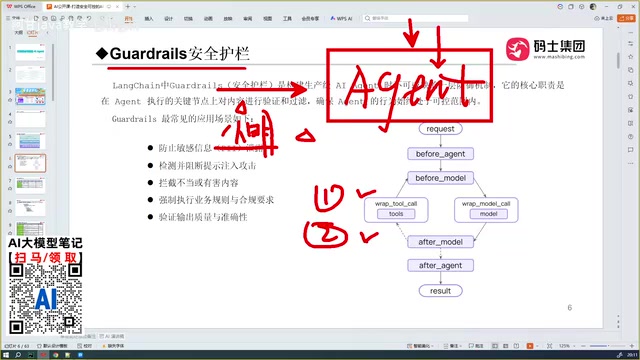
Primary Use Cases
In summary, security guardrails cover these typical scenarios:
- Preventing sensitive information leakage: Intercepting privacy data such as ID numbers, phone numbers, and bank card details from being exposed;
- Defending against prompt injection attacks: Also known as "poisoning" — malicious users attempt to corrupt the model's context through conversation. Guardrails can intercept harmful content before it reaches the model;
- Business compliance checking: Validating input and output content for regulatory compliance at the business level.

Prompt injection is one of the most significant new attack surfaces in AI Agent scenarios. Attackers embed special instructions in user inputs or external data sources to override or manipulate the system's predefined behavior — for example, making the model ignore safety restrictions, leak system prompts, or exploit the Agent's tool-calling capabilities to execute malicious operations. Similar to traditional SQL injection, the victim is the "executor" that trusts the input — in an AI Agent, that's the large language model itself. Since Agents often have the ability to read/write databases, send requests, and call external APIs, a successful injection can cause far more damage than simple information leakage. Guardrails that perform pattern scanning and semantic filtering at the "before Model" node are a critical line of defense against these attacks.
Implementation: Middleware-Based Hook Mechanism
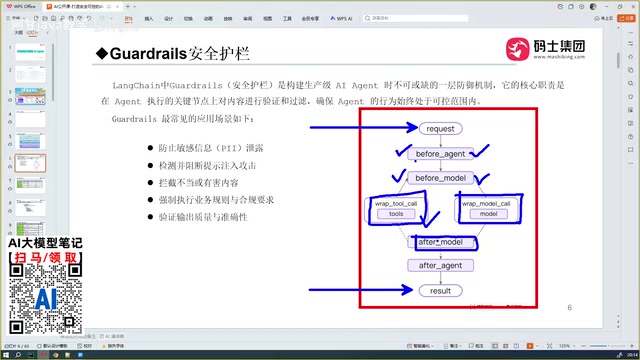
The underlying implementation of security guardrails relies on middleware. Think of middleware as a piece of executable logic that can be inserted at any point in the Agent's conversation flow — essentially hook functions. Whether before or after an Agent call, or before or after a model call, different processing logic can be injected at each stage.
From when a user sends a request to when the final response is returned, the entire Agent conversation flow passes through multiple middleware nodes:
Key Middleware Nodes
- before Agent: Triggered before the Agent executes; used for pre-processing business logic;
- before Model: Triggered before the model is called; used to process and filter input information;
- wrap Model Call: Closer to the actual model invocation than
before Model; wraps the model call itself; - before Tool Call: Triggered before a tool is invoked;
- after Model: Triggered after the model call completes; used for additional processing of the model's response;
- after Agent: The final checkpoint triggered before the result is delivered to the user.
This hook mechanism gives developers fine-grained control over every stage of the conversation flow. Security guardrails work by inserting detection and processing logic at these nodes to perform input validation, execution isolation, and output desensitization.
The middleware pattern has been widely validated in web frameworks — Express, Django, Spring, and others all use it as a core extension mechanism. Its essence is decomposing the request/response processing flow into an ordered chain of responsibility, where each middleware node can read, modify, or terminate the data in the pipeline. This pattern translates equally well to AI Agent scenarios: a conversation request travels from the user through multiple pluggable processing nodes before returning a final response, and each node can be developed and tested independently. The key advantage of this design is separation of concerns — cross-cutting concerns like security validation, logging, and rate limiting don't need to be embedded in core business logic; instead, they're mounted as plugins at the appropriate hook points. For team collaboration, the security team can independently maintain guardrail rules without affecting the Agent's feature development.
Two Types of Guardrails: Deterministic vs. Model-Driven
Security guardrails can be divided into two major categories based on their implementation approach. The two are complementary, covering different types of risks.
Deterministic Guardrails
Deterministic guardrails target structured, pattern-predictable sensitive information — such as ID card numbers, phone numbers, and bank card numbers. This type of information follows clear, rule-based patterns and can be precisely identified through deterministic methods like regex matching, then masked, truncated, or further processed.
This approach is accurate, controllable, and performant. However, its limitation is equally clear — it can only handle content that "looks like" sensitive information in a fixed format.

Regular expressions are the core tool for deterministic guardrails. For common sensitive data: mainland Chinese phone numbers follow the 1[3-9]\d{9} format; ID card numbers follow an 18-digit rule with a check digit at the end; bank card numbers typically satisfy the Luhn algorithm checksum. Because of these well-defined structures, regex matching outperforms calling a large model in both accuracy and performance. In real-world engineering, deterministic guardrails are typically deployed as a list of rules that can be added or removed as needed, balancing flexibility and maintainability. It's worth noting that desensitization doesn't mean full deletion — a common approach is replacing phone numbers with 138****5678 and masking the middle section of ID numbers with *, preserving readability while avoiding privacy exposure.
Model-Driven Guardrails
Deterministic guardrails can't handle more subtle risks. For example, a model's response might read smoothly and contain no obvious prohibited words, yet subtly guide the user toward an incorrect action. This kind of risk, expressed in natural language, simply can't be detected by fixed rules.
This is where model-driven guardrails come in: they leverage the model's own comprehension capabilities to determine whether a response is compliant, and whether any potential issues are present. This trades some degree of determinism and performance for the ability to identify complex semantic risks.
The two types of guardrails are not mutually exclusive — they work in tandem. Deterministic guardrails hold the line against structured sensitive data, while model-driven guardrails fill the gap for semantic-level risk detection.
Summary
Building a secure and controllable AI Agent comes down to embedding security capabilities throughout the entire conversation flow. Through the middleware hook mechanism, validation logic can be inserted at every stage — before and after Agent calls, model calls, and tool calls. Combined with both deterministic and model-driven protection strategies, these guardrails address both structured sensitive data and semantic-level risks. For any Agent application connecting to real business systems, this Guardrails framework is an essential security foundation that cannot be skipped.
Related articles

AI New Grad Resume Diagnosis: How to Stand Out for ML/CV Roles?
How can AI/ML new grads optimize their resumes to get interviews? Based on a real Reddit case, this article analyzes project selection, depth display, and structure for ML/CV roles, with actionable revision advice.

OpenAI Opens Up Decision Models as Competition with Jev Heats Up
OpenAI makes its decision model widely available, directly challenging first mover Jev. We analyze the impact on the decision model competitive landscape and key considerations for developers and enterprises.

Startup Growth Secrets: Early Sales Are Not the Key
At Disrupt, experts from Lovable, Polska, and Theory Ventures said early startup growth depends not on early sales but on a repeatable sales process, a clear ICP, team development, and data-driven iteration.