AI Agent Skill Architecture Breakdown: Decision Layer + Encapsulation Layer + Execution Layer Practical Guide

AI Agent skill systems evolve from simple tool calls to standardized business capability modules
This article explains how AI Agent Skills represent a fundamental upgrade over traditional Function Calling: they are no longer simple tool calls but standardized encapsulation modules containing metadata, business SOPs, and resource scripts. The modern Agent Skill architecture consists of three layers—Brain Decision Layer (RAG vector retrieval and hierarchical routing), Skill Encapsulation Layer (three core components), and Execution Engine Layer (state machine driven with self-healing capabilities)—with practical solutions for the three major deployment challenges of context explosion, error recovery, and generality balance.
The Paradigm Shift in AI Agent Development: From Tool Calling to Skill Systems
If you still think AI Agent skills are just simple Function Calling or making a few API calls, your understanding of current industrial standards probably needs an update. As large model applications move from the lab to enterprise-level deployment, Agent skill systems are undergoing a profound architectural upgrade—evolving from "handing over a wrench" style tool calls to independent business modules that come with "operation manuals and field experience packages."
It's necessary to first clarify a fundamental concept: Function Calling is a capability that OpenAI introduced in June 2023 alongside the GPT-3.5/GPT-4 API, allowing large models to generate structured function call parameters based on user input, which external programs then execute and return results to the model. Its essence is a single-interaction protocol between "model → tool." Agent Skill, on the other hand, is an engineering-level upgrade built on top of Function Calling. It not only includes the tool calling interface but also encapsulates business process knowledge, execution strategies, and fault-tolerance logic, forming a self-contained business capability unit. An analogy: Function Calling is a screwdriver, while Agent Skill is a complete toolkit that includes usage instructions, applicable scenario guides, and troubleshooting manuals.
This article will break down the core architecture of AI Agent Skills layer by layer, covering the standard encapsulation structure and key challenges in deployment, helping you build a complete understanding of modern Agent skill systems.

Complete Breakdown of the Agent Skill Three-Layer Architecture
To understand the design philosophy of Agent Skills, you can't just look at surface definitions—you need to break down the complete architecture from top to bottom. Modern Agent Skill systems can be divided into three core layers: the Brain Decision Layer, the Skill Encapsulation Layer, and the Execution Engine Layer.
Brain Decision Layer: Dynamic Routing and Precise Skill Retrieval
Imagine your Agent has thousands of skills mounted—how does the large model know which one to use? Stuff all skill descriptions into the prompt? The context window would definitely overflow.
Here we need to understand the engineering constraints of the context window. The context window refers to the maximum number of tokens a large language model can process in a single inference. GPT-4 Turbo supports 128K tokens, Claude 3 supports 200K tokens, and Gemini 1.5 Pro even reaches 1M tokens. But a large context window doesn't mean you can fill it with unlimited information—research shows that when context is too long, models exhibit the "Lost in the Middle" phenomenon (where attention to information in middle positions drops significantly), leading to degraded reasoning quality. Additionally, longer context means higher inference latency and API call costs (billed per token). Therefore, in engineering practice, even when models support ultra-long contexts, precise information filtering and dynamic injection strategies are still needed to control actual input length—this is the fundamental reason why skill routing mechanisms exist.
This is the core problem the Brain Decision Layer solves—the design of the skill routing mechanism:
-
RAG Vector Retrieval: Based on the user's actual needs, semantically match and retrieve the most relevant skills rather than dumping everything to the model at once. RAG (Retrieval-Augmented Generation) is a technical paradigm proposed by Meta AI in 2020. Its core idea is to retrieve relevant information from external knowledge bases and inject it into context before the large model generates an answer. In the Agent skill routing scenario, each skill's description is converted into high-dimensional vectors by Embedding models (such as OpenAI's text-embedding-ada-002 or open-source BGE series models) and stored in vector databases (such as Milvus, Pinecone, Weaviate). When a user makes a request, the system similarly converts the user intent into a vector and uses cosine similarity or dot product metrics to quickly retrieve the Top-K semantically relevant candidate skills from thousands of options. Compared to full injection, this approach can compress context usage from tens of thousands of tokens to just a few hundred while maintaining extremely high recall accuracy.
-
Hierarchical Routing and Filtering: First determine which business domain the user intent belongs to (e.g., finance, R&D, customer service), then perform fine-grained filtering within the corresponding skill pool.
This "coarse filtering then fine selection" mechanism is essentially the Agent's "filter net," ensuring the model gets the most valuable skill information within its limited context window.
Skill Encapsulation Layer: Three Core Components of Standardized Skill Structure
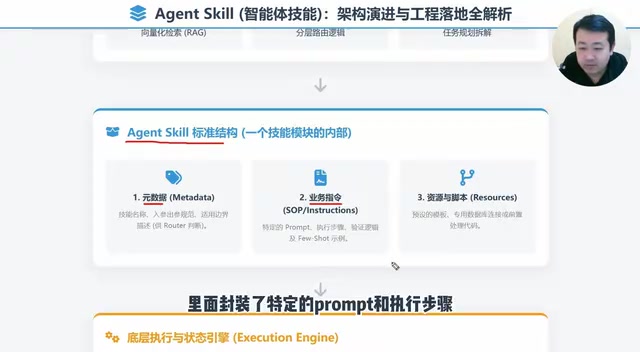
The Skill Encapsulation Layer is the most critical part of the entire AI Agent Skill architecture. A qualified intelligent agent skill encapsulation must contain three key components, none of which can be omitted:
1. Metadata — The Skill's "Business Card"
Metadata tells the large model: what this skill is called, what it can do, what input parameters it needs, and what results it returns. This is the foundation for the model to understand and select skills, and the prerequisite for Function Calling to trigger correctly.
2. Business Instruction SOP — The Skill's "Soul"
This is the key differentiator between Agent Skills and traditional Function Calling. SOP (Standard Operating Procedure) is a classic concept from industrial manufacturing and enterprise management, referring to decomposing complex operations into standardized, repeatable step sequences. Introducing the SOP concept into Agent Skills essentially transforms "tacit business knowledge" into "explicit execution instructions." In the traditional Function Calling model, the large model needs to independently reason about tool usage order and parameter combinations, which heavily depends on the model's reasoning capabilities and is prone to errors in complex scenarios. The SOP model pre-encodes expert experience into Prompt templates and step chains, so the model only needs to make decisions following preset procedures, drastically reducing dependence on model reasoning capabilities. This design philosophy aligns with the "Convention over Configuration" principle in software engineering—improving system determinism and reliability by reducing degrees of freedom.
The SOP encapsulates specific Prompt templates and standardized execution steps. The large model doesn't need to "guess" how to use tools—it just follows the SOP process. This design significantly reduces the probability of model reasoning errors and makes skill execution results more stable and predictable.
3. Resources and Scripts — The Skill's "Arsenal"
This includes preset output templates, dedicated database connection configurations, preprocessing code, etc. When the large model needs to execute a skill, these resources are dynamically loaded into the context to ensure the completeness of the execution environment.
Execution Engine Layer: State Machine Driven with Self-Healing Capabilities
Skill execution is not a "one-shot deal." The key to the underlying execution engine lies in the Agent state machine mechanism:
A state machine is a foundational concept in computer science that describes a mathematical model of a system transitioning between different states based on input events. In the Agent execution engine, Finite State Machines (FSM) are used to manage the lifecycle of skill execution: each execution step corresponds to a state node, and transitions between steps are triggered by conditions. The Checkpoint mechanism borrows from the Snapshot concept in distributed systems—persisting the current execution context (including completed steps, intermediate results, variable states, etc.) at critical state nodes. When system failures or network interruptions occur, execution can resume from the most recent Checkpoint rather than starting from scratch. This design is already widely used in stream processing frameworks like Apache Flink and deep learning training, and has now been migrated to Agent engineering to solve reliability issues in long-chain tasks.
- Breakpoint Memory and Recovery: The skill execution process needs to remember current progress, supporting continuation from the interruption point rather than restarting from the beginning every time an error occurs.
- Self-Reflection and Retry: When underlying tools report errors, the execution engine can interpret error logs, autonomously adjust parameters, and retry, rather than simply throwing the error to the user.
This "self-healing capability" is the true essence of modern Agent Skills and an important standard for measuring Agent engineering maturity.
Three Major Challenges in Agent Skill Deployment with Practical Solutions
The theoretical architecture looks perfect, but what thorny problems do you encounter when actually deploying large model applications? Here are three of the most typical challenges and their practical solutions.
Challenge One: Context Explosion from Massive Skills
The Core Problem: You can't spread all skill manuals on the table for the model to read—the large model's context window is limited.
Practical Solutions:
- Adopt a dynamic retrieval injection strategy, only injecting skill information needed for the current task into the context
- Build a hierarchical routing architecture, splitting skill pools by business lines to narrow the search scope each time
- This significantly reduces the model's "cognitive load" and correspondingly improves decision quality
Challenge Two: Error Recovery in Complex Workflows
The Core Problem: A task requires five steps, and the network crashes at step three—should the user start over from the beginning?
Practical Solutions:
- Introduce state machines and Checkpoint mechanisms to enable "resume from where it broke"
- Mandate Actor-Critic self-reflection loops in the SOP, having the model perform self-checks after each step. Actor-Critic is a classic architecture in reinforcement learning, where the Actor is responsible for selecting and executing actions, and the Critic evaluates action quality and provides feedback signals. In the Agent Skill context, this concept is applied abstractly: the Agent's "execution module" plays the Actor role, responsible for calling tools and generating results according to SOP steps; while the "reflection module" plays the Critic role, performing quality assessment on each step's execution results—checking whether outputs match expected formats, whether values fall within reasonable ranges, whether logical contradictions exist, etc. If the Critic determines a step's execution result is unsatisfactory, the system triggers a retry or parameter adjustment. This mechanism is academically called Reflexion or Self-Refine, systematically proposed by Shinn et al. in their 2023 paper, and has been proven to significantly improve Agent success rates in complex tasks, with some experiments showing improvements of 20%-30%.
- This mechanism ensures reliability and robustness of long-chain tasks

Challenge Three: Balancing Skill Generality vs. Overfitting
The Core Problem: If skills are written too rigidly they won't be generalizable; if written too broadly they're prone to errors—how do you find the balance?
Practical Solutions:
- Adopt parameterized dynamic injection to decouple business logic from specific data. Parameterized dynamic injection is essentially an application of template engine thinking: the core logic of a skill is abstracted into templates containing placeholders, with parameters dynamically filled at runtime based on specific business scenarios (such as database connection strings, business rule thresholds, output format requirements, etc.). This decoupled design allows the same "data query" skill framework to serve completely different business scenarios—financial report queries, user behavior analysis, inventory audits—through different parameter configurations, achieving true "develop once, reuse across scenarios."
- Prepare high-quality Few-shot examples that clearly delineate the skill's capability boundaries. Few-shot Learning is one of the core capabilities of large language models, guiding models to understand task patterns and generate expected results by providing a small number of input-output examples in the Prompt. In Agent Skill design, high-quality Few-shot examples not only demonstrate correct skill usage but more importantly implicitly define the skill's capability boundaries—which requests should be handled by this skill, and which should be rejected or handed off to other skills.
- Use templated design to adapt the same skill framework to different business scenarios
Four Core Values of Standardized Agent Skills
After understanding the architecture and challenges, let's look at why major companies are actively promoting Agent Skill standardization. The core values can be summarized in four keywords:
Plug-and-Play: Highly modular design, flexibly assembled like puzzle pieces, enabling rapid setup for new business scenarios.
High Reusability: Develop once, share across all intelligent agents in the company, completely eliminating the inefficient pattern of reinventing the wheel.
High Reliability: Built-in SOP and self-reflection mechanisms provide execution stability far exceeding direct bare API calls.
Ecosystem Connectivity: Bridging the gap between underlying toolboxes and complex business logic to build a complete Agent capability ecosystem.
Summary: The Evolution Path from Loose Tools to Standardized Skill Packages
Evolving from loose tools to standardized skill packages is the inevitable path for AI Agent scaled deployment. The current Agent Skill system has formed a complete closed loop of "Dynamic Routing → Standard Encapsulation → Stateful Execution," solving the scalability, reliability, and maintainability problems that traditional Function Calling faces in enterprise scenarios.
For those learning or working in AI Agent development, understanding this skill architecture mindset is crucial. Whether in interviews or actual projects, being able to discuss from definitions to architecture, then to pitfall-avoidance strategies, and finally elevate to the value proposition—this systematic thinking is the true watershed that distinguishes an "API-calling engineer" from an "Agent architect."
As the intelligent agent skill ecosystem further matures, we can expect to see more standardized skill marketplaces and cross-organizational skill sharing mechanisms emerge, greatly accelerating the deployment of AI Agents across industries.
Key Takeaways
- Agent Skill is not simple Function Calling, but a standardized encapsulation module containing metadata, business SOPs, and resource scripts
- Modern Agent Skill architecture has three layers: Brain Decision Layer (dynamic routing), Skill Encapsulation Layer (standard structure), and Execution Engine Layer (state machine)
- Three major deployment challenges: context explosion requires dynamic retrieval injection, error recovery requires state machines and Checkpoint mechanisms, generality balance requires parameterized dynamic injection
- The core value of Agent Skills lies in four dimensions: plug-and-play, high reusability, high reliability, and ecosystem connectivity
- The evolution from loose tools to standardized skill packages is the inevitable path for scaled enterprise deployment of AI Agents
Related articles
Deep Dive into AI Agent Skill Design: …
Deep Dive into AI Agent Skill Design: Engineering Practices from Anthropic and Perplexity
A deep dive into Skill design philosophy from Anthropic's Claude Code team and Perplexity's Agent team, covering the Tax Test, Gotchas Flywheel, progressive disclosure, and Eval-First practices for building high-quality AI Agent skill systems.
Deep Dive into OpenAI's Official GPT-5…
Deep Dive into OpenAI's Official GPT-5.6 Prompting Guide: The Shift from Manual to Automatic
A deep dive into OpenAI's official GPT-5.6 Sol prompting guide: conciseness-first, outcome-oriented design, autonomy boundaries, tool routing, and reasoning intensity tuning.
 Deep Dives
Deep Dive into How OpenClaw (Open-Source Crayfish) AI Agent Works
Deep analysis of OpenClaw AI Agent internals: System Prompt, tool calling, SubAgents, Skill system, memory, and Context Engineering explained.