AI Agents for Absolute Beginners: A Practical Guide to LLM Prompt Engineering

Learn AI agent development on Coze with zero coding—from platform basics to real projects.
This article maps out a hands-on AI agent development course on ByteDance's Coze platform for zero-base learners. It covers two modules: first, deep-diving into Coze's core features (agent creation, plugins, knowledge bases, workflows) and the underlying logic of prompts and variables; second, completing two full projects that yield publishable agents. Prompt engineering is highlighted as the key to performance—no coding required, but logical thinking and iteration are essential. The piece also notes that low-code doesn't mean zero cost, and independent workflow design is the real competitive edge.
Title
AI Agents for Absolute Beginners: A Practical Guide to LLM Prompt Engineering
Meta Description
Can absolute beginners build AI agents? Based on a popular Bilibili course, this article maps out a complete learning path covering LLM fundamentals, prompt engineering, and agent building on the Coze platform—including platform feature breakdowns, two hands-on projects, and job-market competitiveness analysis. Suitable for college students, working professionals, and career switchers.
Article Content
AI agent development is often seen as a high-barrier field—one that seems to require mastery of multiple programming languages just to get started. But ByteDance's Coze platform is challenging that assumption: even users with zero coding experience can build deployable AI applications. Based on a popular hands-on course on Bilibili, this article lays out a complete learning path from LLM fundamentals and prompt engineering to agent deployment, helping students, working professionals, and career switchers seize the window of explosive demand for AI talent in enterprises.
Why Learn AI Agent Development Now
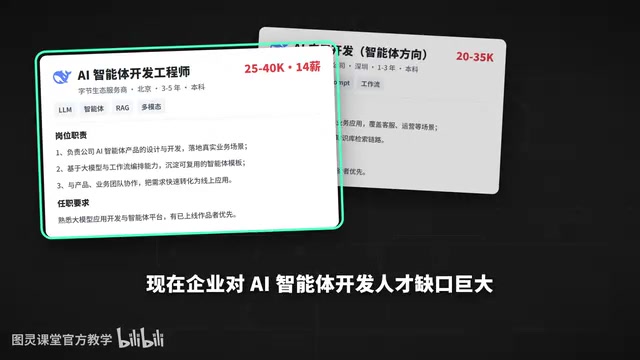
Enterprise demand for AI agent developers is expanding rapidly, with job openings growing significantly. The course opens by pointing out that whether you're a college student looking to add a hard-hitting project to your resume, a working professional hoping to boost efficiency with AI or develop a side business, or a job seeker preparing to compete for AI development roles, mastering agent-building skills can give you a differentiated edge.
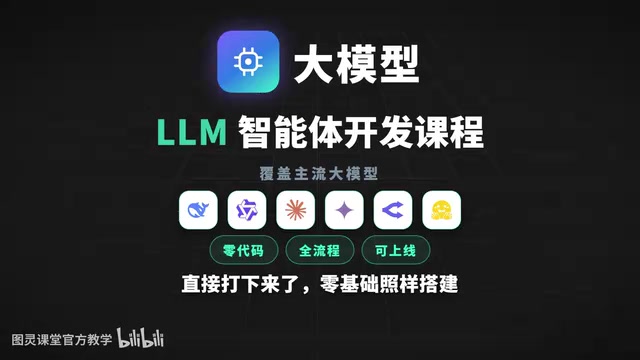
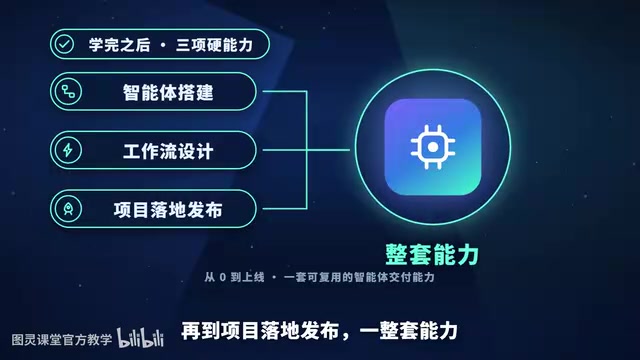
Traditional AI development requires solid programming skills, whereas platforms like Coze encapsulate the underlying complexity, letting learners focus on workflow design and prompt optimization. The course emphasizes "low-code, hands-on," fully aligned with the real requirements of entry-level AI development positions in enterprises. Upon completion, learners will have mastered the full skill set—from agent building and workflow design to project deployment and release.
Two Major Course Modules: Master the Platform First, Then Build Projects
The structure of this hands-on course is very clear, divided into two progressive modules.
Module 1: Deep Dive into Coze Platform Core Features
The first part systematically covers the core features of the Coze platform, including agent creation, plugin invocation, knowledge base configuration, and workflow orchestration. The goal is for learners to not just click buttons but understand the underlying logic—how prompts affect model output, how workflow nodes connect, and how variables pass through conversations. Once you've mastered these mechanisms, you can apply them flexibly in later projects.
Knowledge Base and RAG: The "knowledge base configuration" mentioned above is the key mechanism for connecting agents to private data, typically corresponding to Retrieval-Augmented Generation (RAG) technology. The process is: split documents into chunks and vectorize them into an index; when a user asks a question, first retrieve the most relevant chunks, then insert those chunks as context into the prompt for the LLM to generate an answer. Compared to directly fine-tuning a model, RAG is lower cost and faster to update, making it suitable for enterprise knowledge Q&A scenarios. When configuring a knowledge base in Coze, chunk size, retrieval count, and similarity thresholds all directly affect answer accuracy and recall—which is one reason the course emphasizes "understanding the underlying logic."
Workflows and Variables: Coze workflows are directed flows composed of multiple nodes, which can include LLM calls, plugins, conditional branches, code blocks, and more. Variables pass data between nodes and determine whether context connects correctly; session variables maintain state across multi-turn conversations. Understanding node input/output contracts and variable scope is the dividing line between "knowing how to click buttons" and "being able to design independently."
Module 2: Hands-On Completion of Two Full Projects
The second part guides students through two complete projects, putting all the theory into practice. The course explicitly states that the final output is "a finished agent that can be published directly to the app store." This means the learning outcome is not a demo or a toy, but an application that can genuinely reach users and solve specific problems. For job seekers, this kind of portfolio is far more persuasive than certificates.

Prompt Engineering: The Dividing Line for Agent Performance
The course title pairs "LLMs + prompt engineering" side by side, which shows just how important prompts are. On the Coze platform, with the same model and plugins, how well the prompt is written directly determines the agent's answer quality and task completion rate.
Although the course doesn't expand on specific prompt templates, based on its positioning of "explaining core methods in plain language," the focus is on building the right prompt mindset: clearly define the role, break down task steps, provide few-shot examples, and constrain output format. These methods don't require programming fundamentals but do require logical expression skills—which is why learners from liberal arts backgrounds can also find an advantage on this path.
Few-shot Examples: The "provide few-shot examples" mentioned above refers to giving several input-output examples in the prompt, allowing the model to imitate the target format and style through in-context learning. It is particularly effective for constraining output structure and unifying tone; typically 2 to 5 high-quality examples can significantly improve stability. Examples should cover typical cases and edge cases, and maintain completely consistent formatting—otherwise the model may learn the wrong pattern.
Structured Prompt Frameworks: A common industry practice is to break prompts into blocks such as role, goal, constraints, process, and output format, making them easier to debug and reuse. Combined with parameter adjustments like temperature, you can trade off between creativity and determinism. Prompt optimization is essentially iterative experimentation: first define measurable success criteria, then make small changes and compare results, rather than trying to write the perfect prompt in one shot.
Who Should Learn, and What You Can Do After
The course's target audience is quite broad. College students can use it to accumulate project experience and showcase deployable AI applications on their resumes; working professionals can use it to build efficiency tools or side-business products; career switchers can use it to fill in the skill stack required for entry-level AI development positions in enterprises.
What needs to be viewed calmly is that low-code platforms lower the entry barrier, but that doesn't mean zero learning cost. Workflow design requires clear logical decomposition skills, prompt optimization requires repeated debugging and iteration, and after a project goes live, you still need to pay attention to user feedback and performance evaluation. The course provides a structured path, but real competitiveness still comes from hands-on practice and project accumulation.
Learning Advice: From Following Along to Independent Design
If your goal is to find a job or take on freelance work, it's recommended not to stop at typing along with the videos. After completing the course projects, try defining a real need yourself—such as a course Q&A assistant, a content summarization tool, or a customer service Q&A chatbot—and design the workflow from scratch and publish it. This leap from "following along" to "independent design" is the true proof of ability that enterprise interviewers value.
The barrier to AI agent development is being lowered by platform tools, but the talent gap means that those who master it first still have a time window. For zero-base learners, choosing the right path and getting hands-on is more meaningful than agonizing over "whether to learn programming."
One-line Summary
Zero-base learners can study AI agent development via the Coze low-code platform, covering the full path from platform features to hands-on projects.
Paragraph Summary
This article introduces a hands-on AI agent development course based on ByteDance's Coze platform, arguing that zero-base users can also build deployable applications. The course is divided into two major modules: first, a deep dive into Coze's core features such as agent creation, plugin invocation, knowledge base configuration, and workflow orchestration, understanding the underlying logic of prompts, node connections, and variable passing; then, two complete projects that produce finished agents ready to publish directly to the app store. The article emphasizes that prompt engineering is the dividing line for performance—no programming required, but logical expression and repeated debugging are needed; the target audience includes college students, working professionals, and career switchers, and a portfolio is more persuasive than certificates. It also reminds readers that low-code doesn't mean zero cost, and the leap from following along to independently designing workflows is the true proof of ability.
Related articles
 Tech Frontiers
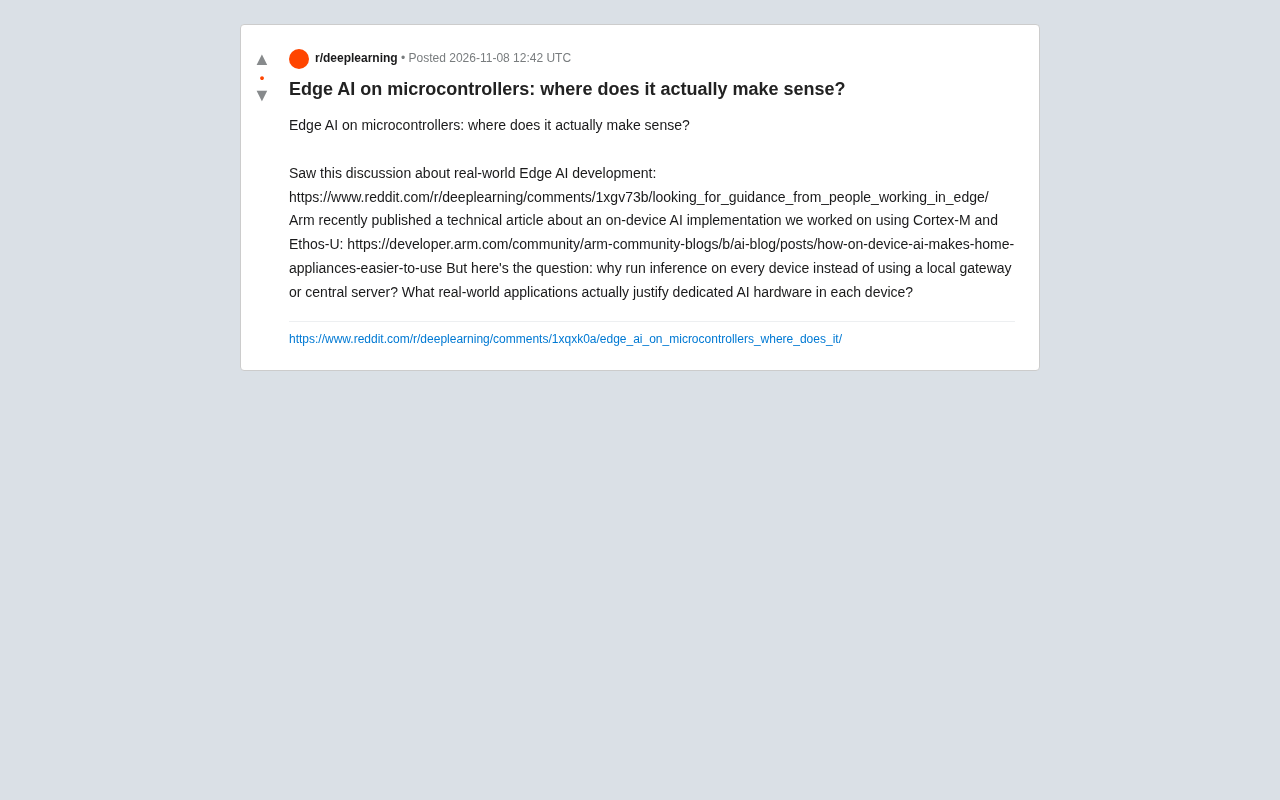
Edge AI on Microcontrollers: When Is It Actually Worth Deploying?
Drawing on Reddit discussions and Arm case studies, this article analyzes the real-world use cases for edge AI on microcontrollers: when each device needs independent inference, when a gateway or cloud is more reasonable, and the costs and boundaries of specialized hardware.
 Tech Frontiers
Pushing the Limits of Extreme Sudoku on a 16GB GPU: Insights from Depth and Flow Matching
A researcher trained a 16.54M-parameter model on a 16GB GPU to solve extreme Sudoku, finding effective depth breaks the 60% plateau and flow matching with improved sampling pushes accuracy past 99% with ~50× lower layer-evaluation budget.
 Tech Frontiers
AI Agent Approval Workflows: Why Human Confirmations Always Get Mindlessly Clicked
Why do AI agent approval workflows always get mindlessly clicked? A Reddit discussion shows that separating rules from keys, low-frequency high-risk approvals, and GitHub Environments-style gates are the keys to effective approvals.