AI Agents Go Mainstream Internally: What's Behind Company-Wide Adoption
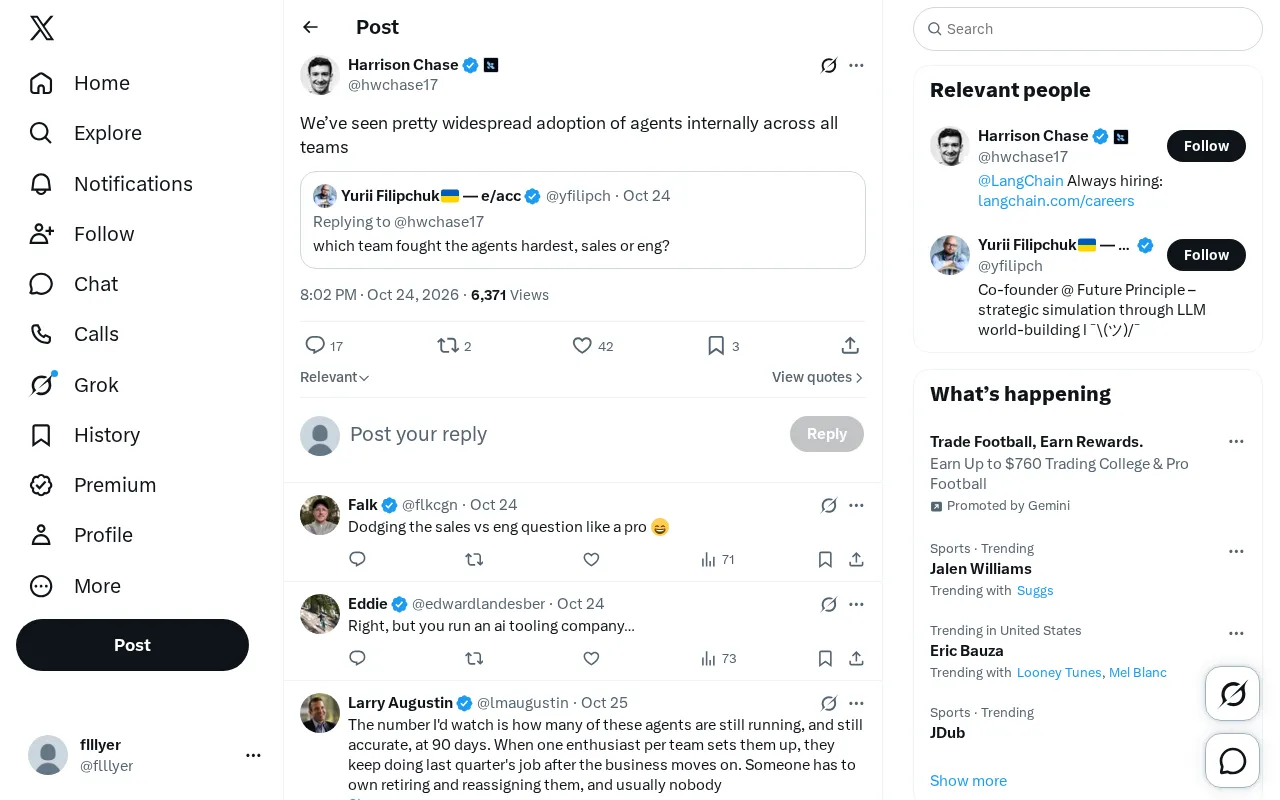
Agents have gone cross-team mainstream; the competitive focus is shifting to organizational adaptation and governance.
Starting from an industry tweet, the article notes that AI agents have been widely adopted across all teams within enterprises, marking a shift from experimental tools to cross-departmental infrastructure. The author argues agents have passed the "is it useful" test and entered the "how to use it better" phase, proposing that whether non-technical teams depend on agents is a new indicator of AI maturity. Key enablers are end-to-end multi-step task completion, lower barriers to use, and embedding into existing workflows. But widespread adoption brings governance challenges around permissions and data boundaries, effectiveness evaluation, and experience reuse. The conclusion: competition has shifted from model capability to organizational adaptation.
An industry insider revealed on Twitter that AI agents have achieved fairly widespread adoption across all teams within their company. That single sentence captures a key turning point in enterprise AI today: agents are shifting from experimental tools into cross-departmental infrastructure.
What It Means to Go from "Pilot" to "Mainstream"
Over the past year, most enterprise AI exploration has stayed at the level of isolated experiments: one team uses a chatbot to draft copy, another department uses a coding assistant to complete functions. These applications share a common trait—the tools are isolated and the value is local.
"Widespread adoption across all teams" describes a different state. It means agents have crossed the boundary of technical departments and entered functional scenarios like marketing, sales, operations, and finance. This penetration isn't driven by administrative mandates; instead, teams have organically developed usage habits in their actual work. In other words, agents have passed the "is it useful" test and entered the "how do we use it better" phase.
The value of this judgment lies in offering a new indicator for observing enterprise AI maturity: it's not about how many models you've deployed, but about how many non-technical teams can't function in their daily workflows without agents.
Why Agents Can Spread Across Teams
The core difference between agents and earlier AI tools is their ability to autonomously break down tasks, invoke tools, and complete multi-step operations. For non-technical teams, this means no prompt engineering and no need to understand model parameters—just describe the goal, and the agent runs the whole process.
Take a marketing team, for example: an agent can simultaneously complete competitor research, data organization, and briefing generation, rather than handling just one step like a traditional AI assistant. This end-to-end completion capability dramatically lowers the barrier to use.
Another driving factor is the change in integration approach. Agents can be embedded directly into existing enterprise collaboration platforms and workflows, so users don't need to switch applications. When the tool disappears into the background, adoption naturally rises.
The key difference between agents and ordinary large-model applications is "autonomy." An agent typically uses an LLM as its reasoning core, combined with task planning, tool invocation (such as search, code execution, API interfaces), and memory modules to form a closed loop: the model first breaks down the goal, decides the next action, then adjusts its plan based on tool results, cycling until the task is complete. This architecture is often called the "ReAct" or "plan-and-execute" paradigm. Because "how to do it step by step" is left to the system itself, users only need to provide the goal, which is why agents can run multi-stage processes end-to-end; but this also places higher demands on tool reliability and error handling.
New Problems After Mainstream Adoption
Widespread adoption doesn't equal mature governance. When every team is using agents, new challenges emerge in concentrated form.
Permissions and data boundaries are the first hurdle. Different teams have different data access, and how agents comply with these boundaries during cross-departmental collaboration requires clear rule design.
Effectiveness evaluation is the second hurdle. During local pilots, intuition can judge good from bad; after full rollout, a unified measurement system is needed—otherwise you can't tell whether the investment is generating real returns.
Third is experience reuse. How does one team's efficient usage get codified as an organizational asset rather than remaining at the level of individual tricks? This determines whether mainstream adoption translates into sustained capability improvement.
When agents are used across departments, the permission issue is essentially about separating "data access boundaries" from "operational permissions." In traditional software, user permissions are relatively static; but an agent executes multi-step operations on behalf of a user, and each step may touch different data sources or trigger write operations, so more fine-grained authorization mechanisms are needed—for example, temporary authorization by task scope, mandatory human confirmation for sensitive operations (human-in-the-loop), and complete operation audit logs. Without these designs, agents can easily overstep read permissions or mistakenly modify data during cross-team collaboration, becoming a major governance risk.
Implications for Enterprises
Although the information is brief, it points to a pragmatic conclusion: the competitive edge for agents is no longer in model capability itself, but in organizational adaptation. Whoever can more quickly establish supporting permission standards, evaluation mechanisms, and knowledge-codification methods will be able to turn widespread adoption into real efficiency.
For teams still on the sidelines, the signal is clear—when peers have already achieved company-wide usage, the pilot-phase window is closing. The next focus isn't whether to use agents, but how to manage and use them well.
One-line Summary
Agents have achieved cross-team adoption, and the competitive focus for enterprises is shifting to organizational adaptation and governance.
Paragraph Summary
Starting from an industry tweet, the article points out that AI agents have been widely adopted across all teams within enterprises, marking their transition from experimental tools to cross-departmental infrastructure. The author argues this means agents have passed the "is it useful" test and entered the "how do we use it better" phase, proposing whether non-technical teams can't function without agents as a new indicator of enterprise AI maturity. The key reasons agents can spread are end-to-end completion of multi-step tasks, a lower barrier to use, and embedding into existing workflows. But widespread adoption also brings three types of governance challenges: permissions and data boundaries, effectiveness evaluation, and experience reuse. The conclusion is that the competitive focus for enterprises has shifted from model capability to organizational adaptation, and the pilot window for those on the sidelines is closing.
Related articles
AWS AgentCore Gateway: Connecting AI A…
AWS AgentCore Gateway: Connecting AI Agents to Enterprise Backends with MCP
How AWS AgentCore Gateway acts as a primary MCP server to aggregate REST APIs, Lambda, and existing MCP services? Analyzing its AST real-time mapping, zero cold start, semantic search for tool overload, session isolation, and key injection security design, plus the architectural approach to decoupling enterprise AI agents from backends.

One Link Gives Figma AI a New Skill: Hands-On with MCP Connectors
Paste one MCP server link and the AI Agent in Figma gains new tool capabilities. We break down the setup flow, 20+ one-click apps, read/write permissions and execution policies, and the public HTTPS requirement.

Cognition SWE-2 in Practice: One Prompt to Handle the Whole Product Launch Process
Analyzing a YouTube creator's prompt for using Cognition SWE-2 to launch a product: a landing page, seven-email sequence, and non-buyer follow-up tool, plus how the 'test and report' constraint changes AI delivery quality.