AI Agents in the Daily Stand-Up: A Fascinating Vision and Its Real-World Challenges

Exploring what it means for AI agents to join the daily stand-up as active team participants.
This article examines the idea of AI agents participating in daily stand-up meetings. As agents gain the ability to run continuously and plan autonomously, they develop a natural need to sync progress with the rest of the team — making the stand-up a compelling vehicle for observability. The piece identifies three key challenges: whether agents can filter for truly important information, whether their self-assessments can be trusted, and how to define their role in team decision-making. Ultimately, it frames the discussion as a signal of a broader trend: when AI moves from tool to teammate, our collaboration paradigms will need fundamental rethinking.
When AI Agents Join the Daily Stand-Up
The daily stand-up is one of the core rituals of agile development teams. Members take turns reporting what they did yesterday, what they plan to do today, and what blockers they're facing. As AI agents take on an increasingly integral role in software development workflows, an imaginative idea has emerged: what would happen if AI agents joined the stand-up too?
This topic recently sparked a small but lively discussion on Hacker News. Though the conversation was modest in scale, it touched on a direction worth serious consideration — AI agents are no longer just passive tools that execute commands, but are gradually becoming active participants in team collaboration.
From Execution Tool to Collaborative Team Member
Traditionally, developers interact with AI tools in a one-directional way: issue a command, receive a result. Whether it's code completion, documentation generation, or bug fixing, AI has always occupied the position of something that gets called upon.
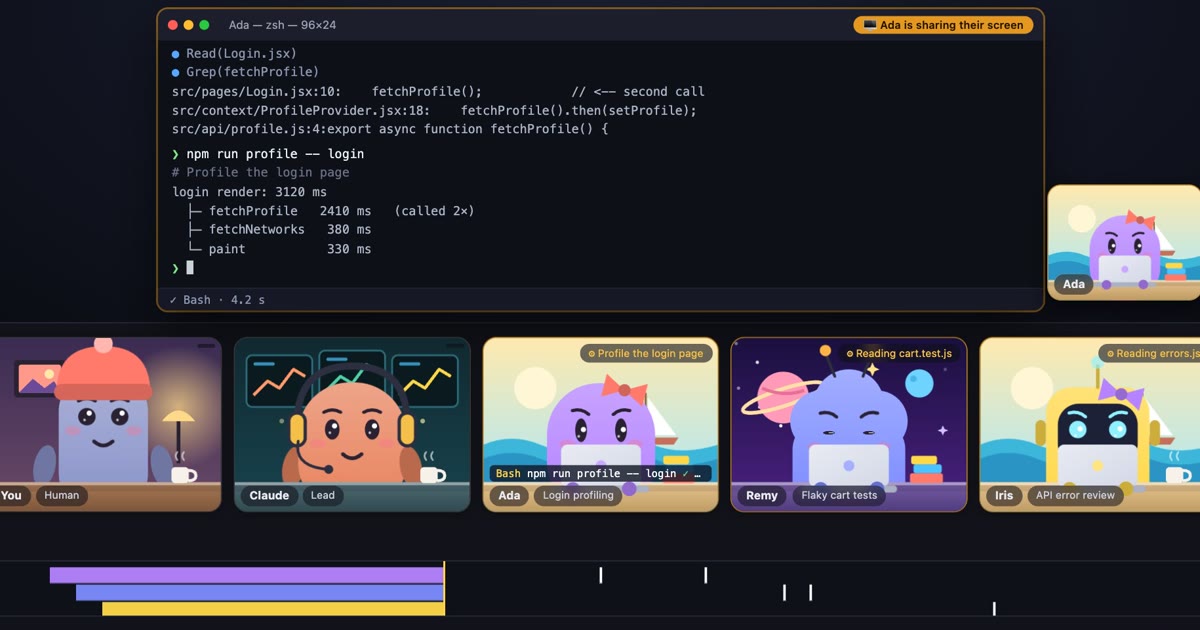
The idea of an "AI agent joining the stand-up" hints at a fundamental shift in roles. In this vision, an AI agent can proactively report progress on its assigned tasks, identify technical blockers it has encountered, and even offer collaboration suggestions to human team members. The logic behind this shift is straightforward: once an AI agent is given the ability to run continuously and plan autonomously, it naturally develops a need to stay in sync with the rest of the team.
In other words, if an agent is running in the background handling a module refactoring task, the team needs to know how far along it is, whether it's stuck, and whether human intervention is needed. The stand-up is a ready-made vehicle for exactly this kind of synchronization.
The core distinction between an AI agent and a conventional AI tool lies in autonomy and continuity. Ordinary AI tools (like code completion) are stateless, single-shot calls: input goes in, output comes out, and the task is done. AI agents, by contrast, typically possess the ability to perceive their environment, formulate plans, execute step by step, and adjust strategies based on feedback — advancing a complex goal autonomously over an extended period of time. Notable frameworks in this space include OpenAI's function calling system, Anthropic's Claude tool use protocol, and open-source projects like AutoGen and LangGraph. It is precisely this "long-running, autonomous decision-making" characteristic that gives AI agents a need for state synchronization similar to that of human team members — they are no longer one-off calls, but ongoing, active participants.
What Problem Does This Vision Actually Solve?
In practice, asynchronously running AI agents often operate as a kind of "black box." Once a developer kicks off a task, it's hard to get real-time visibility into what's happening under the hood — until the agent either succeeds completely or fails entirely.
Having AI agents report their status in a stand-up format is essentially addressing the problem of observability. Through structured, human-readable progress updates, the team can:
- Quickly spot when an agent has gotten stuck in a loop or gone off course
- Intervene rapidly when the agent requests help
- Incorporate the AI's progress into the team's overall task board
This is far more intuitive than combing through lengthy logs or staring at monitoring dashboards, and it aligns naturally with the collaborative habits that human teams already have.
Observability is a foundational concept in distributed systems engineering, referring to the ability to understand a system's internal state through the logs, metrics, and traces it exposes externally. The observability challenge for AI agents is highly analogous: when an agent executes a multi-step task, its intermediate states are often opaque to outsiders. Existing solutions tend to focus on the technical layer — tools like LangSmith and LangFuse offer visual tracing of agent execution chains. The "join the stand-up" idea takes a different angle: it reframes the observability problem as a natural language summarization task aimed at humans, prompting the agent to proactively generate status reports that fit the team's cognitive style, thereby reducing the overhead of manual oversight.
Key Real-World Challenges
As appealing as the vision is, putting it into practice faces a number of significant hurdles.
Signal-to-Noise Ratio in Reporting
Human team members naturally filter information during stand-ups, sharing only what's truly important. An AI agent lacking a strong sense of "what matters" might output an overwhelming flood of trivial details, burying the blockers that actually need attention. Teaching an agent to identify and surface the essentials remains an unsolved problem.
Trust and Verification
When an AI agent claims it has "completed a certain module," can the team trust that report? Unlike human team members, AI agents can produce a kind of hallucinatory self-assessment — concluding that a task is done when hidden defects remain. This means agent reports still require a second layer of verification, whether by humans or automated systems.
AI hallucination carries a particular danger in agentic scenarios. Hallucinations in single-turn question-and-answer interactions are usually immediately visible, but agents executing multi-step tasks can develop a "self-assessment bias" — incorrectly marking a task as successful when tool call results are ambiguous or erroneous. This is especially pronounced in coding tasks: passing tests does not equal correct logic; successful compilation does not equal fulfilled requirements. For this reason, the industry broadly advocates for "human-in-the-loop" mechanisms in agent outputs — requiring mandatory human confirmation at critical decision points rather than fully trusting an agent's self-reported status. For stand-up reports to be genuinely trustworthy, they would similarly need to be corroborated against objective data such as automated test results and code review records.
Defining the Boundaries of Collaboration
A stand-up is not just one-way reporting — it involves discussion and decision-making among team members. To what degree should an AI agent participate in those decisions? Can it push back on a human's work plan? These questions touch on the division of responsibility and authority in human-AI collaboration, and there are no mature answers yet.
A Directional Signal
Even if this was just a small-scale discussion on Hacker News, it reflects the developer community's sustained attention to how the role of AI agents is evolving. From code completion to autonomous agents, and now to the imagined role of "team member," AI's position in software development is steadily moving up the stack.
The value of explorations like this lies not in whether they're ready for production today, but in the trend they reveal in advance: future development teams may well be composed of humans and AI agents working side by side. When that day arrives, designing the workflows, tools, and norms for human-AI collaboration will become an entirely new engineering challenge.
The stand-up is just one entry point. The deeper question worth pondering is this: when AI shifts from being a tool to being a colleague, do our existing collaboration paradigms still hold?
Related articles

NVIDIA's 30,000 Developers Use Cursor, Code Commit Volume Triples
Cursor engineer Chris Diaz breaks down five organizational gaps blocking enterprise AI coding scale—strategy, risk tiering, governance, metrics, and operating model. NVIDIA's 30,000 developers use Cursor daily, tripling code commits while defect rates stay flat. The key: rewrite the SDLC, not add tools.

Ponytail: Giving AI Coding Agents a Senior Engineer's Mindset
Ponytail is a free GitHub tool that injects a senior engineer's mindset into AI coding agents, making them ask whether code is even necessary first. According to TamilDeck, it can compress 200 lines of AI-generated code to 30, cutting token costs, with support for Cursor rules and Claude Code skill integration—though security review still requires human oversight.

Complete Guide to Connecting Cursor AI to the GitHub MCP Server
A step-by-step guide to connecting Cursor AI to the GitHub MCP server: create a personal access token, configure mcp.json, store the token in the ENV block, and verify with a PR query.