AI Agents Keep Forgetting? Beacon Open-Source Tool Makes Memory Persist Across Sessions

Open-source tool Beacon gives AI agents cross-session memory via session timelines, supporting 20+ tools.
AI coding assistants clear context with each new session, forcing users to repeat background across multi-day tasks and sometimes causing inconsistent decisions. Open-source tool Beacon aims to solve this: it saves each session as a timeline, then reads history and injects it into the current context when a new session starts. Beacon supports 20+ tools including Cloud Code, Cursor, and Codex, acting as a universal memory layer so the same project memory can be reused across tools. It offers Local Mode with data stored locally, optional cloud features, a free tier with 50 Findings, has 3,600 stars, and lets users inspect what was actually saved via Beacon Traces. The article also notes that key details such as memory quality, retrieval strategy, and context cost still need real-world verification.
AI agents "forgetting" between different sessions is a long-standing problem: every new conversation feels like meeting for the first time. The YouTube channel CodeBuddy introduced an open-source tool called Beacon in a short video, which attempts to solve this problem through session timelines.
The Problem: The "Zero Starting Point" Dilemma for Agents
The way mainstream AI coding assistants currently work determines this problem: after each session ends, the context is cleared, and the next conversation starts over. For a task that only runs a few minutes, this is not a big deal, but for engineering tasks that need to be advanced across days, it is very unfriendly—yesterday's technical decisions, pitfalls encountered, and ideas tried but rejected all have to be explained again today.
This gap is not just an efficiency loss but also leads to inconsistent decisions: the agent may recommend a solution in the second session that was already ruled out in the previous round, because that discussion never happened in its memory.
The "amnesia" of AI agents stems from the stateless nature of large language models themselves: each inference is based only on the context window carried in the current request, and no information from the previous call is automatically retained. So-called "session memory" is essentially implemented at the application layer by re-splicing historical content into the prompt with each request. Context windows have length limits, and length directly corresponds to token cost and latency, so simply stuffing all history back in is both expensive and dilutes key information. Cross-session memory is therefore an independent engineering problem that requires design around "what to store, when to retrieve, and how to compress," not just persisting conversation records.
Beacon's Approach: Storing Each Session as a Timeline
According to CodeBuddy's introduction, Beacon's core mechanism is to save the history of each session and organize it in timeline form. When a new session starts, the agent can read this timeline and bring previous key information into the current context, thereby remembering "what was discussed last time."
The idea is not complicated; its value lies in making it a universal layer: rather than being a built-in feature bound to a single agent product, it provides memory capabilities to multiple clients as an external tool. This kind of "memory middleware" approach is gaining increasing attention in the open-source community because it bypasses the fundamental limitation of stateless models.
"Memory middleware" refers to an independent service layer between the agent client and the model, responsible for persisting, retrieving, and injecting historical information without relying on a product's built-in memory features. Its advantage is decoupling from both the model and the client: the same memory can be shared by multiple tools, and tool iterations do not affect memory assets. Representative approaches include long-term memory libraries based on vector retrieval, entity memory based on knowledge graphs, and the timeline-style records discussed in this article. Their common challenge is retrieval relevance—injecting irrelevant history pollutes the context, while insufficient injection is equivalent to having no memory, so retrieval ranking and injection timing often determine success more than storage itself.
Supports Over 20 Tools, Covering Mainstream AI Coding Environments
The integrations explicitly mentioned in the video include Cloud Code, Cursor, and Codex, and it states that Beacon has already adapted to more than 20 tools. This means that no matter which AI coding assistant you use, you have a chance to manage cross-session memory uniformly through Beacon.
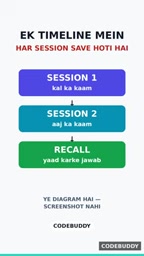
For developers using multiple tools, this is especially valuable: the same project memory can be reused across different tools, rather than each tool maintaining its own set of context.
Local Mode: Data Stays on Your Own Machine
Privacy is an unavoidable consideration for this type of tool. Beacon provides Local Mode; according to the video, in this mode all data is stored on the user's own machine and does not pass through external services. It also offers optional cloud features (Cloud Optional), with the free tier including 50 Findings.
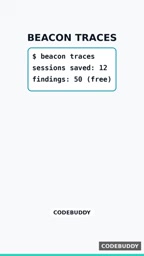
For developers working with private codebases, local mode is basically a necessity. Beacon makes "local-first, cloud-optional" the default architecture, a pragmatic trade-off.
In memory tools, "data stays local" is not just a privacy slogan; it also involves actual architectural differences: Local Mode usually means session records are stored as files or in a local database on the user's disk, with retrieval and injection completed locally, and no code content sent to vendor servers; cloud mode, by contrast, requires uploading memory for cross-device synchronization and stronger retrieval capabilities. For teams working with private codebases, local mode can avoid compliance risks from code leakage, at the cost of making memory difficult to share when switching machines or collaborating as a team. When evaluating such tools, confirm whether telemetry or metadata reporting still occurs in local mode.
Open Source, Free, and Already Has Some Community Attention
Beacon is open source and free, and the video says it has received 3,600 stars. This scale indicates that it has entered the actual workflows of some developers and is no longer a pure concept demo.
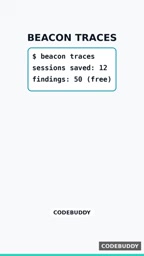
To verify whether memory is actually being stored, the video suggests running Beacon Traces, which shows what has been saved. This design effectively adds observability to the memory feature—developers can check for themselves what the agent actually remembers, rather than relying on intuition.
Worth Watching But Needs Verification
It should be noted that this information comes from a short video, and the information density is limited. The following questions are not expanded upon in the original source and are worth verifying before actual use:
- Memory quality: Saving complete session records and timelines is one thing; "having the agent recall the right content at the right time" is another. Whether retrieval and injection strategies are well designed directly determines whether this tool improves efficiency or adds confusion.
- Context cost: Bringing historical records into each request increases context length. How trade-offs and compression are handled is not mentioned in the original source.
- Depth of multi-tool adaptation: Whether all 20+ tool integrations reach the same level of usability cannot be judged from a short video alone.
There are several general metrics that can serve as references when evaluating memory tools: retrieval accuracy, i.e., whether recalled history is relevant to the current task; injection signal-to-noise ratio, i.e., the proportion of useful information in the context brought in; and context overhead, i.e., the number of tokens added per request due to memory. These metrics are difficult to learn from promotional materials and usually require running the tool on your own project for a period of time, comparing task completion quality and call costs with memory enabled versus disabled. This is exactly where observability tools (such as the Traces mentioned in the article) add value: they turn memory content from a black box into something that can be reviewed.
Summary
Beacon addresses a real pain point in the deployment of AI agents: the lack of cross-session memory. It offers a general solution with a local-first, open-source, free, multi-tool-adapted approach, and has gained some recognition in the community. For developers who run AI coding workflows over the long term, it is worth installing and trying; however, the actual effectiveness of memory tools depends heavily on detailed implementation. It is recommended to run it on your own project for a few days first, use Traces to check storage quality, and then decide whether to incorporate it into your daily workflow.
Related articles

Nothing CMF Buds 2A Drops to $17.89 on Black Friday: A New Low for ANC Earbuds
Nothing CMF Buds 2A wireless earbuds Black Friday deal: just $17.89 on Amazon, about $11 off retail and a record low. ANC earbuds at an entry-level price.

When AI Creation Gets Accused of "Spitting": Hacker News Heats Up Over the Glaude Controversy
A Hacker News post, "Spitting in the Face of Glaude," sparks debate on AI creation transparency and attribution ethics. This analysis examines the blurred creator identity behind the controversy and offers practical advice for AI content production.

Akai Embraces Custom Firmware: MPC Sample 1.4 Lets Users AI-Program Their Sampler
Akai embraces the modding community with MPC Sample 1.4 firmware, supporting vibe-coded custom firmware and effects. We analyze the impact of this open strategy on music hardware and AI-assisted programming.