AI Agents Running Locally: A New Paradigm for Working Even When the Network Goes Down

AI Agents are shifting from cloud to local operation, gaining continuity, privacy, and tool integration benefits at the cost of compute and operations overhead.
Starting from a single tweet, the article examines the overlooked architectural dimension of where an AI Agent runs. Mainstream Agents place inference and execution in the cloud, implicitly requiring the device to always be online — once the network drops, the task chain breaks. Running an Agent locally keeps inference and execution on your own machine, with the phone as just a remote control, yielding three advantages: continuity is no longer bound by the network, sensitive data stays off third-party servers, and it naturally fits the local file system and toolchain. But local Agents also carry clear costs: compute is limited by hardware, operational costs shift to the user, and cross-device coordination becomes more complex. The article argues this shift turns the Agent from "a service you call" into "a process you own," driven by improved on-device models, surplus device compute, and growing data sovereignty awareness.
From "Cloud Dependency" to "Local Autonomy": The Key Shift in Where Agents Run
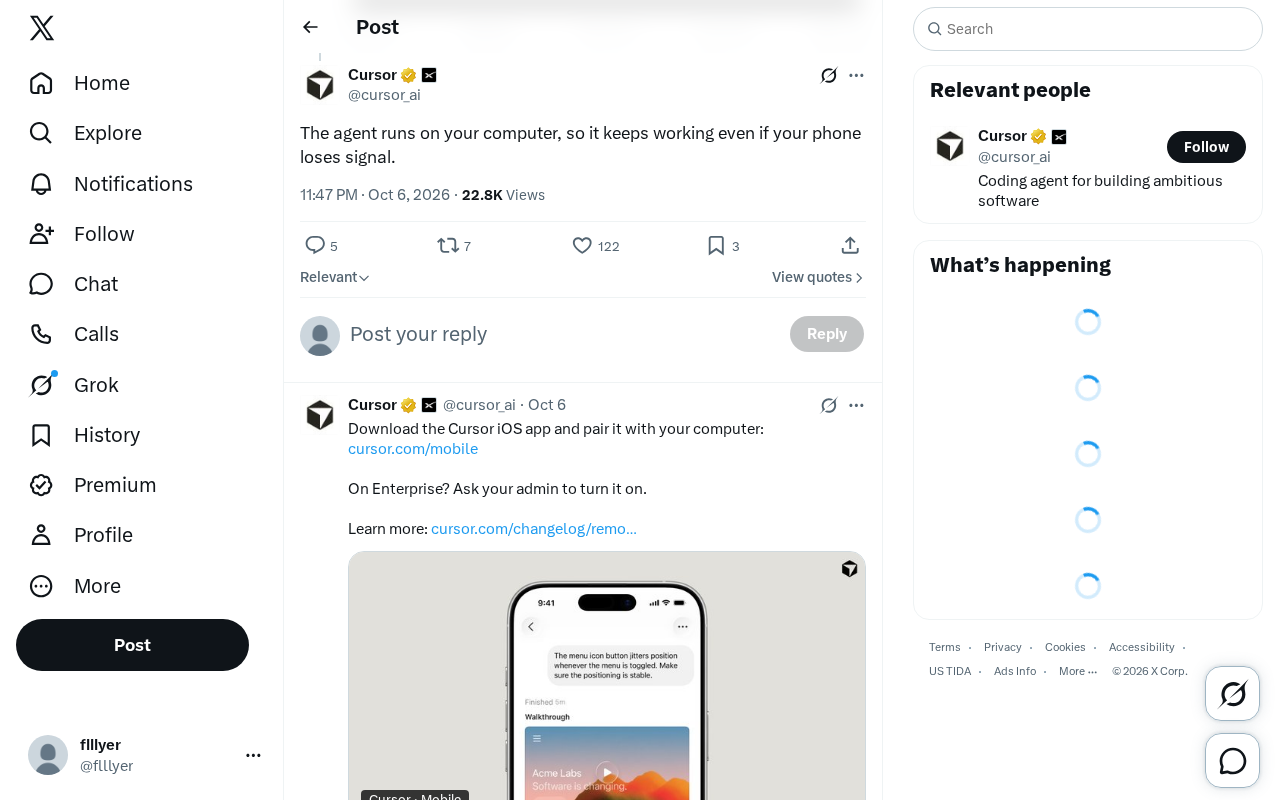
A recent tweet was short but worth pondering: "The agent runs on your computer, so it keeps working even if your phone loses signal."
On the surface, this is about "working when the network is down," but what it really highlights is a long-overlooked dimension of AI Agent architecture — where it runs.
Most mainstream AI Agent products today put inference and execution in the cloud: you issue commands via your phone or a web page, the request is sent to a remote server, the model completes inference in a data center, and the result is pushed back to your device. The advantage of this architecture is centralized compute, a unified model, and easy iteration — but it carries an implicit precondition: your device must always be online.
Once your phone signal drops, your Wi-Fi becomes unstable, or you simply step into an elevator or an underground garage, the task chain breaks. For tasks that need to run continuously — "keep an eye on a certain process for me," "organize local files on a schedule" — this is a structural flaw.
"An Agent that runs on your own computer" is precisely the solution proposed to address this flaw.
AI Agent differs fundamentally from traditional chatbots. A chatbot typically follows a passive "question-and-answer" response pattern, whereas an Agent has goal-oriented autonomy: it can decompose tasks, plan steps, call tools (such as reading and writing files, executing code, accessing the network), and adjust its strategy based on intermediate results across multiple loops until the goal is achieved. Precisely because an Agent needs to run continuously and repeatedly invoke external capabilities, it is unusually sensitive to the physical condition of "where it runs." Every tool call by a cloud Agent requires a network round trip, and once the connection breaks, the entire execution chain collapses. A local Agent, by contrast, places planning, inference, and execution on the same machine, with task state always preserved in a local process — giving it inherently stronger continuity and fault tolerance.
What Problems Does a Local Agent Solve
Continuity Is No Longer Held Hostage by the Network
Once the Agent is deployed on your own machine, both inference and execution happen locally. Your phone becomes just a "remote control" — an entry point for issuing commands, not the carrier of the task itself. If your phone goes offline, the Agent keeps advancing according to plan on your computer; when you reconnect, what you see is the finished result, not a "task failed" notification.
This is fundamentally different from the traditional "cloud Agent + mobile control" experience: the latter ties availability to the mobile network, while the former ties availability to your computer's power and processes — and the latter is usually far more stable than a mobile signal.
Data Doesn't Have to Leave the Device
Another direct benefit of local operation is a change in the privacy boundary. When the Agent processes files, reads directories, and invokes local tools on your machine, sensitive data doesn't need to be uploaded to a third-party server and sent back. For scenarios involving contracts, code repositories, or personal notes, this is often more compelling than "works when offline."
On-device models are one of the technical preconditions that make local Agents viable. In recent years, with the maturation of model quantization, distillation, and miniaturization techniques, models with parameter counts in the billions can now run smoothly on consumer laptops and even phones. Quantization dramatically reduces memory usage and compute requirements by lowering weight precision (e.g., compressing from FP16 to INT4), while distillation lets small models learn the output distribution of large models, approaching large-model performance on specific tasks. This means a local Agent doesn't have to rely on a cloud-based large model to complete a considerable portion of inference work. Of course, the "capability ceiling" of on-device models is still constrained by hardware, and complex reasoning tasks may still require dynamic routing between a local small model and a cloud large model — which is why "hybrid architectures" are becoming the mainstream choice.
Naturally Suited to the Local Toolchain
A local Agent can directly operate the local file system, invoke installed software, and connect to local databases or development environments. Under a pure cloud architecture, such tasks often require an extra sync layer or permission proxy, whereas local operation turns them into the simple problem of "they're already on the same machine."
Costs and Trade-offs: A Local Agent Isn't Free
The tweet emphasizes the advantages, but a complete judgment requires seeing the other side.
Compute constraints. The model size you can run locally is limited by your hardware. Getting close to the capability of a cloud-based large model requires a sufficiently powerful GPU and memory, which is itself a barrier.
Operational costs shift to the user. Upgrades, maintenance, and failure recovery for a cloud Agent are the service provider's responsibility; process management, dependency updates, and crash restarts for a local Agent all fall on the user. To make it "keep working," you first have to ensure it won't silently exit because of a single system sleep.
Cross-device coordination becomes more complex. Binding a task to a particular computer means that switching devices or running tasks in parallel across multiple devices requires extra design for state synchronization. The natural advantage of cloud solutions here becomes the local solution's weakness.
Process supervision is a key engineering element for making a local Agent "keep working." Unlike cloud services, where the platform automatically guarantees process survival, a local Agent must contend with a series of interruption risks unique to the local environment: system sleep, memory reclamation, unexpected crashes, and more. To make it truly "always online," you typically need to introduce process supervision mechanisms (such as systemd, launchd, supervisor, etc.) that automatically relaunch the process when it exits abnormally, combined with logging, resumable execution, and task queue persistence to ensure execution can resume from the last interruption after a restart. This is also the core difference between a local Agent and a "one-off script": the former requires recoverable task state, while the latter only needs to run once to completion. For ordinary users, this operational logic itself constitutes a certain barrier to use.
Why This Direction Is Worth Watching
The reason this tweet was retweeted and discussed isn't that it announced some new technology, but that it represents an architectural choice that more people are beginning to take seriously: turning the Agent from "a service you call" into "a process you own."
Behind this shift is the convergence of several trends — the continuous improvement of on-device model capabilities, surplus compute on personal devices, and rising user sensitivity to data sovereignty. When these conditions hold simultaneously, "whose machine the Agent runs on" is no longer an implementation detail but a core question of product positioning.
For developers, the question worth considering is: after your Agent loses its network, sleeps, or restarts, can it still keep working? For users, the question worth asking is: do you want this program acting on your behalf to live on someone else's server, or on your own computer?
One-line Summary
AI Agents are shifting from cloud to local operation, gaining advantages in continuity, privacy, and tool integration — but at the cost of compute and operations overhead.
Paragraph Summary
Starting from a single tweet, the article explores the overlooked architectural dimension of where an AI Agent runs. Mainstream Agents today place inference and execution in the cloud, with the implicit precondition that the device must always be online — once the network drops, the task chain breaks. A locally run Agent puts both inference and execution on the local machine, with the phone serving only as a remote control, yielding three major advantages: task continuity is no longer held hostage by the network, sensitive data doesn't need to be uploaded to third parties, and it is naturally suited to the local file system and toolchain. But the local approach also has clear costs: compute is limited by hardware, operational costs shift to the user, and cross-device coordination becomes more complex. The article argues that this shift represents the Agent moving from "a service you call" to "a process you own," driven by the convergence of trends such as improved on-device model capabilities, surplus device compute, and growing awareness of data sovereignty.
Related articles

Gemini 4 Argon Hands-On: AI Builds Board Games, Constructs Temples, and Trains Robots Autonomously
Gemini 4 Argon hands-on roundup: AI autonomously builds a desk racetrack and temple in Blender, writes a ray tracing engine, trains a humanoid robot to sink 7 shots, plus API pricing and developer access.

The Magic Octagonal Coin: Why Only 9% of People Can Predict Its Flip?
Only 9% of people can correctly predict the Magic Octagon coin flip. This article explains its spatial rotation mechanism, common cognitive pitfalls, and a new hypothesis based on Relevance Theory, exploring the limits of human spatial reasoning.

Sam Altman: AI Is Entering the Era of Scientific Discovery — Math Breakthroughs Will Replicate in Biology and Energy
Sam Altman says AI is entering the era of scientific discovery — math breakthroughs will replicate in biology, materials science, and energy to help develop new drugs and energy sources.