AI Analyzes 360,000 Tweets: The 'Happiness-Action' Paradox in Climate Movements

Climate campaigns boost happiness language but suppress action language, AI analysis of 364K tweets finds.
A study of 364,118 Twitter/X posts across four major global climate campaigns reveals a striking 'happiness–action divergence': well-being language rose 9.02 percentage points above baseline during events, while action language fell 10.75 points. Happier posts were also less likely to generate retweet cascades, consistent with research showing high-arousal negative content spreads more readily. The findings warn that feel-good celebratory campaigns may dilute urgency and action conversion, and call for careful management of the tension between making audiences feel good and motivating them to act.
When Climate Movements Meet Sentiment Computing
Climate change communication has long been measured by two core metrics: attention and mobilization. We typically gauge the success of a climate campaign by retweet counts, trending topics, and participation numbers. But one overlooked dimension is this: how does the emotional language accompanying these movements actually shift?
A new study published on arXiv (arXiv:2609.22096) attempts to answer that question. The research team analyzed 364,118 publicly available Twitter/X posts from four major global climate campaigns — Earth Day, Earth Hour, Global Climate Action Day, and World Environment Day — spanning 19 occurrence-years, comparing three time windows: the 30 days before each event, during the event, and after.
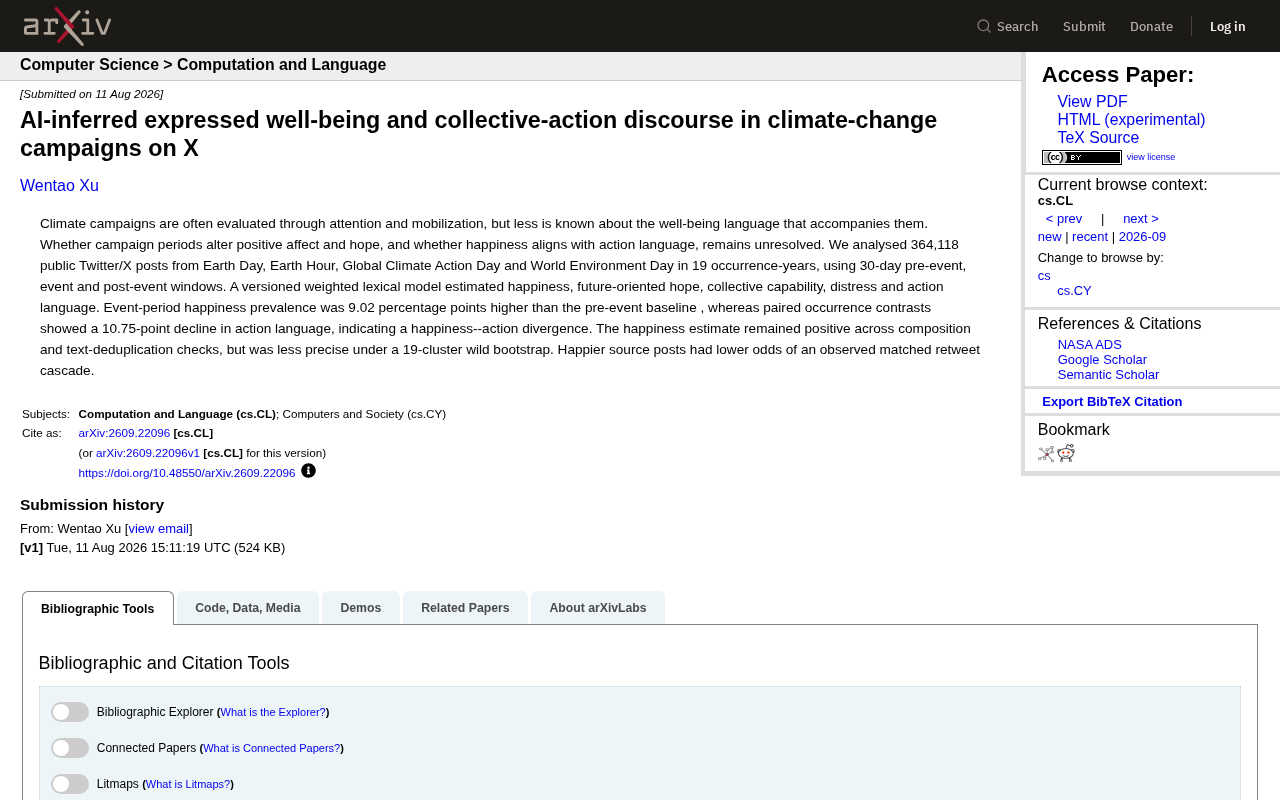
The study employs a versioned weighted lexical model to estimate five categories of linguistic signals from the text: happiness, future-oriented hope, collective capability, distress, and action language. The value of this methodology lies in moving beyond "how many people are talking about it" to ask "what emotional register are people using when they do."
The Core Finding: Happiness Up, Action Down
The study's most striking conclusion is the so-called happiness–action divergence.
The data show that during climate campaigns, happiness language appeared at a rate 9.02 percentage points higher than the pre-event baseline. This seems intuitive — collective environmental celebrations tend to generate positive, unified, hope-filled atmospheres. Yet when researchers performed paired occurrence contrasts, they found that action language dropped by 10.75 percentage points.
In other words, people became more "happy" on these climate awareness days, but language expressing intent for actual action simultaneously declined. Emotional uplift and calls to action moved in opposite directions.
This finding carries a direct cautionary message for climate communication practice: a campaign that makes everyone feel good does not necessarily translate into genuine collective action mobilization. Celebratory emotional resonance may, paradoxically, dilute urgency and action orientation.
The happiness–action divergence has theoretical roots in behavioral science. The moral licensing effect holds that when people engage in symbolic positive actions — such as retweeting an environmental post or participating in an awareness day — they often develop a sense of psychological satisfaction from having "already contributed," which in turn reduces their willingness to take substantive action later. Climate communication researchers call this the feel-good trap: ritualized collective participation strengthens identity and emotional belonging, but potentially at the cost of depleting action motivation. Furthermore, positive affect itself reduces perceived risk, and perceived risk is a key driver of protective behavior. This provides a reasonably robust mechanistic explanation for the divergence observed in the data.
Happier Posts Actually Spread Less
The study surfaces another counterintuitive detail: original posts with higher happiness scores were observed to be less likely to form matched retweet cascades.
This means that content filled with positive emotion does not hold an advantage in social media's propagation chain. By contrast, content carrying distress, urgency, or strong calls to action may be more effective at triggering user retweets. This aligns with established findings in social media diffusion research — that high-arousal emotions (especially negative arousal) spread more readily.
For climate campaign organizers, this reveals a strategic dilemma: cultivating a joyful atmosphere may support short-term engagement but could sacrifice viral reach and action conversion rates.
The principle that "high-arousal negative emotions spread more easily" has been validated across multiple large-scale studies. Wharton researcher Jonah Berger's analysis of New York Times articles found that content eliciting high-arousal emotions like anger and awe garnered significantly more sharing than content eliciting sadness (a low-arousal negative emotion); positive content with insufficient arousal could even underperform negative content in terms of diffusion. Social media platform algorithms amplify this bias further — engagement rates (likes, comments, shares) are central to recommendation weighting, and strong emotional responses (including anger and fear) tend to drive more immediate interaction than calm happiness. For climate communication, this means "alarm-style" content has a structural advantage at the diffusion layer, even if its effects on audiences' long-term engagement remain debated.
Methodological Caution and Limitations
To their credit, the researchers maintain considerable rigor in how they frame their conclusions.
The authors note that happiness estimates remained positive under both composition checks and text-deduplication checks — meaning the finding of rising happiness is reasonably robust. At the same time, they candidly acknowledge that precision of this estimate declined when tested using a 19-cluster wild bootstrap approach.
This honest disclosure of uncertainty is exactly the right posture for social science research relying on lexical models. Such models carry inherent limitations: they depend on predefined emotion word lists and struggle to fully capture irony, context-dependency, or complex implied sentiment. There remains an irreducible gap between "AI-inferred emotional expression" and users' actual psychological states.
Wild bootstrap is a statistical inference method designed for heteroskedastic data, particularly suited to hypothesis testing when the number of clusters is small. Traditional bootstrap estimates the distribution of a statistic by resampling with replacement; wild bootstrap instead multiplies residuals by random perturbation weights at each resample, preserving the heteroskedastic structure of the original data. "19 clusters" means the study has only 19 independent time units (i.e., 19 occurrence-years) — a relatively small number for cluster-based inference. In theory, reliable clustered standard error estimation typically requires at least 30–50 clusters. The researchers' acknowledgment that happiness estimates lose precision under this test is therefore an honest statement of statistical limitation, signaling readers to interpret the confidence levels of quantitative conclusions with appropriate care.
Implications for Climate Communication
The broader value of this research lies in introducing "emotion" as a quantifiable analytical dimension within the framework for evaluating climate movements.
Previously, assessments of climate campaign success largely stopped at communication metrics. This work suggests something more nuanced: positive affect and action mobilization do not share a simple linear relationship. As movements increasingly resemble enjoyable social rituals, they may quietly be losing the motivational force needed to drive real change.
For policymakers, NGOs, and communication practitioners, finding the balance between "making people feel good" and "prompting people to actually act" will be a central design challenge for future climate communication. And using AI to jointly analyze sentiment and action language across massive volumes of social data is opening a new methodological path toward answering that challenge.
Related articles

OpenAI Partners with Shield: How the Astra Agent Revolutionizes IT Troubleshooting
OpenAI and Shield launch the Astra agent, which autonomously logs into computers and legacy systems to fix IT issues in real time, 35-40% faster than traditional models, with humans involved only when judgment is needed.

iPhone Duo Battery Life Tested: One Charge a Day Is Unavoidable, and the Large Screen Is the Culprit
iPhone Duo battery test: heavy use needs at least one charge a day, and about 30% remains after 6.5 hours of screen-on time. How often the large screen is unfolded is key; a MagSafe battery pack helps, and long-term degradation is also worth watching.

Kimi K3.1 Pro Open-Sourced: 2.8 Trillion Parameters Close In on Opus
Moonshot releases the open-source MoE model Kimi K3.1 Pro, with 2.8T total parameters and 104B activated, trailing Opus 5.5 by under 1 point on Terminal Bench 4.0.