AI and Science: The Ideal Outcome Is Empowering Millions of Curious Scientists, Not a Few Closed-Source Labs

AI-assisted science faces a fork: a few labs cracking trophy problems with proprietary models, or a million scientists following curiosity with open-source AI.
The article explores the fork in the road for AI for Science. One side is the "trophy problem" path: a few labs with proprietary models and massive funding concentrate on cracking landmark challenges like protein folding, producing high-impact results but with an extremely high barrier. The other is the "million scientists" path: AI tools are widely distributed, letting a large number of researchers follow their own curiosity at low cost, exploring more distributed problems closer to the real world. The tweet author clearly supports the latter, arguing that proprietary models create new research barriers, while open-source models and mature toolchains are lowering the barrier. The article also presents the opposing view: concentrated efforts are indeed necessary for some problems, with AlphaFold as an example. The core judgment is: science's long-term health depends on the number and diversity of participants, not the number of milestones.
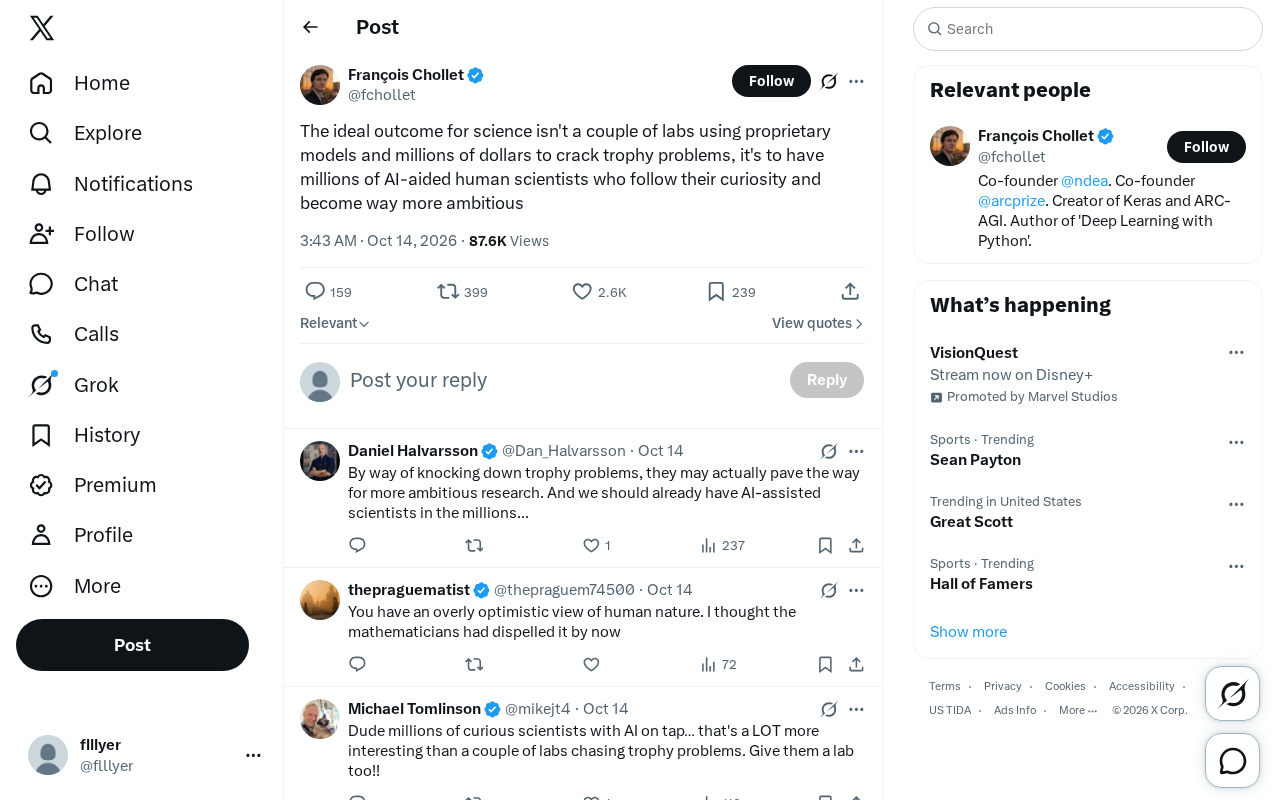
The ideal outcome for science isn't a couple of labs using proprietary models and millions of dollars to crack "trophy problems" — it's letting millions of AI-assisted human scientists follow their curiosity and become more ambitious.
This observation from social media points to a fundamental fork in the road in the current AI for Science wave: are we pursuing breakthroughs from a handful of elite labs, or a capability leap for the entire scientific community?
Two Scientific Futures: Trophy Problems vs. Curiosity-Driven
According to this tweet, AI-assisted science has two very different paths.
One is the "trophy problem" path. A handful of labs with proprietary models and massive funding concentrate compute and data to crack landmark challenges like protein folding and new material discovery. The output of this model tends to be high-impact papers and eye-catching milestones, but the barrier to entry is extremely high — without tens of millions of dollars in budget and a top-tier engineering team, ordinary researchers can barely get on the field.
The other is the "million scientists" path. AI tools are widely distributed, letting a large number of human scientists follow their own curiosity at lower cost and higher efficiency. These researchers may not be aiming for the cover of Nature or Science, but their questions are more distributed and closer to real-world complexity. The tweet's author clearly stands on this path, believing it is science's ideal outcome.
The two paths aren't entirely mutually exclusive, but their priorities for resource allocation and tool accessibility are fundamentally different.
The term "trophy problem" borrows a mountaineering metaphor, referring to landmark scientific challenges with clear goals, quantifiable results, and enormous prestige upon success. Typical examples include protein structure prediction, controllable nuclear fusion ignition, and room-temperature superconductor discovery. What characterizes these problems is that once solved, they are seen as milestone breakthroughs, often landing on the covers of top journals or even contending for Nobel Prizes. But precisely because of their "trophy" nature, cracking them usually requires extremely concentrated resource investment — large-scale compute clusters, massive proprietary datasets, cross-disciplinary top engineering teams, and budgets running into tens or even hundreds of millions of dollars. This resource structure naturally limits participants to a few institutions, forming a high-barrier "tournament" in which the vast majority of researchers can only watch from the sidelines.
How Proprietary Models Constrain Scientific Ambition
Proprietary models have certainly contributed to big science, but they also create new barriers.
When model weights, training data, and inference interfaces are all closed, outside researchers can only access limited capabilities through API calls. They can't fine-tune models to fit specific domains, can't audit internal model mechanisms, and can't embed models into their own familiar localized workflows. This limitation directly compresses the space for scientific exploration — you can only ask the questions the model allows you to ask.
A more insidious problem is incentive distortion. When compute and funding concentrate in a few institutions, the research evaluation system tilts accordingly. Young researchers find that rather than spending three years chasing an obscure but interesting question, it's better to join some "trophy project" doing engineering implementation. Curiosity gets marginalized, and scientists' risk appetite declines.
The "millions of dollars" in the tweet isn't rhetoric. The training cost of frontier AI models really is at that scale, which means only a very few institutions can afford to train from scratch.
Getting AI into the Hands of a Million Scientists: Open Source and Tool Democratization
If we agree that "a million AI-assisted scientists" is the better goal, then tool accessibility is the core variable.
Open-source models are narrowing the capability gap. Open-weight models represented by the Llama series, Mistral, and Qwen may not match top closed-source models on all benchmarks, but they're already sufficient for most academic scenarios. Researchers can run inference locally or on campus clusters, handling sensitive data without uploading it to third parties.
A maturing toolchain is equally critical. From Hugging Face's model hub to orchestration frameworks like LangChain and LlamaIndex, to various domain adapters, the barrier to building an AI-assisted research workflow has dropped from "needs an ML PhD" to "needs Python and domain knowledge."
What this democratization brings isn't a linear efficiency gain but an exponential expansion of the set of scientific questions that can be chosen. When every ecologist, archaeologist, and materials scientist can casually invoke AI to analyze data, generate hypotheses, and design experiments, the corner problems that big labs never noticed can finally be systematically explored.
Open-weight models refer to large language models whose parameters can be downloaded, locally deployed, and fine-tuned by the public, in contrast to closed-source models that only offer API access. The Llama series is released by Meta, Mistral comes from French startup Mistral AI, and Qwen is developed by Alibaba — they are among the most influential families in the current open-source ecosystem. Although these models may lag top closed-source models like GPT-4 or Claude by a few percentage points on some authoritative benchmarks (such as MMLU and GPQA), they already have practical value for common academic research tasks — literature summarization, coding assistance, hypothesis generation, and data cleaning. More critically, open weights mean researchers can run inference locally or on campus clusters, and don't have to upload sensitive data involving privacy or unpublished work to third-party servers — which is crucial for compliance requirements in fields like medicine and the social sciences.
What Kind of Infrastructure Does Curiosity-Driven Science Need?
For the "million scientists" path to land, open-sourcing models alone isn't enough.
The compute layer needs more flexible academic quota mechanisms. National supercomputing centers, cloud providers' research credits, and pilot projects like the NSF-funded NAIRR are all trying to lower the compute barrier for academia.
The data layer needs domain-specific open datasets and evaluation benchmarks. General benchmarks can't reflect the real needs of paleontology or epidemiology; domain communities need to build their own evaluation standards.
The collaboration layer needs to support the publication and reuse of long-tail problems. When only a few dozen people care about a problem, traditional journals lack the motivation to review it; preprint servers, open review, and code-sharing platforms become more suitable vehicles.
The cultural layer requires restoring legitimacy to curiosity. This isn't sloganeering — it means leaving room in grant review, promotion criteria, and team evaluations for work that is "interesting but not yet showing application."
NAIRR (National AI Research Resource) is a pilot program led by the U.S. National Science Foundation (NSF) aimed at providing academia with centralized compute, datasets, models, and training resources to narrow the AI resource gap between academic researchers and industry labs. The program launched its pilot in 2023 and expanded in 2024, drawing on the success of NSFNET (which later became the internet backbone). Its core logic: if frontier AI capabilities rest only in the hands of a few commercial companies, publicly funded scientific research will be constrained in problem selection and technical direction. NAIRR attempts, through government-coordinated shared infrastructure, to give universities and small research teams without self-built supercomputing capacity access to substantial GPU quotas and curated datasets. Similar ideas have been attempted in Europe, the UK, and Japan, but their scale and coverage remain at an early stage.
Dissenting Voices: Proprietary Models Also Have Their Reasons
It should be noted that this discussion isn't one-sided. Those who support concentrated efforts with proprietary models argue that some scientific challenges genuinely require extreme-scale compute and engineering investment, and that decentralization would actually slow breakthroughs. AlphaFold's success in protein folding is proof of the concentrated model.
Another concern is quality control. If a million scientists each use AI to generate hypotheses and results, the credibility and reproducibility pressures on scientific literature will rise further. Tool democratization must be accompanied by the popularization of methodology education.
These disagreements won't disappear soon. But the tweet author's core judgment deserves attention: equating the scientific ideal with a few trophy problems is a misconfiguration of the objective function. Science's long-term health depends on the number and diversity of participants, not the number of milestones.
AI's role here is not to replace scientists, nor to serve only top labs, but to become a lever that amplifies curiosity.
AlphaFold is the most persuasive case for the concentrated approach. Developed by DeepMind, this protein structure prediction system reached accuracy comparable to experimental methods in the 2020 CASP14 competition and is regarded as one of the most significant breakthroughs in structural biology in fifty years. Its success depended on a unique combination of resources that DeepMind possessed: hundreds of specialized TPUs, protein sequence databases accumulated over years, and a cross-disciplinary team of top machine learning researchers and structural biologists. This configuration is almost impossible to replicate in a single university lab. Based on this, supporters of the concentrated model argue that some scientific problems have a "critical mass" — investment below that scale won't produce breakthroughs, and decentralization only leaves many small teams repeatedly burning limited compute on the same problem. Therefore, proprietary models and concentrated resources are not only reasonable in specific frontier areas but even necessary.
One-line Summary
AI-assisted science faces a fork: a few labs cracking trophy problems with proprietary models, or a million scientists following curiosity with open-source AI.
Paragraph Summary
The article revolves around the fork in the road for AI for Science. One side is the "trophy problem" path: a few labs with proprietary models and massive funding concentrate on cracking landmark challenges like protein folding, producing high-impact results but with an extremely high barrier. The other is the "million scientists" path: AI tools are widely distributed, letting a large number of researchers follow their own curiosity at low cost, exploring more distributed problems closer to the real world. The tweet author clearly supports the latter, arguing that proprietary models create new research barriers and compress the space of questions outside researchers can choose, while open-source models and mature toolchains are lowering the barrier. Realizing this path requires infrastructure at four levels: compute, data, collaboration, and culture. The article also presents the opposing view: concentrated efforts are indeed necessary for some problems, with AlphaFold as an example. The core judgment is: science's long-term health depends on the number and diversity of participants, not the number of milestones.
Related articles

A Single Prompt Triggers a Global PHP Security Storm: Is AI a Savior or a Hidden Risk?
A single AI prompt triggered a global PHP security crisis affecting Wikipedia and the Internet Archive. This article reviews the incident, analyzes the OpenAI-Amazon controversy, and explores the security paradox of lowered vulnerability discovery barriers in the AI era and developer response strategies.

When AI Is Taken Away: How Reliance on Shortcuts Undermines Your Problem-Solving Resilience
A study of 1,222 people found that after using AI to answer questions, once AI was removed, people gave up on more problems than a control group that never used AI. The article analyzes the impact of AI reliance on learning resilience and metacognition, and explores design implications for AI learning tools.

Carta and NewView Partner to Let Startup Employees Cash Out Equity Early
Carta and NewView Capital partner to simplify startup tender offers, helping employees sell equity early. Analysis of the mechanism, liquidity pain points, and impact.