AI Auto-Generates Siemens TIA Portal Ladder Diagrams & HMI Interfaces: A Complete Practical Guide

AI automatically generates compilable TIA Portal ladder diagrams via the Openness API
Wang Junjie, a PLC engineer with 15 years of experience, developed a complete solution for using AI to auto-generate Siemens TIA Portal ladder diagrams and HMI interfaces. The approach has AI generate files conforming to Siemens Semantic SD/XML specifications, then uses C# to call the Openness API to import them into TIA Portal projects with zero compilation errors. It already handles motor control, Modbus communication, PID control, and other typical scenarios, reducing project development time from days to hours.
PLC Programming Is Entering the AI Era
Wang Junjie, an engineer with 15 years of PLC programming experience, shared a workflow he refined over more than a year of repeated testing — using AI to automatically generate ladder diagram programs and HMI touchscreen interfaces for Siemens TIA Portal. This isn't simply having AI output programming ideas; it's a complete engineering solution that can be imported into TIA Portal and compiled with zero errors and zero warnings.
The pain points of traditional PLC programming are well known: manually drawing flowcharts, mapping I/O points, writing ladder logic, debugging, modifying, and debugging again. A complex project often takes days or even a week. If the client changes requirements midway, the entire program structure may need a major overhaul. TIA Portal itself is powerful but structurally complex — instruction lists, program blocks, ladder diagrams, HMI variables, screen compilation — every step must be error-free.
Background: Siemens TIA Portal Siemens TIA Portal (Totally Integrated Automation Portal) is Siemens' fully integrated automation engineering software platform. Since its release in 2010, it has become the mainstream development environment in industrial automation. It integrates PLC programming, HMI configuration, drive setup, and network communication into a unified interface, supporting mainstream PLC series like the S7-1200 and S7-1500. TIA Portal's strength lies in its high level of integration, but this also creates a steep learning curve — program block management, variable table configuration, hardware configuration, and HMI screen compilation alone involve dozens of operational steps, and any single mistake can prevent the entire project from compiling.
Why Previous AI-Generated PLC Program Solutions Didn't Work Well
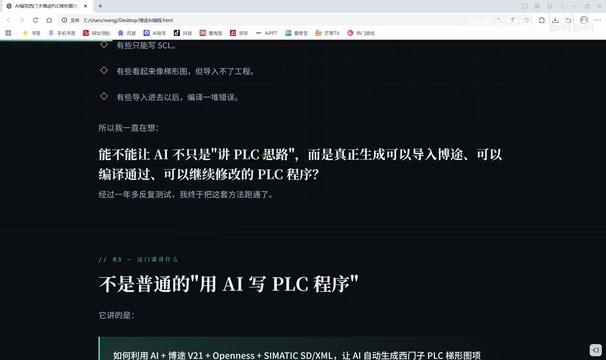
Many PLC engineers have already tried using AI to write programs, but commonly encountered these problems:
- AI can only generate programming ideas: It outputs logic descriptions that can't be directly imported
- It can only write SCL: Not intuitive enough for engineers accustomed to ladder diagrams
- It looks like a ladder diagram but can't be imported: The format is incompatible with TIA Portal project files
- Garbled text after import: Incorrect underlying data structures lead to massive compilation errors
Background: Ladder Diagram (LD) Ladder Diagram (LD) is the most widely used graphical programming language in PLC programming. Its design is inspired by relay control circuit diagrams — two vertical lines on the left and right represent power rails, while horizontal "rungs" represent control logic. The IEC 61131-3 standard defines five PLC programming languages, and ladder diagram is the most intuitive among them, particularly suitable for engineers with electrical backgrounds. Compared to text-based programming methods like SCL (Structured Control Language), ladder diagrams excel in logic visualization and real-time monitoring of contact states during debugging, but are less flexible than text languages for expressing complex algorithms. This is why many engineers prefer to stick with ladder diagrams rather than switching to the SCL format that AI can more easily generate.
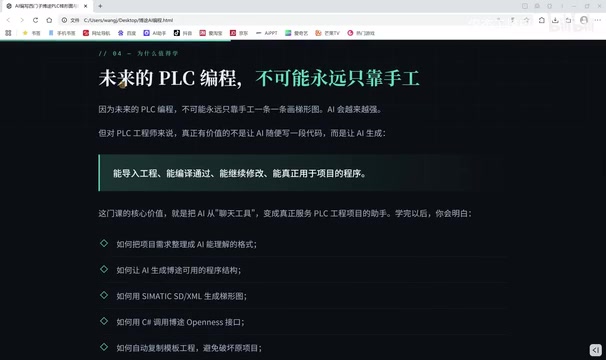
The core problem is that there's no reliable "bridge" between AI-generated code and TIA Portal software. Wang Junjie's solution is a complete workflow combining: AI + TIA Portal V21 + Openness API + Siemens Semantic SD/XML format.
Core Technical Architecture for AI-Generated TIA Portal Ladder Diagrams
Key Technology Stack
The technical pipeline of this method can be summarized as:
- AI generates program structure: Project requirements are organized into a format AI can understand, and AI outputs Semantic SD source files or XML format code that conforms to Siemens specifications
- C# + Openness API: A C# program calls TIA Portal's Openness API to automatically import AI-generated programs into the TIA Portal project
- Template project mechanism: Automatically copies template projects to avoid corrupting the original, ensuring every generation is safe
Background: TIA Portal Openness API TIA Portal Openness is an automation API interface provided by Siemens that allows external programs to control TIA Portal operations programmatically, including creating projects, adding devices, importing/exporting program blocks, and compiling projects. This interface is based on the .NET framework and is primarily called through C# or VB.NET. The core value of Openness is that it breaks TIA Portal's "black box" state — traditionally, engineers could only operate manually through the GUI, while Openness makes programmatic batch operations possible. Siemens introduced Openness starting with TIA Portal V13, and by V21 it has become quite mature. Using Openness requires specifically enabling API access permissions in TIA Portal and installing the corresponding version of the Openness SDK on the development machine — this forms the technical foundation of the entire AI workflow.
Background: Semantic SD and XML Format Semantic SD (Semantic Source Description) is an internal program source file format used by Siemens TIA Portal to describe the underlying data structures of graphical programming languages like ladder diagrams and function block diagrams. Unlike ordinary text code, ladder diagrams are essentially collections of graphical objects — each contact, coil, and function block has its coordinate position, connection relationships, and parameter attributes, all encoded in Semantic SD or XML files. This is the biggest challenge in AI-generated PLC programs: AI needs to output not human-readable code, but structured data files conforming to Siemens' internal specifications. Any deviation in format will cause TIA Portal to throw errors or produce garbled content during import. The core breakthrough of Wang Junjie's solution is teaching AI to generate files that comply with this strict specification.
What Typical PLC Control Scenarios Can It Handle?
Based on demonstrations, this method can already handle the following typical scenarios:
- Sequential start/stop control for five motors
- Six-station rotary table manipulator control
- Four-axis motor motion control
- Modbus communication programs
- PID constant pressure water supply programs
- Automatic HMI touchscreen interface generation
The final output is a real TIA Portal project file with complete ladder diagram programs, bindable instruction list addresses, and zero errors and zero warnings during compilation.
How High Is the Learning Curve for PLC Engineers?
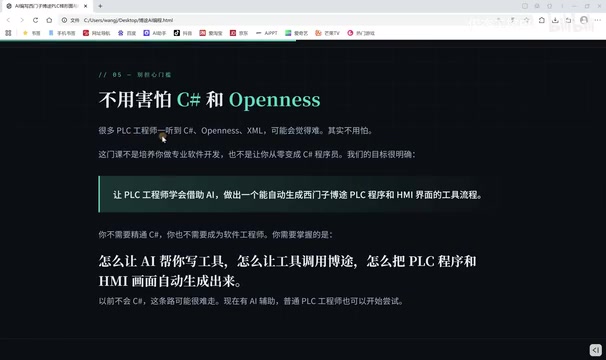
Many automation engineers shy away the moment they hear C#, Openness, or XML. But this method isn't designed to train software developers — it's meant to help PLC engineers master a reusable "workflow."
Learning Path from Scratch
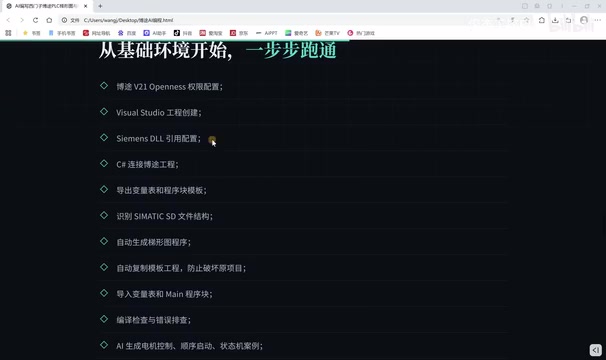
The course starts from zero-base configuration and progresses step by step:
- TIA Portal V21 Openness permission configuration: This is the most critical first step — only after enabling permissions can AI import programs through the interface
- Creating a project in Visual Studio: Setting up the C# development environment
- Siemens DLL reference configuration: Connecting to TIA Portal's underlying library files
- C# connecting to TIA Portal project: Enabling automatic program writing
- Exporting instruction lists and program templates: Building a reusable project foundation
- Understanding Semantic SD file structure: Grasping TIA Portal's underlying programming language format
Practical Value Analysis of AI-Assisted PLC Programming
Dramatically Improved Development Efficiency
For projects with high repetitiveness (such as standardized production line control), after AI generates the initial program framework, engineers only need to fine-tune and optimize on that basis — potentially reducing project development time from days to hours.
Knowledge Reuse of Engineering Experience
Converting typical project experience into reusable templates, combined with AI's generation capabilities, effectively "productizes" personal experience.
Related articles
 Tutorials
ChatGPT Plus Subscription Guide: Are GPT-5.5, image-2, and Codex Worth the Upgrade?
A detailed look at ChatGPT Plus features — GPT-5.5, image-2, and Codex — with a Plus vs Pro comparison and a complete step-by-step subscription guide for users outside the US.
 Tutorials
Harness AI Engineering in Practice: Using Claude Code to Master Enterprise-Level E-Commerce Development
Deep dive into Harness AI Engineering: master enterprise e-commerce development with Claude Code using the Rules, Skills, Wiki, and Changes framework.
 Tutorials
Cursor + Codex Dual-IDE Collaboration: A Practical Methodology for Open-Source Project Customization
A complete methodology for open-source project customization based on real-world experience, detailing the Cursor+Codex dual-IDE workflow, seven-stage process, MVP validation, and AI source code reading techniques.