AI-Automated Repetitive Tasks: A New Client Acquisition Approach for Web Designers

A web designer uses AI to automatically analyze business website issues and generate personalized outreach emails, automating the research phase of client acquisition.
Starting from a Reddit share by a web designer, the article explores how creative and technical workers should judge which repetitive tasks are suitable for AI. The designer uses the tool Swokei to filter businesses with websites, automatically analyze their design, SEO, loading speed, and mobile optimization problems, and turn them into personalized outreach emails for "evidence-based outreach." The article notes that AI's value isn't in replacing people to write emails, but in automating "research" and "matching." Tasks suitable for AI typically have three traits: high frequency, breakable processes, and structured inputs and outputs. Current tools are more like a "copilot" than "autopilot," and humans still need to define rules, review results, and make final decisions. The core threshold isn't technology, but workflow decomposition ability.
On Reddit, a web designer shared how he uses AI to automate his most repetitive work—finding new clients. This raises a thought-provoking question: for creative and technical workers, which repetitive tasks are best suited to hand over to AI?
From "Cold Emails" to "Precision Outreach": How AI Is Changing the Client Acquisition Logic
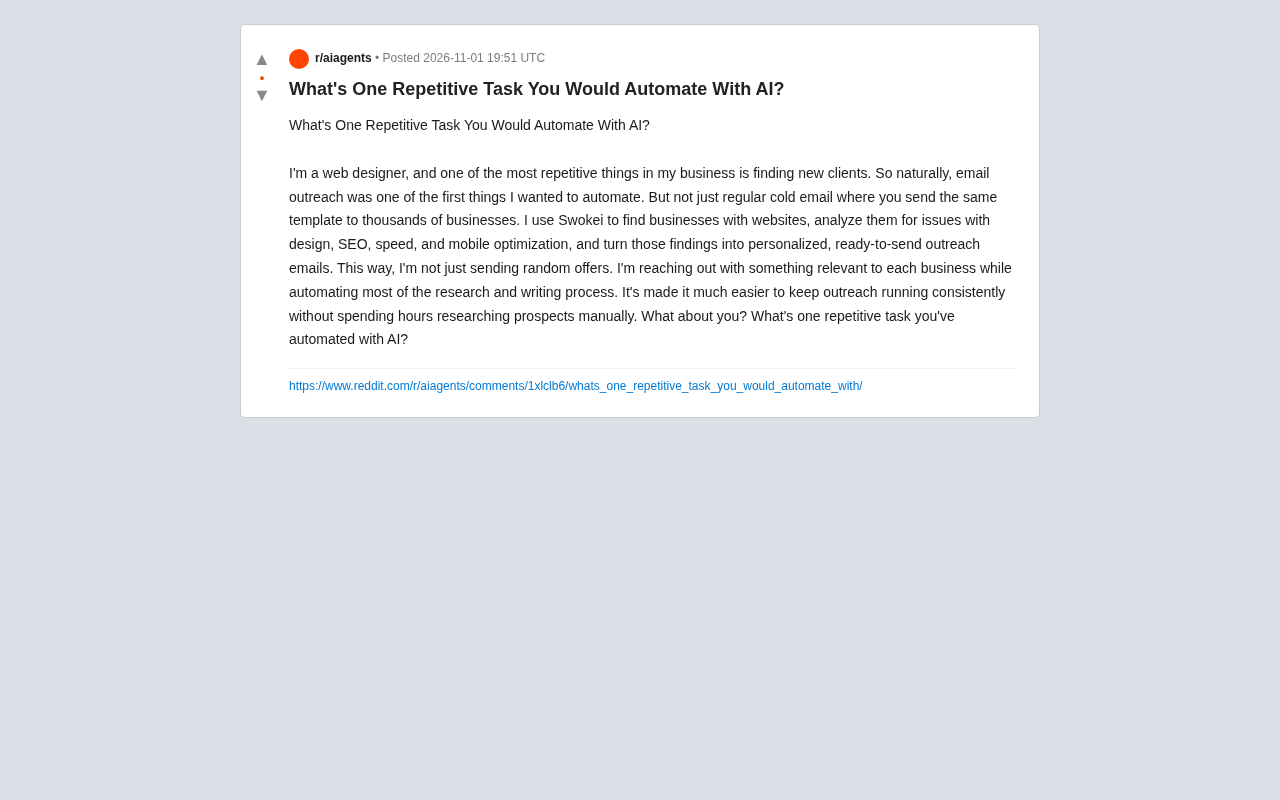
Traditional cold emails often involve sending the same template in bulk, and their effectiveness is declining. This designer takes a different approach: he uses a tool called Swokei to first filter out businesses that have websites, then automatically analyzes problems with those websites in terms of design, SEO, loading speed, and mobile optimization, and finally turns the analysis results into personalized, ready-to-send emails.
The logic behind this is clear—the value of AI isn't in replacing people to write emails, but in automating the "research" and "matching" process. Doing this analysis manually would take hours, while AI can generate targeted communication material in minutes. According to his account, this allows outreach to continue consistently without spending large amounts of time manually researching potential clients.
The core of this model is "evidence-based outreach": you're not pitching services, you're pointing out real problems on the other party's website. For web designers, this is both a client acquisition method and a demonstration of professional capability.
Cold email refers to sales emails sent to potential clients with whom no prior relationship has been established. The traditional approach is to buy email lists and then mass-send the same template, which typically yields extremely low open and reply rates (industry average reply rates are often below 1%-5%) and easily triggers spam filters. In recent years, as anti-spam algorithms (such as Gmail's Postmaster filtering) have become stricter, the effectiveness of pure template mass-sending has declined further. Therefore, customizing content based on genuine analysis of the recipient's specific situation has become a key strategy for improving deliverability and reply rates—this is also the background behind the rise of "evidence-based outreach."
SEO (Search Engine Optimization) refers to the practice of improving a website's structure, content, and technical performance so that it ranks higher in search engines' organic results. In the context of web design, SEO issues often include: missing title tags and meta descriptions, images lacking alt attributes, messy URL structures, insufficient internal links, slow page loading speed, and more. These issues can be detected in bulk with automated tools, making them very suitable as the "evidence" source for AI to analyze websites and generate personalized outreach emails. Mobile optimization involves responsive design, viewport settings, and touch-friendliness, which are likewise quantifiable evaluation dimensions.
AI-ifying Repetitive Tasks: Which Work Is Really Worth Automating?
This designer's choice reveals a criterion: tasks that are repetitive with clear rules but require some cognitive input are the best fit for AI.
Finding clients itself consists of multiple subtasks: filtering target businesses, analyzing their websites, and writing personalized emails. Among these, "analyzing website problems" and "generating email drafts" are highly repetitive but follow patterns, so AI can handle them; while "deciding whom to contact" and "final sending" still require human judgment.
Compared with other common repetitive tasks—data entry, meeting minutes organization, social media scheduling—their commonality is: relatively fixed input and output formats, but consuming large amounts of attention when done manually. AI's involvement doesn't replace thinking; it frees up human energy from mechanical labor to focus on strategy and relationship maintenance.
Interestingly, the original poster emphasized that he uses "personalized" emails rather than mass templates. This points to a boundary: AI can generate personalized content at scale, but the personalization itself must be based on real data. If the analysis results are inaccurate, the emails lose credibility.
The Insight Behind the Tool: Automation Is Not the Same as Going Unmanned
Swokei's workflow can be broken down into three steps: find businesses with websites → analyze website problems → generate outreach emails. Each step involves human-set rules and judgment criteria.
This reflects a common trait of current AI automation tools: they are more like a "copilot" than "autopilot." Designers still need to define target client profiles, review the reasonableness of analysis results, and decide email tone and sending timing. AI handles the most time-consuming middle环节.
For solo entrepreneurs and small teams, this model is especially valuable. Large companies can hire people to do research; small teams can only rely on themselves. AI tools make repetitive work that would otherwise need to be outsourced or abandoned feasible, allowing one person to maintain a systematic client acquisition process.
However, limitations should also be noted: the original post didn't disclose Swokei's specific pricing, accuracy, or actual reply rate data. Whether personalized emails really outperform traditional cold emails still needs more practical verification. But at least this approach provides a replicable framework—use AI to automate "information collection + preliminary processing," and leave "decision-making + execution" to humans.
The copilot model is a common human-AI collaboration paradigm in current AI tool design, first widely known through GitHub Copilot. Its core feature is: AI provides suggestions and drafts within the human workflow, but the final decision-making power remains with the human. In contrast, the "autopilot" model pursues end-to-end intervention-free operation. The advantage of the copilot model lies in fault tolerance—errors in AI output can be quickly spotted and corrected by humans, while humans always remain accountable for the results. In client acquisition automation scenarios, this means AI is responsible for generating analysis reports and email drafts, while pre-send review, tone adjustment, and timing selection are still done by humans, thereby balancing efficiency and credibility.
In Your List of Repetitive Tasks, Which One Most Deserves to Be Handed to AI?
The original post ends by asking the community: which repetitive task have you automated? This question itself is worth every knowledge worker pondering.
The criteria can be summarized in three points: Does the task occur frequently? Can the process be broken down into clear steps? Are the inputs and outputs of each step relatively structured? If all three are met, AI can potentially take over most of the work.
The web designer's case is representative because it shows that the real threshold of AI automation isn't technology, but the ability to break down workflows. Being able to split your own repetitive labor into "automatable parts" and "parts that must be done manually" is more important than how many tools you know how to use.
From cold emails to precision analysis emails, what changes isn't the email itself, but the way information is processed behind it. This may be AI's most practical change for individual workers: not making decisions for you, but giving you the time and energy to make more important decisions.
One-line Summary
The web designer uses AI to automatically analyze business website problems and generate personalized outreach emails, automating the research phase of client acquisition.
Paragraph Summary
Starting from a Reddit share by a web designer, the article explores how creative and technical workers should judge which repetitive tasks are suitable to hand over to AI. The designer uses the tool Swokei to filter businesses with websites, automatically analyze their problems in design, SEO, loading speed, and mobile optimization, and turn them into personalized outreach emails, achieving "evidence-based outreach." The article points out that AI's value isn't in replacing people to write emails, but in automating the "research" and "matching" process. Tasks suitable for AI typically have three characteristics: high frequency, breakable processes, and structured inputs and outputs. Current tools are more like a "copilot" than "autopilot," and humans still need to define rules, review results, and make final decisions. The core threshold isn't technology, but the ability to break down workflows.
Related articles

How Accurate Are Sci-Fi's Predictions About AI?
How accurate are sci-fi's predictions about AI? Drawing on a Hacker News discussion, this article analyzes sci-fi's foresight and blind spots in AI development, arguing its true value lies in inspiring thought rather than precise prediction.

SwarmEvolve: Latent-Space Agent Swarms Accelerate Evolutionary Search
SwarmEvolve lets hundreds of low-cost agents swarm-reason in latent space, sharing info via KV caches to achieve fast evolutionary search for math and science problems—reaching in a median of 3–8 minutes the best scores other frameworks need 60 minutes for.

trainlint: Static Checks Catch ML Training Bugs That Don't Crash
trainlint is a static analysis tool that finds ML training bugs that don't throw errors, including data leakage, leftover eval mode, and softmax/CrossEntropyLoss conflicts across 14 categories. This article covers its principles, validation results, and limitations.